|
Last week I wrote that everything getting better was
getting better by making a authorization grants smaller.
Task-based consent, optional scopes, narrower tokens. I
said the agent era keeps discovering the answer was
already in the API junk drawer.
This week the drawer got emptied into a product roadmap.
Enterprise-managed authorization went generally available,
and within days a second wave of writing showed up asking
the question that follows immediately after: fine, the
grant is narrow — but a grant is one hop, and an agent
calling an agent calling a tool is three. Where does the
consent go when it crosses boundaries?
Nobody seems to have a good answer yet. What is notable is
that people are now asking this question publicly, with
implementation details attached, rather than just with a
diagram or infographic (generated by AI).
Two other things happened that I want to put next to each
other, because I do not think either means much alone.
The first is that after a week in which literally zero
third-party posts in this network named a specification in
a title, OpenAPI came back — in three security advisories
about a self-replicating worm inside openapi-react-query-codegen. The description layer nobody is writing about turns out
to be load-bearing enough that compromising one of its
code generators propagates across three package
ecosystems.
The second is quieter. One in five MCP posts this week was
published by a help desk. Not a launch blog, not an
engineering post. A support article, with a
ticket-deflection URL. That is what a technology looks
like on the way to becoming plumbing.
|
|
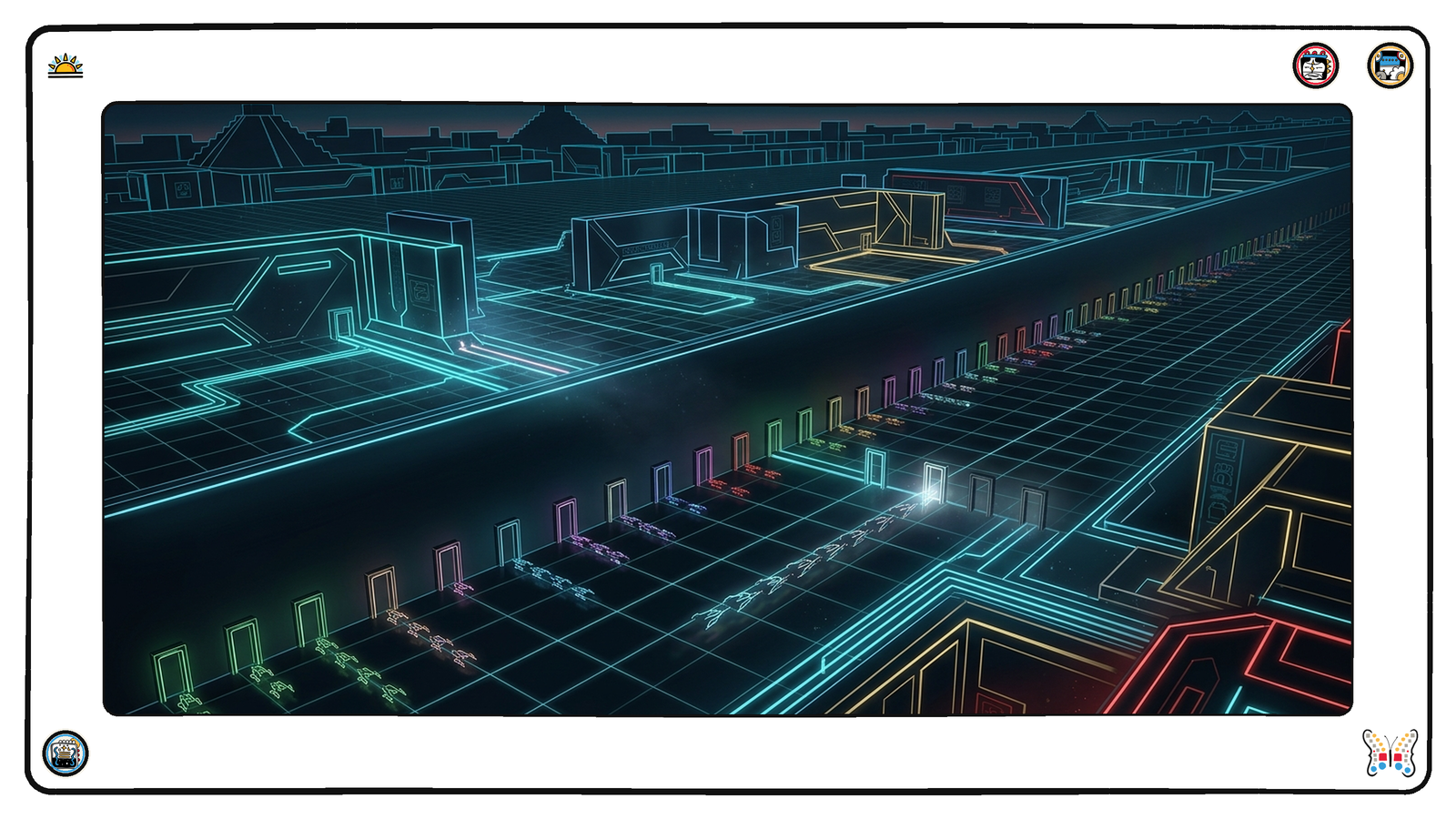
A vast dark neon grid at dusk where a single
enormous ceremonial archway has been dismantled into
hundreds of small identical service doors set into a
low continuous wall, each one lit a different faint
colour, with streams of small angular light-vessels
queuing at individual doors while one long chain of
vessels passes through four doors in sequence and
grows visibly dimmer at each one.
|
Enterprise-Managed Auth Went GA, and the Consent Chain Got
Lost
Last week this was a design principle. This week it is a
generally available product with a migration path, and the
interesting writing has already moved one hop downstream.
-
WorkOS shipped enterprise-managed auth to GA and
told MCP server builders they need a new grant
type. That second clause is the whole story. A GA
announcement that also tells you your existing
integration is on the wrong grant is not marketing, it
is a migration notice.
-
Supabase shipped enterprise-managed auth for its
own MCP server in the same window, and Auth0 added a UI to an Auth0-secured MCP server
with Skybridge. Three companies, one week, the same shape: the
enterprise admin grants, not the user clicking through
a dialog.
-
Then Cerbos published the post that actually advances
the argument — multi-hop delegation for AI agents,
and how the consent chain gets lost. Every consent mechanism shipped this year assumes
one hop. The user consents, the agent acts. But agents
call agents, and by the third hop the thing holding
the token has no structural memory of what the human
agreed to. Cerbos is the first vendor I have seen
state that plainly rather than pretending narrow
scopes solve it.
-
Cerbos had the run of the week generally, and all of
it circles the same seam: Istio authorization stops at identity, not at what
a workload may do, and not every authorization decision is allow or
deny. Both are arguments that authentication and
authorization are different problems, which is the
thing I complained the industry keeps conflating two
weeks ago.
-
Nudge Security wrote up what OAuth scopes really
control, and their URL slug is more honest than their title:
the fine print nobody can read. We are asking users to
make informed delegation decisions through a consent
screen listing strings they have no way to evaluate.
-
The infrastructure kept narrowing underneath. Cloudflare added app-scoped API tokens for
Flagship. WorkOS argued that running your own OAuth and OIDC
provider in 2026 is an operations problem, not a build problem — which is what identity
vendors always argue, but the operational surface
genuinely did just grow a new dimension.
-
And the Linux Foundation's Decentralized Trust
group opened PDP-Connect, a specification lab for
personal data consent and authorization. A standards body forming around consent, at the
exact moment the vendors have shipped five
incompatible versions of it. That sequence is not new
and it is not going to be fast.
The pattern I would flag: everything in this section is
a product. Nobody standardized anything.
PDP-Connect is a lab, not a specification. We narrowed the
grant and shipped it five different ways, and the
multi-hop problem Cerbos names is exactly the kind of
thing that does not get solved five different ways — it
either gets a shared vocabulary or it stays broken.

|
|
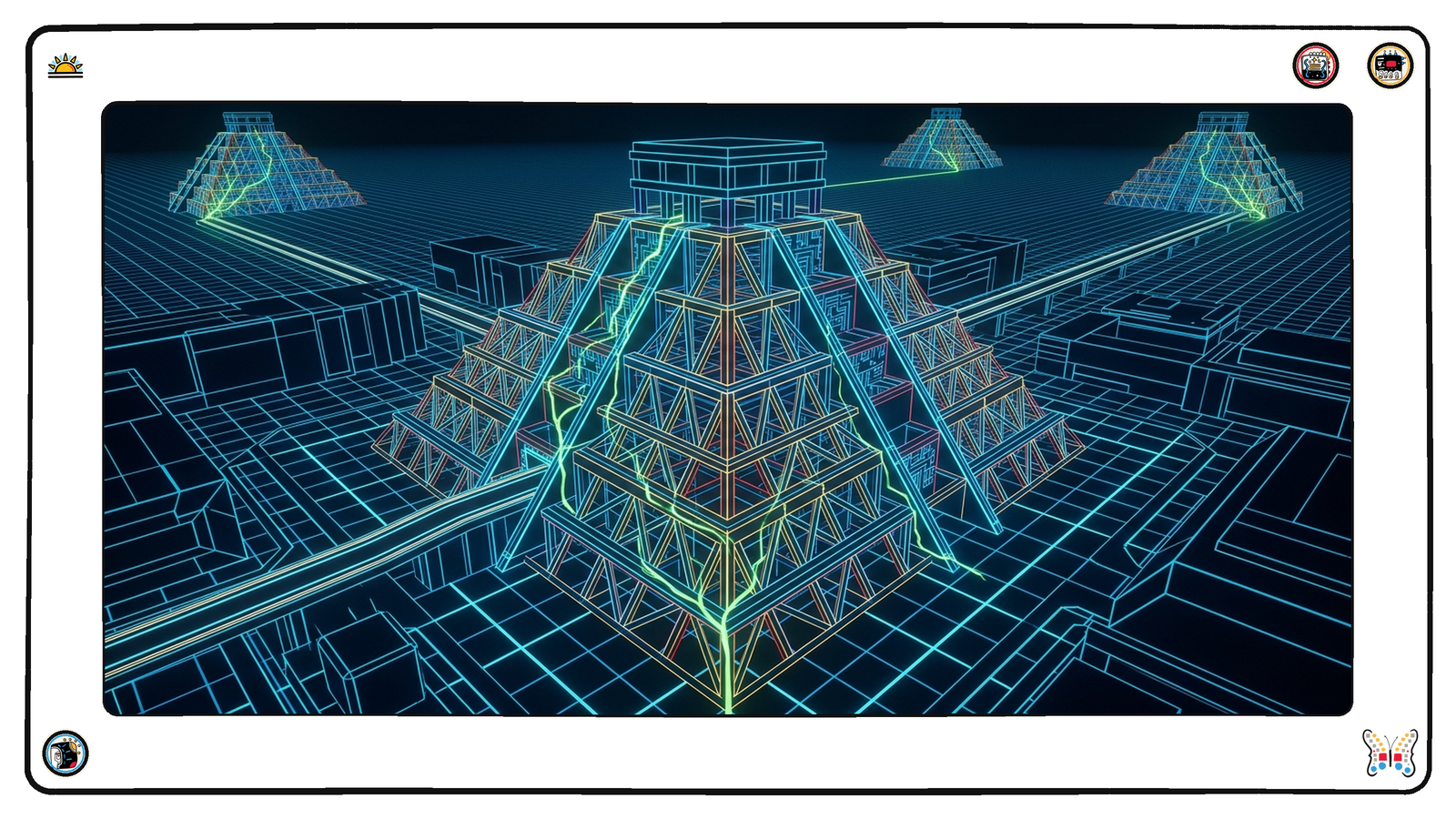
An immense dark neon grid where a towering ornate
broadcast spire stands unlit and abandoned, while at
ground level a long low utilitarian counter
stretches to the horizon lined with dozens of
identical small lit service windows, a patient
orderly queue of small angular light-vessels at
every one.
|
MCP Moved From the Engineering Blog to the Support Desk
I count 66 third-party posts that named MCP in a title
this week. Fourteen of them — one in five — were published on a
help desk, a support centre, or a docs changelog rather than a blog. Katana has three. Qargo has three.
Mixmax, Frontify, Instabug, SAP's community forum,
Buildkite's changelog, Cloudflare's changelog.
That is a genuinely different week than the ones before
it. A launch post is written by devrel for an audience
that might adopt you. A support article is written by a
support team for customers who already did, and who are
now filing tickets. "Unable to connect AI through
Katana MCP?" is not an announcement. That is a
ticket-deflection page, and you only write one after the
tickets arrive.
-
The long tail shipped, in volume: Gravity Forms, Knack, with a HIPAA-compliant angle, Runpod, Testmo, Sinch, Losant adding write tools, Aha's MCP connectors, Vantage adding Linear, Notion and GitHub, G-P for global workforce data, and Everlaw wiring into Google Gemini Enterprise.
-
Thirty days after the spec revision, Arcade published what actually changed — the most useful retrospective of the week, because
it is written from the position of someone who had to
migrate. Cloudflare's MCP server portals now support
the 2026-07-28 specification, and Open Liberty shipped MCP Java API support so you can expose Liberty business logic as agent
tools. The enterprise Java stack arriving is always
the last signal before something is boring.
-
The gateway category kept consolidating and the
tooling started getting graded. Zuplo compared ten MCP server generators — a comparison post only exists once there are
enough implementations to be confused between. OpenVPN introduced an MCP Gateway as one front door for every agent a business runs,
and cData spent the week arguing what an MCP gateway does that an API gateway
cannot.
-
On the security side, Escape published a guide to pentesting LLMs and MCP
servers, and ScrapingBee made the sharpest architectural point
of the week almost in passing: MCP servers should carry control, not data. Piping
a scrape result through the context window is the
expensive way to do everything.
-
And the new MCP roadmap circulated widely, which is where the protocol says
out loud what it intends to become.
I have been doing this long enough to recognize the shape.
This is the same arc SOAP had, then REST, then webhooks:
announcement, comparison post, generator, gateway, support
article. MCP got there in about eighteen months, which is
fast, and the support-desk tell means the adoption is real
rather than performative. It also means the interesting
work has moved. When your protocol is a help-centre topic,
the differentiation is no longer whether you have one.
📄 MCP Documentation Beyond Reference — Fourteen support articles about MCP this week is the
tell that reference documentation is not enough. An agent
does not fail on your parameter types. It fails on the
third call, in a state your docs never described. This is
the five-part operational layer most MCP servers ship
without: the order operations must run in, the side
effects, the rate limits, and what happens when a call
half-succeeds. Written for the provider who would rather
document the behavior than answer the ticket. $25
|
|
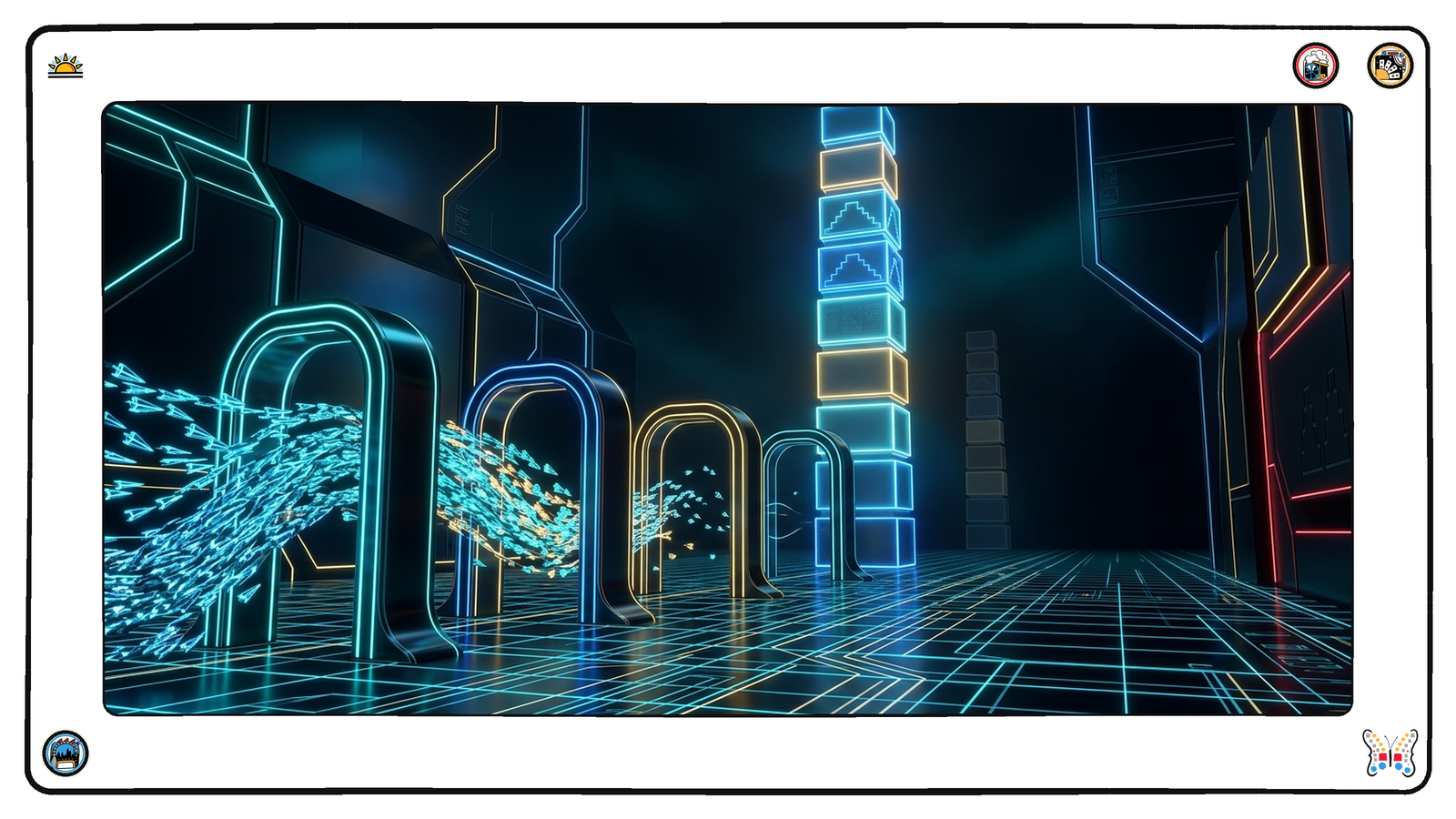
A dark neon grid dominated by one colossal
blueprint-lattice structure of clean glowing lines,
beautiful and precise, with a thin vein of sickly
green light entering at one low corner and branching
upward through the lattice, and three smaller
identical lattices in the far distance showing the
same green vein at the same corner.
|
OpenAPI Came Back to the Headlines, as a Malware Vector
Last week I reported a number I did not enjoy
reporting: zero third-party posts in this
network named OpenAPI, AsyncAPI, GraphQL, JSON Schema,
Arazzo or gRPC in a title. Not a small number. Zero.
This week there are eight. I would like to tell you the
description layer had a renaissance. Three of the eight
are security advisories about the same worm.
Here is why I think this matters more than the raw count.
A code generator is the most trusted thing in an API
toolchain. You point it at a contract, it writes the
client, and the client goes into production. Nobody reads
that output line by line. The contract is the thing
everyone treats as authoritative, and the generator is the
unexamined machine that turns authority into running code
— which makes it a nearly ideal place to hide.
We spent the last month watching the industry build
gateways, registries, portals and consent screens on top
of a description layer that almost nobody writes about any
more. This week we learned what happens when someone
attacks that layer's tooling instead of its
specification. It propagated to three ecosystems before it
made a headline.
And here is the week in numbers, pulled from the 6,768 unique posts across 1,927 provider blogs between the 23rd and the 30th:
-
66 third-party posts named MCP in the
title. 14 of those were on a support
or docs surface.
-
360 posts — 5.3% —
carried any API-related keyword in the title at all.
The other ninety-five percent is what a network of
company blogs actually publishes: pricing pages,
release notes, hiring posts, industry commentary. That
ratio has been remarkably stable at five to six
percent for a month now.
-
8 third-party posts named a
specification, up from zero. Three of the eight are
the worm.
One more housekeeping note in the spirit of last
week's complaint. I fetched every third-party story
in this issue with an ordinary browser user-agent to
confirm the links resolve. Three refused me with a 403: Fireblocks' comparison of the agentic payment
protocols, Sinch's guide to using its own MCP server, and cData's piece on what an MCP gateway does that an
API gateway cannot.
Read that list slowly. A custody provider explaining how
autonomous agents should pay for things. A communications
platform documenting the MCP server it wants agents to
call. A data company explaining the gateway it wants to
sell you for governing agent traffic. All three behind bot
protection that refuses a machine reading the web.
cData was on this list last week too, for a different
post. That is the part worth sitting with — it is not a
one-off misconfiguration, it is a standing default nobody
has revisited, and it is running on the blogs of the
companies whose entire pitch is machine consumption. I
keep finding this and I am going to keep counting it.
|
|
Four smooth glowing toll-arches on a dark neon grid,
two of them wide with heavy braided streams of small
angular light-vessels flowing through, one
moderately busy, one nearly empty, and behind them a
tall bare tally-column of stacked light-blocks
rising much higher than the week before.
|
Agent Payments Went to Four Protocols, and Grew Real
Volume
Last week Formance put three agentic payment protocols
side by side and I said three credible contenders is the
normal shape of a standards fight. It took one week to
become four, and this time somebody put transaction volume
next to it.
I have been building the x402 machine door on my own
storefront, so I have a stake in this and you should weigh
what I say accordingly. My read: four protocols is one too
many for anyone to build against confidently, and the
deciding factor will not be protocol design. It will be
which one a payment processor makes boring first.
|
|
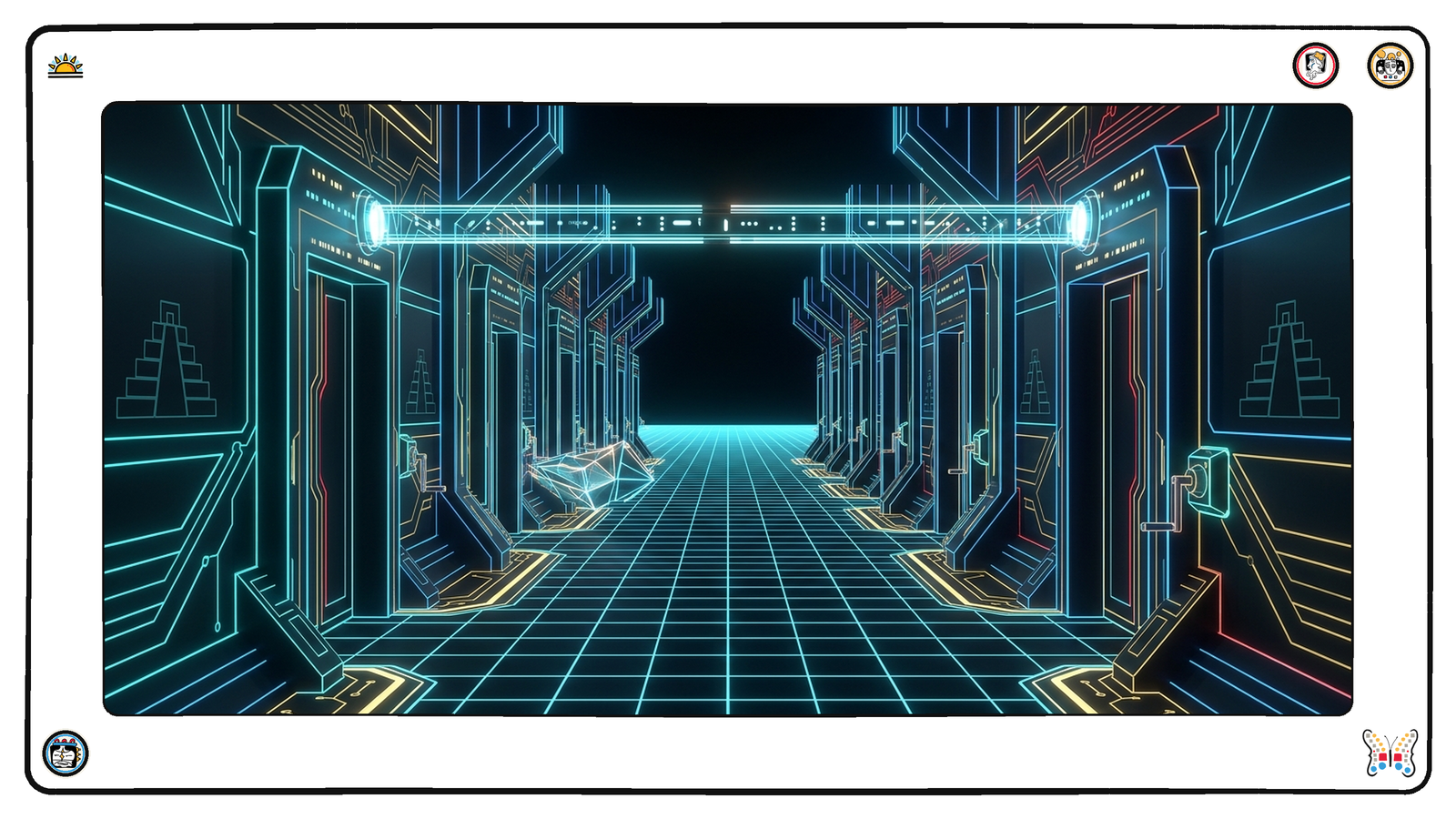
A long dark neon corridor lined with a dozen tall
doorways, each with a small glowing hand-crank
beside it and no automatic mechanism, a single small
angular light-vessel stalled at the third doorway,
while far above the corridor a bright precise
measuring-frame hovers scoring each doorway with
rows of small blank light-marks.
|
From My Desk: Every Door Still Needs a Human Hand
-
The onboarding series hit the wall from three more
directions this week, and then WorkOS published the
same finding from theirs. Notion hands you the token, but only after you
click. HubSpot has the OAuth, but not the onboarding. Discord will not let you register an app
programmatically at all. Atlassian makes you click through a console before
an agent can touch Jira. Then WorkOS wrote up what shipping an OAuth app on
Slack, Microsoft and Atlassian actually takes — arriving independently at the conclusion I have
been documenting provider by provider. The agent can
hold the credential. It still cannot obtain one.
-
I shipped the other half of the rating work. Inside the Agent-Readiness Score opens up the standalone layer that sits beside the
composite, and your agentic programmability investment is an API
foundation investment is the argument underneath it.
-
The Australian banking thread turned into the most
interesting finding I have had in a while: low composite, high agent-readiness — the
Australian banking paradox, and why the agentic turn rewards what Australia's
banks already ship. Regulation forced them to publish standards and
artifacts years ago, for reasons that had nothing to
do with agents, and it turns out to have been the
exact preparation.
-
On MCP, which is where most of my writing went: the MCP roadmap is an API roadmap, the federation aspect MCP needs, next MCP API design, what Medusa teaches every MCP author about
feedback, and the one I would point at first — every MCP server bakes in the provider's
motivations. Which tools you expose is a business decision
wearing an engineering costume.
-
Elsewhere: ClaudeBot read my entire catalog in a single day, which is the agent-traffic story arriving on my own
doorstep. Your agent should run its own observability
stack. Bringing coherence to sprawling enterprise API
estates. Bringing order to the agentic realm with the CLI
Agent spec. OpenAPI Overlays for test fixtures and mock
generation. And two on business models — what is commercial open source, really and the self-hosted seed is the next business model.
-
A conversation with Emma Kriskinans on marketing
from inside VS Code, building a trust hierarchy
for your sources, and filling in the middle ground
on AI. Emma is VP Global Marketing at
Tyk, and since March she has done most of her working
day inside Claude Code — not because anyone asked, but
because she wanted to learn it at the harder level.
Her analogy is the UK driving test: learn on a manual
and you can drive an automatic, but not the other way
round. We compare notes on the trust hierarchy
document she keeps to tell the model which sources to
weight, what she deliberately refuses to use it for,
and the AI-disclosure etiquette forming in both
directions. It ends somewhere neither of us planned,
on novels and whether the humanities graduate's
moment has finally arrived. I also wrote it up as filling in the middle ground on AI.
-
A conversation with Danny Preussler on reopening
the SoundCloud API, the agent that scraped its way
to a token, and writing documentation for
machines. Danny is an engineer on the API
team at SoundCloud. This is one of the great API
origin stories and one of the great API closures — a
public API in 2008, the Android lead hired because he
built a better SoundCloud app on it than SoundCloud
had, then the labels, the scrapers, a hundred thousand
apps registered in 2016, and the 2017 shutdown that
was supposed to be temporary. He walks through the
soft reopening, and the moment that changed
everything: they handed an agent the task of creating
a SoundCloud app, it could not find a token, so it
scraped the website for one and quietly rewired itself
from the public API to the internal one. Read that
next to my onboarding series and to the WorkOS post
above. This is what happens at the end of a front door
that requires a human hand.
The through-line this week is smaller than usual and I
think it is the right size. We are getting extremely good
at the second hop and still cannot do the first one.
Enterprise-managed auth is GA. Consent chains, four
payment protocols, ten MCP generators, a gateway category
with a comparison matrix. And an agent still cannot
register an application on Notion, HubSpot, Discord,
Atlassian or Slack without a person clicking a button — so
when SoundCloud gave one a real task, it went and scraped
a credential off the website instead.
Everything upstream of that button is beautifully
governed. The button is not governed at all.
See you next week.
🔌 APIs.io Pro — OAuth scopes and security artifact
collections — This whole issue argues that the grant should be
narrower. Here is the part I can hand you: I have the
OAuth scopes and security definitions extracted from every
API in the catalog, as artifact collections you can query.
Eighteen of the twenty per-artifact endpoints on APIs.io
are free. These two are not, and they are the two people
push on hardest — security and scopes are the most-hit Pro walls by an order of magnitude,
well ahead of the ratings everyone assumes is the product.
The operation worth your week: before you
design your next set of scopes, go read how a few hundred
other providers named and split theirs.
curl -H "X-API-Key: $KEY" "https://apis.io/api/v1/scopes?limit=50"
Same data as the find_scopes MCP tool, if you would rather ask an agent. Pair it
with /v1/security to see which auth schemes those same providers actually
declare, and you have a real baseline to design against
instead of copying whatever your gateway
scaffolded. Pro is $49/mo — log in with GitHub for a free Starter key first and see how far the free
tier gets you.
|