|
Agent searches hit an all-time high, the catalog
crossed 115,000 APIs, and one collaboration giant
published 178 contracts nobody can call.
Week of August 3 – 9, 2026 · 26,701 providers · 115,066
APIs indexed
Every Monday I read what people and agents actually typed
into apis.io — the search box and the MCP server — as a demand signal
for the API economy. Nobody else has this data, so nobody
else can send you this email.
📈 The Demand Report
MCP searches hit 1,924 this week, the highest since I
started tracking. The series now reads 35 → 42 → 310 → 1,027 → 518 →
1,924.
That's the line I'd watch. It's a separate
surface with a different caller profile — agents reaching
the catalog through the MCP server rather than people
typing into a search box — and it is growing on a widening
vocabulary rather than a narrowing one. One week is still
one week; I flagged the drop to 518 last issue and
I'll flag the next reversal too. But 271% on the
agent surface, in a week when nothing else grew, is the
number worth carrying into your planning.
The rest of the traffic tells a quieter story. Requests are logged by tier: internal is the apis.io site calling itself and every crawler
walking those pages; keyless is somebody hitting the API directly from outside.
|
|
Last week
|
This week
|
|
|
Internal (the site itself)
|
118,232
|
31,048
|
−74%
|
|
Keyless API (outside callers)
|
5,266
|
63,838
|
+1,112%
|
|
MCP server
|
518
|
1,924
|
+271%
|
|
Owner-key calls
|
0
|
41
|
new
|
|
|
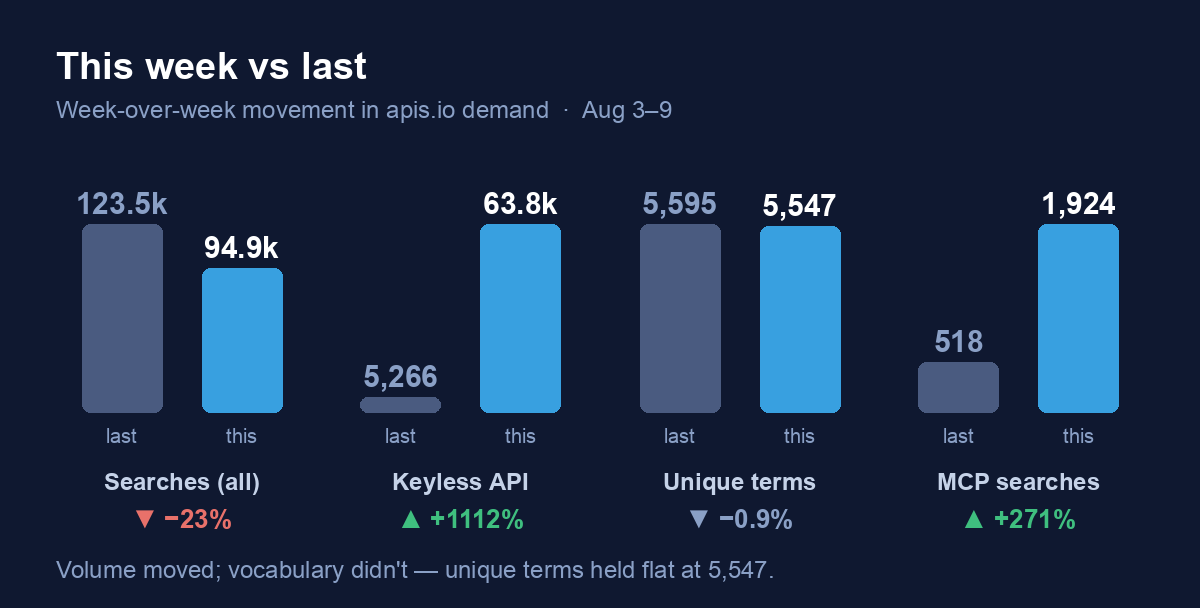
This week vs last: total searches −23% to 94.9k,
keyless API +1,112% to 63.8k, unique terms flat at
5,547, MCP searches +271% to 1,924. Footnote: volume
moved, vocabulary didn't — unique terms held
flat at 5,547
|
Read those two big moves together and they cancel
out. Distinct search terms went from 5,595 to 5,547 — down
0.9%. Twelve times the keyless requests, asking for the
same number of different things, while the internal tier
fell by almost exactly what keyless gained. That's
automated traffic changing which door it uses, not a surge
of new buyers. The top 100 terms account for 2,852 of
94,927 requests, and the single loudest — "Automation Preflight API" — ran 1,988 times at machine cadence.
Unique terms is the line I'd hold you to, and
it's flat. Demand didn't grow this week. It also didn't
shrink.
Two signals underneath that I do like. United States sessions rose to 43,806 and the US is the
top country again for the first time in three weeks, with
Singapore falling from 422,260 sessions to 34,493. And the
first owner-key calls showed up — 41 of
them — meaning somebody is now driving the API with a real
credential rather than anonymously.
On the Pro tier: 35 attempts on ratings, 5 on security, 3 on me, 1 each on compare, gaps and scopes. ratings has been the most-reached-for gated resource every
single week.
🕳️ The Gaps (demand we couldn't answer)
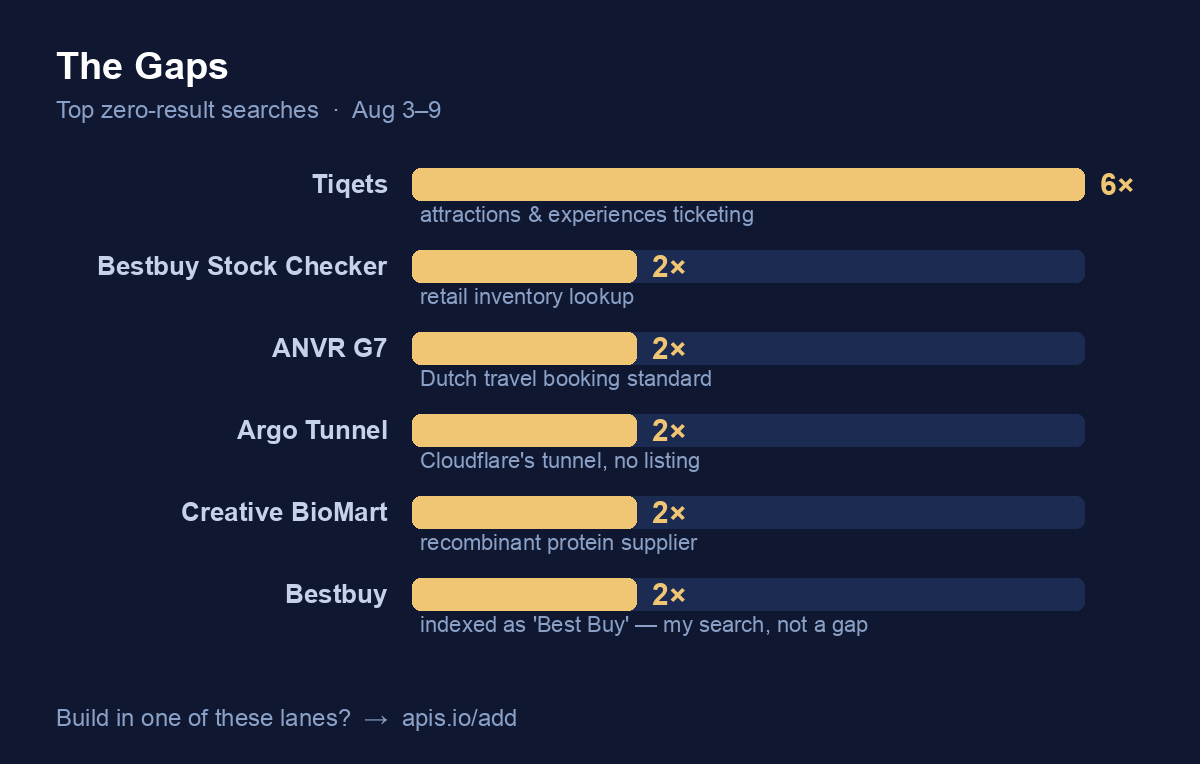
Six searches came back empty this week that are worth
putting in front of you. Every one re-probed against the
live API this morning and confirmed genuinely uncovered:
|
|
The Gaps — top zero-result searches: Tiqets 6×, then
Bestbuy Stock Checker, ANVR G7, Argo Tunnel,
Creative BioMart and Bestbuy at 2× each
|
-
ANVR G7 (2×) — the Dutch travel trade
association's booking-message standard. Somebody
wanted a specification indexed, not a
company. TUI ships a b2bota-g7 API against it and the catalog has neither.
-
Argo Tunnel (2×) — Cloudflare's
tunnel product under its former name, with no
standalone listing.
-
Creative BioMart (2×) — recombinant
proteins, 100,000+ products, no API surface indexed.
-
Bestbuy Stock Checker (2×) — retail
inventory lookup, a genuinely uncovered intent.
-
Bestbuy (2×) — worth knowing that
this one resolves if you type it as Best Buy,
which has a full profile and 6 APIs. People search
brands the way brands write their own domains.
Travel ticketing, a European trade standard, life-science
supply, and retail inventory — four different corners of
the economy, none of them served.
If you build in one of these lanes, this is your
invitation. Add your API in about two minutes: apis.io/add — or point your agent at the apis.io MCP server and let it submit for you.
🆕 New to the Index
The catalog grew by 768 providers and 6,801 APIs this week, to 26,701 and 115,066. Last week added 494
providers and 1,339 APIs — so the API count moved five
times faster than the provider count, which is what
happens when existing providers get their real first-party
contracts harvested.
Seven provider profiles publish over the coming week, and
they line up into an unusually clean comparison:
-
Salesforce — 294 APIs; Kin
Score 80.1 (exemplar), Agent
Readiness 59.9. 256 contracts, 100% callable, and the
most balanced facet spread of the set (CRM)
-
Microsoft Graph — 564 APIs; 67.9 (exemplar). Every one of the 564 contracts callable as
published, 17,655 acting operations, 93 consent
gates (Productivity & Identity)
-
PostHog — 139 APIs; 63.7 (strong), AR 42.3. 1,567 operations — 11.3 per entry, the
densest surface of the week (Product Analytics)
-
Coveo — 152 APIs; 62.0 (strong), AR 55.0. A first-party MCP server, plus an Agent
Configuration API and an Agent Orchestration API (AI Relevance)
-
Deel — 91 APIs; 59.6 (strong), AR 42.3. 659 operations, 327 that act, and 10 human-in-the-loop gates —
on a platform that pays people in 150 countries (Global Employment)
-
Webex — 178 APIs; 58.9 (strong), AR 48.6. See below (Collaboration)
-
Mastercard — 249 APIs; 49.5 (developing). 166 contracts at 100% callable, and a 36.7 regulatory posture that is the whole story (Payments)
Deel is the one I'd sit with if you only read one.
Half the operations mutate state; ten of them pause for a
human.
All on the apis.io blog.
⭐ Rated This Week: Webex — 178 contracts, zero callable
This week's angle: the provider that did the
expensive parts right.
Webex scores 58.9 — a strong band — on 178
APIs. Cisco's collaboration platform: messaging,
meetings, calling, devices, contact centre.
|
Facet
|
Score
|
|
Governance
|
68.8
|
|
Contract Quality
|
67.4
|
|
Commercial Clarity
|
60.5
|
|
Regulatory (Telecommunications)
|
58.3
|
|
Developer Ergonomics
|
56.5
|
|
Discoverability
|
50.0
|
|
Operational Transparency
|
42.1
|
Callable contracts: 0.0%. Not one of the
178 resolves to a host a client can call as published.
This is not the API being broken — Webex works, thousands
of integrations run against it daily. It means the
published specifications carry no servers block. I fetched all nine specs straight from github.com/webex/webex-openapi-specs to confirm it: 1,374 paths, 2,055 operations, and servers: null in every single file. No host, no basePath either. This is Cisco's own publication, not a
modelling artifact.
Compare across the same week: Microsoft Graph is 100%
callable across 564 contracts. Salesforce is 100% across
256. Mastercard is 100% across 166.
A developer hits a missing host and shrugs — reads the
docs, finds the real base URL, hardcodes it. An agent hits
it and stops. The contract is the only thing it has.
And Webex is otherwise careful. Three verified agent-readiness dimensions —
error semantics, OpenAPI examples, rate-limit signalling —
which is more than most providers in this catalog manage,
and all three verified against the contract rather than
credited to a documentation link.
The cheapest points on the table: populating servers is a build-pipeline change, not an architecture change,
and contract quality is the heaviest facet in the rubric
at 25%. Cisco already runs governance tooling; one
Spectral rule requiring a resolvable, non-templated server
URL would catch all 178 files at once. After that, a .well-known/api-catalog linkset is four agent-readiness points for a static
file.
Webex did the expensive parts well and left the cheap part
broken. (Full profile publishes Friday.)
The bands, on rubric 0.9.1: exemplar 66+ · strong
56–65.9 · developing 42–55.9 · thin 28–41.9 · emerging
13–27.9 · minimal 0–12.9.
🤖 Reproduce this yourself
The Webex claim is two steps, and you can do both without
me. First, ask the catalog what it thinks — paste into
your agent against the apis.io MCP server:
get_provider(slug="webex", fields=["score"])
Read score.provenance.contracts — total: 178, derived: 0, callable: 0.
Then check it at the source, which is the step that
matters:
curl -s https://raw.githubusercontent.com/webex/webex-openapi-specs/main/public-spec/webex-messaging.json \
| python3 -c "import json,sys; print(json.load(sys.stdin).get('servers'))"
If that prints None, my number is right. Do it for any provider you like —
that's the point.
Or read the demand data directly: apis.io/search-terms/, refreshed every Monday.
26,701 providers. 115,066 APIs. 1,924 agent searches —
an all-time high. See a gap that's yours? → apis.io/add
The Demand Report is a weekly read of apis.io's
own search + discovery signal. Forward it to someone who
ships an API.
|