|
Human searches held flat. Agent searches tripled.
Here's what the machines were shopping for.
Week of July 20 – 26, 2026 · 25,439 providers · 106,926
APIs indexed
Every Monday I read what people actually typed into apis.io — the search box and the MCP server — as a demand signal
for the API economy. Nobody else has this data, so nobody
else can send you this email.
Quick housekeeping: this is Issue #02, and it lands three
weeks after #01. Those weeks went into a catalog rebuild
that took the index from roughly 10,000 providers to
25,439, and from 34,569 APIs to 106,926. Two things drove
that. First, we started listing every provider we profile
rather than only the ones with a machine-readable spec on
file. Second, a full artifact refresh finally landed the
specs, scopes, and security definitions for the rest of
the catalog. So treat the big numbers as a re-baseline,
not a one-week growth rate — and treat the demand numbers
below as the real weekly signal, because those are
measured the same way they were three weeks ago.
📈 The Demand Report
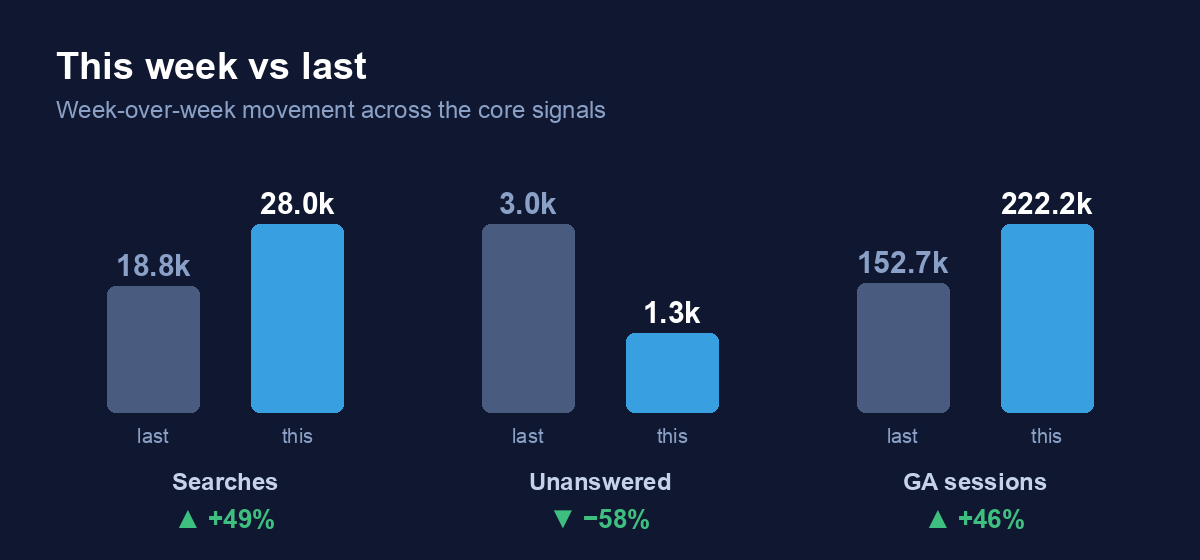
Raw volume went sideways: 38,015 searches, down 0.4% week-over-week. That's the least interesting number in this email.
Two others aren't:
Unique terms rose 9.5%, from 5,553 to 6,082. Same volume, more distinct questions. Demand is getting
more specific, not bigger.
Searches arriving over the MCP server went from 310 to
1,027 — up 231%. That is agents, not people, and it is the fastest-moving
line we have.
|
|
This week vs last: searches flat at 38.0k, unique
terms +9.5% to 6,082, MCP searches +231% to 1,027
|
Those two facts explain each other. An agent doesn't
type "weather." It decomposes a task and issues
a string of narrow, literal queries. When agent traffic
triples, the vocabulary widens.
And you can see it in what was searched. The agent stack shows up as its own coherent cluster in
the top 100 this week:
|
Searched for
|
Times
|
|
RAG
|
14
|
|
MCP Server
|
10
|
|
Chat Completions
|
10
|
|
OpenAI Compatible
|
9
|
|
Model Gateway
|
8
|
|
Validated Output
|
8
|
|
x402
|
8
|
|
Model Routing
|
7
|
|
AI Gateway
|
6
|
|
Agent Memory
|
6
|
Read that list as a shopping list, because that's
what it is. Nobody searching "OpenAI Compatible"
or "Model Routing" wants to read about AI — they
want an endpoint that speaks a protocol they've
already committed to. x402 showing up eight times is the one I'd watch:
that's agent-native payments, being looked for by
name, by machines.
The rest of the top 100 is stubbornly, reassuringly
boring — and that's the other half of the story. Images
(30), Weather (24), Mailgun (19), Payment Processing (14),
Twilio (13), Places (12), QuickBooks (8), GitHub (8). The
integration primitives that have been in demand since the
first web APIs are still the volume leaders. The agentic
layer is being added on top of that, not instead of it.
Underneath both, a long tail of genuinely specific
enterprise asks: Carrier Billing (10), Laboratory
Instruments (10), Stop Loss (10), Resource Optimization
(10), Delivery Reports (9), Writebacks (9), Barcode
Scanning (8), Charge Points (8), Construction Management
(8), Privileged Identity Management (8), Vehicle History
(8), Water Data (8), Non-Tariff Measures (8), Bills of
Material (7), Utility Rates (7). Every one of those is
somebody with a real integration to ship.
🕳️ The Gaps (demand we couldn't answer)
263 distinct terms came back empty this week, up
marginally from 257. Tripling the catalog
did not close the gap — because the gaps
aren't categories anymore. They're names.
A note on method: the raw unanswered list had 623
terms; 360 were dropped as noise. A scraper spent the
week walking a dictionary through our search box, which
is why the unfiltered list is full of things like
"kielbasa" and "creme brulee."
What's below is what survived.
|
|
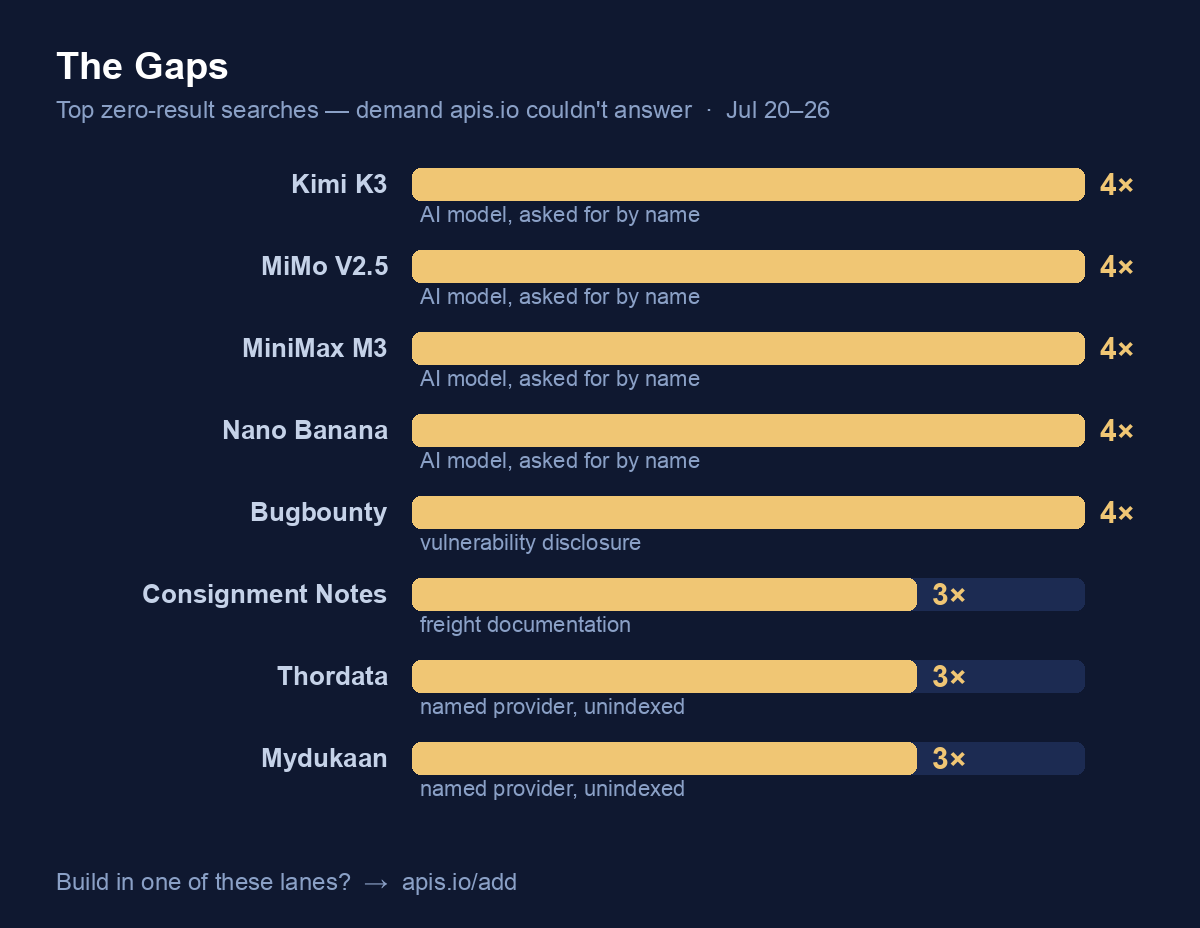
The Gaps — top zero-result searches: Kimi K3, MiMo
V2.5, MiniMax M3, Nano Banana and Bugbounty at 4×
each, Consignment Notes, Thordata and Mydukaan at 3×
each
|
The headline gap is AI models, asked for by
name. Kimi K3, MiMo V2.5, MiniMax M3, Nano Banana — four model
names, four times each, zero results. People are treating
an API index as a model index. That's a genuine
signal about how the two categories are collapsing, and
it's a gap we own rather than one a provider can fill
for us.
The second cluster is named products nobody has
submitted. Thordata, Mydukaan, Kiwi TCMS, Altium 365, MirrorFly,
GitScrum, Moysklad, NeutrinoAPI, Tangocard, Streakwave.
Someone specifically wanted your API this week and got
nothing. If one of those is you, that's a two-minute
fix.
The third is verticals still under-covered, and this week they lean logistics, agriculture, and
non-US: Consignment Notes, Missed Pickup, Precision
Farming, Instant Payouts, POS SAFRA, Cadastro Bancário
(Brazilian banking registration, asked four different
ways), Techniker Krankenkasse (a German statutory health
insurer). Demand is not only in English and not only in
the US.
One to flag for the security crowd: Bugbounty (4×) and Indirect Prompt Injection (2×) both came back empty. Vulnerability-disclosure and
prompt-injection-defense APIs are being looked for and are
not in the index.
If you build in one of these lanes, this is your
invitation. Add your API in about two minutes: apis.io/add — or point your agent at the apis.io MCP server and let it submit for you.
🆕 New to the Index
The arrivals board — provider profiles publishing daily
this week, with their real catalog surface:
-
SendGrid — 44 APIs behind what most
people think is one send-email endpoint (Email)
-
Zoom — 41 APIs; a platform surface,
not a marketing surface (Communications)
-
Adyen — 202 APIs and 202 specs, a 1:1
ratio that's rarer than it sounds (Payments)
-
FactSet — 460 APIs, 447 specs; the
deepest single-provider surface in financial data (Market Data)
-
Shopify — 213 APIs, 197 specs (E-Commerce)
-
Palo Alto Networks — 168 APIs, 159
specs (Security)
-
Slack — 115 APIs, 109 specs (Collaboration)
Worth noting: "Palo Alto" was searched 9 times this
week, and the Palo Alto Networks profile publishes Saturday.
Demand and supply occasionally do meet.
Full profiles publish daily on the apis.io blog through August 2.
⭐ Rated This Week: Alpaca
Every provider carries a Kin Score across six facets —
discoverability, contract quality, governance, operational
transparency, developer ergonomics, and commercial clarity
— plus a conditional regulatory layer for providers
operating under a real regime.
This week the top of the whole index, all 25,439
providers, is a company most people outside fintech have
never heard of:
Alpaca — 86.4 / 100 · Band: EXEMPLAR 🟢 (up from 83.7)
The commission-free trading and market-data broker scores
#1 by doing the boring things completely:
-
Discoverability: 100 · Commercial clarity:
100 — you can find it, and you can tell what it costs,
without talking to anyone.
-
Developer ergonomics: 91.3 —
separate, publicly maintained OpenAPI specs for
Trading, Broker, Market Data, and OAuth, in the alpacahq/alpaca-docs GitHub repo. Not a PDF. Not a portal-only viewer.
-
Operational transparency: 86.8 — real
public reliability signal.
-
Regulatory (Securities & Market Data):
100 — a perfect score on the conditional layer that only
applies to providers in a regulated regime.
Where it leaves points on the table: governance (60.5) and contract quality (69). The specs exist and are public, but the versioning,
deprecation, and change-communication story around them is
thinner than the rest of the profile. That's the
cheapest ground Alpaca has left to take — and it's
the same gap I see on most exemplar-band providers.
Publishing the spec is now table stakes; governing it is
where the remaining points live.
The bands, for reference: exemplar 70+ · strong 60–69 ·
developing 45–59 · thin 30–44 · minimal 0–29.
🤖 Reproduce this yourself
Everything above came out of public apis.io surfaces.
Paste this into your agent (apis.io MCP) to pull the
top-rated providers for yourself:
find_providers(band=["exemplar"], sort="composite", limit=25)
Or check the demand data directly: apis.io/search-terms/ — the top 100 searches and the top 100 unanswered ones,
refreshed every Monday.
25,439 providers. 106,926 APIs. 38,015 searches. 263
still unanswered. See a gap that's yours? → apis.io/add
The Demand Report is a weekly read of apis.io's
own search + discovery signal. Forward it to someone who
ships an API.
|