|
The five most-searched terms last week were not five
searches. They were one stack — outage, network status,
flight tracking, emergency alerts, satellite imagery —
and the catalog has exactly one thin answer for
each.
Week of September 7 – 13, 2026 · 27,596 providers ·
133,764 APIs
Every Monday I read what people and agents actually typed
into apis.io — the search box and the MCP server — as a demand signal
for the API economy. Nobody else has this data, so nobody
else can send you this email.
📈 The Demand Report
Here is the top of last week's search log, unedited:
|
Term
|
Requests
|
|
Critical Infrastructure Outage API
|
197
|
|
Telecommunications Network Status API
|
196
|
|
Aviation ADS-B Flight API
|
195
|
|
Emergency Management Alert API
|
195
|
|
Satellite Earth Observation API
|
195
|
978 requests across five terms, all within two of each
other. That evenness is one caller, and the sixth-placed term
is University at 59 — so this cluster is four times the size of
everything beneath it.
I have written three issues in a row now about a
machine's shopping list, and the reason I keep doing
it is that the lists keep being legible. This one is the
most legible yet. Read the five together and they are not
five product searches. They are one system: is the grid up, is the network up, where are the
aircraft, what has been declared an emergency, and what
does it look like from orbit. That is a
situational-awareness stack — the thing an
emergency-management desk, a reinsurer, a
national-resilience team or an agent doing any of their
work would need to assemble.
Nobody searched for "an API." Somebody searched
for a capability set.
So can the catalog assemble it?
One at a time, honestly. The catalog has an answer for
every one — and in every case it is thin, and it is an
accident rather than a category.
|
The stack asked for
|
What we actually hold
|
|
Aviation ADS-B
|
one exact match — the ADS-B
Exchange feed — plus FlightAware AeroAPI and
Firehose, and Airlabs. 20 APIs on "flight
tracking"
|
|
Critical infrastructure outage
|
13 APIs on "power outage" — EPCOR, SSEN,
Western Power, Manitoba Hydro, SaskPower. Individual utilities, mostly not
American
|
|
Telecom network status
|
ThousandEyes Internet Insights, AEMO Outage
Management, and 128 loose matches on "network
status"
|
|
Emergency management alert
|
5. Bandwidth Emergency
Notification, Weatherbit Severe Weather Alerts,
Department of the Interior Alerts
|
|
Satellite earth observation
|
29 — NASA Earth Imagery and EPIC, AWS Earth
Observation Jobs, then a run of agriculture NDVI
products
|
The sharpest absence is a standard, not a
company. Emergency alerting has one: the OASIS Common Alerting
Protocol, which is what IPAWS and the national weather
services actually speak. Search the catalog for it and you
get 34 fuzzy matches and not one CAP implementation. The
layer that would let these five talk to each other is the
layer that is missing.
So the honest answer is: we can return one of each, and we cannot return the
stack. A buyer assembling this has to know in advance that
ADS-B Exchange, SSEN and NASA EPIC belong in the same
sentence. The catalog will not tell them.
Which is the thing 7,062 requests asked for again
Last issue I reported that cohorts — the endpoint that scores and ranks a group of
providers rather than finding one — went from
never-touched to 7,187 gate bounces, and I flagged that
one week is not a trend.
It came back at 7,062.
|
Gated resource
|
Aug 31–Sep 6
|
Sep 7–13
|
|
cohorts
|
7,187
|
7,062
|
|
security
|
4,481
|
4,782
|
|
scopes
|
331
|
667
|
|
ratings
|
123
|
45
|
|
resolve
|
33
|
32
|
|
agent-readiness
|
16
|
16
|
Total bounces off the paid surface: 13,090 → 13,541. In a week when total volume fell 2%, keyless callers
fell 25%, and the vocabulary hit the lowest point this
report has ever recorded, the steadiest line in the entire dataset is demand for
the layer that compares things. scopes doubled on top of it.
Two weeks is not a law, but it is no longer a spike. And
it sits underneath the lead: somebody spent last week
hand-assembling a five-part stack one search at a time,
and the endpoint that would have done it in one call
refused them 7,062 times.
A correction: the tier line is mine, not the market's
Last issue I reported that pro and business requests appeared in the demand log for the first time
and framed it as the first sign that a subscriber had
actually used a key. I was wrong, and I am withdrawing it.
by_tier records the plan on the presented key. It does not
distinguish my keys from anybody else's, and I hold
three: an Understanding key, an Influence key and an owner
key. Checked this morning against /api/v1/me, they resolve to pro, business and owner exactly.
Then the arithmetic. On 7, 11 and 12 September I ran a
tag-quality pass over 56 tags, every call sending the
Understanding key — the timestamps are in network/_qc/tag-qc.json, 43 of them on the 11th alone. pro went 289 → 2,655 in that same week.
That is me. So is a good part of the rest: authenticated
traffic reads 1,113 → 5,649, and I cannot
show you which slice of it is a subscriber, because the
log was never built to answer that.
Until it carries a first-party flag, the authenticated
line is not a demand signal and I will not print it as
one. The gate bounces above are unaffected — a
bounce is by definition a caller without the plan, and my
keys have it. That is the number to read.
The volume, and the vocabulary floor
|
|
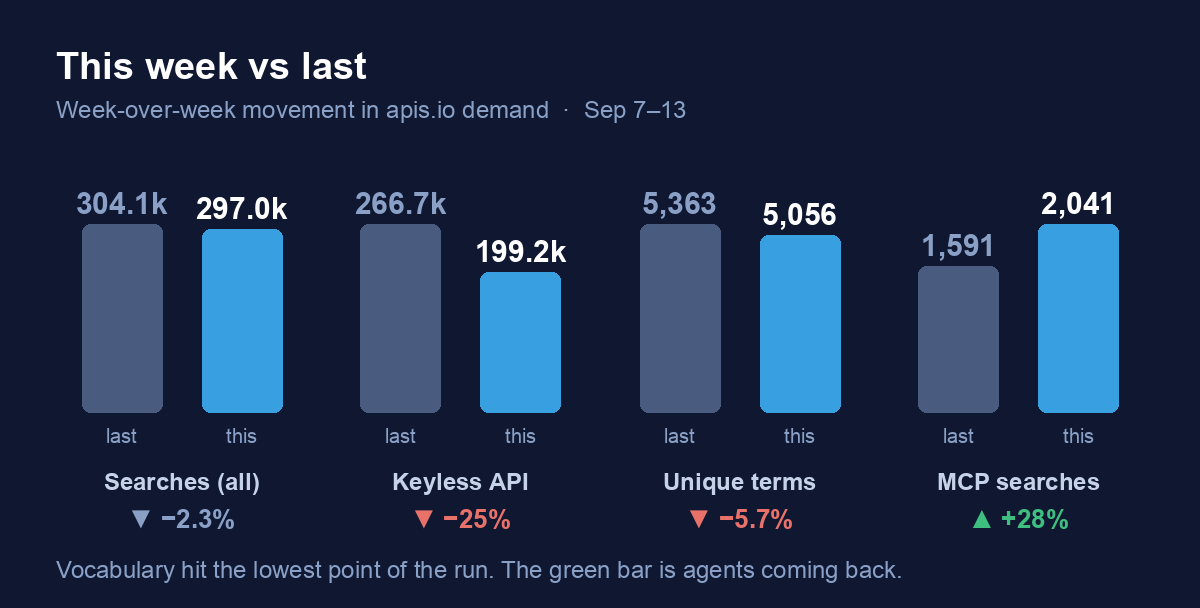
This week vs last: total searches −2.3% to 297.0k,
keyless API −25% to 199.2k, unique terms −5.7% to
5,056, MCP searches +28% to 2,041. Footnote:
vocabulary hit the lowest point of the run; the
green bar is agents coming back
|
Total requests came in at 297,000, down 2.3%, and keyless callers fell hard — 266,651 → 199,207, down 25% — as last week's caller eased off.
Distinct search terms came in at 5,056 — the lowest of
the entire run. The series across nine measured weeks: 5,553 → 6,082 →
5,595 → 5,547 → 5,338 → 5,978 → 5,514 → 5,363
→ 5,056. Total requests stayed near
300,000. That is the sixth consecutive week of volume and
vocabulary pointing in opposite directions, and by now the
interesting question is not which to believe but what is
eating the vocabulary.
Two machines are, and neither is a buyer. The dictionary
crawler from August is back, working the E's and
F's — flugelhorn, gastropod, inglenook, keelhaul. And last issue's catalog crawler is still reading
our own index back to us, now in camelCase: receivetags, reexportdataset, rejectaccess, roleassignees, editmetadata, filedownloads. Neither produces a distinct human term; both inflate
the request count.
Agent traffic recovered: MCP searches 1,591 → 2,041, up
28%. Last issue I called 4,533 a spike and named 1,500–2,800
as the durable band. It landed at 2,041, inside it. That
call held.
Above the noise the human list is the usual: University (59), Payments (52), Football (25), Moomoo (23), AI (22), Text To Speech (15), OpenAI (14), Pulmonary Embolism (13), Wireless Network Monitoring (13).
🕳️ The Gaps (demand we couldn't answer)
The pipeline saw 1,183 raw unmet terms,
dropped 662 as noise — the largest noise share yet, which
is the two crawlers — and kept 234,
double last week's 113.
I re-probed all 100 published zero-result terms this
morning. All 100 still return nothing — a
second consecutive clean sweep.
Three candidates came off the list before it was drawn,
because the provider is already indexed under a spaced
name: coinsph (Coins.ph), enablebanking (Enable Banking) and duckcreek (Duck Creek). That is the third week running for this,
and it is no longer a footnote — the squashed no-space
domain is a normal way to type a company, and while the
search misses it, some share of "unmet demand"
every week is a provider we already hold. I would rather
tell you the number is soft than quote it as though it
were clean.
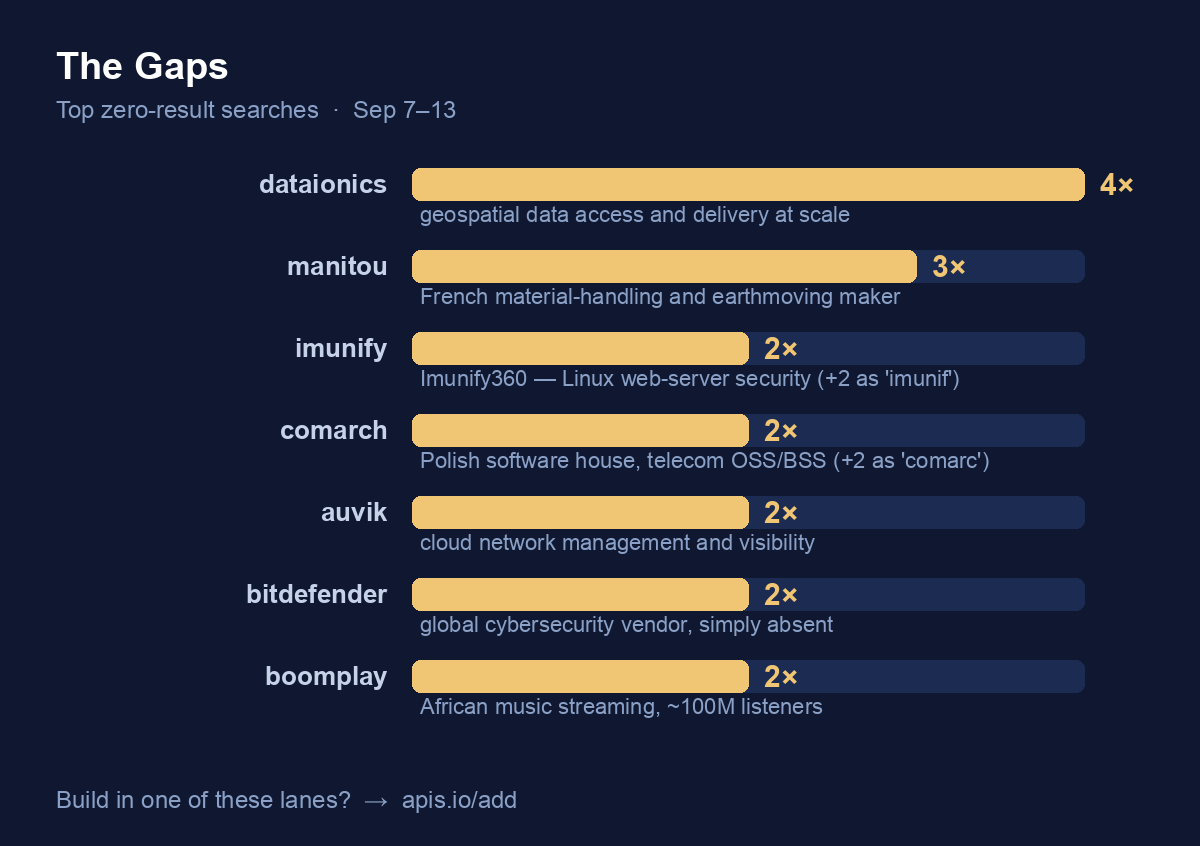
Seven rows survived, each checked against the live catalog
by hand:
|
|
The Gaps — top zero-result searches: dataionics 4×,
manitou 3×, then imunify, comarch, auvik,
bitdefender and boomplay at 2× each
|
-
dataionics (4×) — and it lands
straight on the lead. Dataionics does "geospatial
data access and delivery at scale." That is the
fifth row of the resilience stack, searched for by
name, and we do not have it.
-
manitou (3×) — Manitou Group, the
French manufacturer of telehandlers, aerial work
platforms and earthmoving machinery. Second week
running for the machine layer, after schneider m221 and viessman.
-
imunify (2×, plus 2 as imunif) — Imunify360, the Linux web-server security suite
from CloudLinux, on a great many shared hosts.
-
comarch (2×, plus 2 as comarc) — Comarch, a Polish global software house whose
telecom OSS/BSS runs at carriers. Also inside the
stack: "telecommunications network status"
is what that software is for.
-
auvik (2×) — cloud network management
and visibility. Also inside the stack, and it pairs
with Wireless Network Monitoring at 13 in the top terms.
-
bitdefender (2×) — a global
cybersecurity vendor with a real management API, and
we simply do not have it. Some absences have no story;
this one is just a hole.
-
boomplay (2×) — African music
streaming with something near 100 million listeners.
The non-Anglophone pattern, again.
Three of seven are inside the lane the lead is
about — geospatial delivery, telecom OSS, network visibility.
When the same week's top demand and top gaps point at
the same capability set, that is the clearest buy signal
this report produces.
One repeat worth naming without giving it a
row: apifootball came back a third consecutive week, at 5×. I published
it in #08 and I discount previously-published terms, so it
is not on the chart — but three weeks of somebody looking
for a football-data API by product name is a standing
invitation.
If you build in one of these lanes, this is your
invitation. Add your API in about two minutes: apis.io/add — or point your agent at the apis.io MCP server and let it submit for you.
🆕 New to the Index
The deployed index reads 27,596 providers and 133,764 APIs. Tonight's build carries 28,483 and 138,375 and
ships this week, so the pair above is the pair you can
check right now.
Two thirds of the live MCP servers are somebody
else's engineering
Three weeks ago I wrote that only a quarter of our MCP
inventory is a hosted endpoint. Two weeks ago the index
re-cut the count to require a real server rather than a
candidate manifest. This week the scoring rubric asked the
next question, and it is the sharpest of the
three: of the servers that are real and reachable, who
actually built them?
The probe enumerates tools/list and fingerprints the tool-name set. Of 660 servers that answered with an enumerable tool list,
305 — 46% — serve a tool list byte-identical to at least
one other provider's. Only 20 distinct fingerprints account for all 305.
|
Providers sharing it
|
Served at
|
What it is
|
|
129, 13 tools
|
/api/ucp/mcp
|
one commerce protocol — create_cart, create_checkout, complete_checkout, get_order, lookup_catalog
|
|
68, 9 tools
|
/_api/mcp
|
Wix — CallWixSiteAPI, ExecuteWixAPI, BrowseWixRESTDocsMenu
|
|
36, 1 tool
|
/api/mcp
|
Shopify — search_shop_policies_and_faqs, and nothing else
|
|
15, 1 tool
|
—
|
Mintlify — searchDocs, and nothing else
|
Thirty-six companies — Allbirds, Blue Origin, Athletic
Greens among them — "have an MCP server," and
what it can do is search their shop policies. One tool, installed by their storefront platform,
identical across all thirty-six.
Nothing here is a criticism of those companies; a platform
shipping an agent surface to its whole customer base is a
good thing, and it is how most of the web gets any new
capability. It is a criticism of the count. "Provider
X has an MCP server" has been carrying the
implication that provider X made a decision about agents,
and for 305 of 660 measured servers, provider X's
platform made it for them.
The rubric now grades authorship accordingly — a
platform-authored server earns a quarter of what a
first-party one does, matching how agentic_commerce has always scored the same distinction. 1,055 servers gate tools/list behind auth and are never classified at all; they keep
full credit, because unknown is not a finding.
|
|
Last Monday
|
Today
|
|
|
MCP entries (all)
|
4,801
|
4,961
|
+160
|
|
— real servers
|
2,560
|
2,651
|
+91
|
|
— hosted endpoints
|
1,254
|
1,298
|
+44
|
|
— providers credited with MCP
|
2,476
|
2,566
|
+90
|
|
Security artifacts (providers)
|
24,328
|
24,423
|
+95
|
|
Scopes artifacts (providers)
|
2,824
|
2,871
|
+47
|
Nineteen posts published last week — the heaviest run yet.
A few worth your time:
All on the apis.io blog.
⭐ Rated This Week: ADS-B Exchange vs FlightAware — twenty
points of weather report
This week's angle: the two providers that answer
the week's most-searched capability, and the single
facet that separates them.
Aviation ADS-B Flight API drew 195 requests. The catalog returns exactly one exact
match — ADS-B Exchange, the unfiltered community feed — and one obvious
commercial alternative, FlightAware with AeroAPI and Firehose. Same question, two postures.
|
|
ADS-B Exchange
|
FlightAware
|
|
Kin Score
|
38.6 thin
|
58.4 strong
|
|
Agent Readiness
|
30.6 agent-ready
|
37.2 agent-ready
|
|
Contracts / callable
|
5 / 100%
|
8 / 100%
|
Twenty points apart. Now look at where the twenty points
are:
|
Facet
|
ADS-B Exchange
|
FlightAware
|
|
Discoverability
|
68.5
|
59.3
|
|
Contract Quality
|
68.0
|
65.9
|
|
Access Clarity
|
50.0
|
84.2
|
|
Developer Ergonomics
|
21.4
|
47.0
|
|
Contract Governance
|
9.8
|
4.5
|
|
Operational Transparency
|
0.0
|
76.3
|
ADS-B Exchange writes a better contract and is easier
to find. It beats FlightAware on discoverability, on contract
quality, and even on contract governance — where both are
poor. Its five specifications are 100% callable, none of
them derived by us.
It scores zero on operational
transparency, and that is nearly the whole gap.
I checked it rather than trusting the number. status.adsbexchange.com does not resolve. Its provider record carries thirteen
common artifacts and not one of them is a status page, a
changelog, a deprecation notice or a support channel.
FlightAware's carries thirty-four, including a
live status.flightaware.com, a Firehose revision history, an error catalog and a
published lifecycle.
Here is why that matters this week specifically, and
not as a general scolding. The search that surfaced both of these was somebody
assembling a resilience stack — a system whose entire job
is to know whether things are working. A feed that
publishes no status page, no incident history and no
deprecation notice cannot go in that stack, however good
its OpenAPI is, because the first question that system has
to answer about its own inputs is "is this source up
right now?"
ADS-B Exchange has built the hard part. The 68.0 contract
quality is real engineering and the community feed is
genuinely the unfiltered one. The cheapest twenty points in this issue are a status
page and a changelog — and they would move it from thin to the top of
developing without touching a line of the API.
Kin Score rubric 0.22.0, scored 2026-09-14. Bands:
exemplar 66.5+ · strong 54.3–66.4 · developing 39.3–54.2
· thin 26.2–39.2 · emerging 11–26.1 · minimal 0–10.9.
Agent Readiness 0.2: agent-native 38.7+ (gated on
idempotency AND error semantics) · agent-ready 28.6–38.6
· agent-aware 5.1–28.5 · human-only 0–5. 0.22.0 regrades
MCP servers by authorship, so agent-readiness moved for
providers running a platform-built server; neither of
these two runs an MCP server, so neither is affected by
that change.
🤖 Reproduce this yourself
The stack question, one term at a time, no key required:
apis_io_search(q="ADS-B", return="apis")
apis_io_search(q="power outage", return="apis")
apis_io_search(q="Common Alerting Protocol", return="apis")
One exact match, thirteen utilities, and nothing that
speaks CAP.
The endpoint that would have answered it in a single call
still refuses:
curl -s "https://apis.io/api/v1/cohorts?limit=1"
{"error":"unauthorized",
"detail":"The cohorts endpoint requires an authenticated caller. Register at ..."}
Note the refusal has two shapes, and they mean different
things: an anonymous caller
gets 401 pointing at registration, while
a key without the plan gets 402 pointing
at the plans page. Last issue quoted the 402. Both land in
the bounce count above.
And this week's two providers, checked the way I
checked them:
curl -sI https://status.flightaware.com/ # 200
curl -sI https://status.adsbexchange.com/ # does not resolve
That is the twenty points, on the wire.
27,596 providers. 133,764 APIs. Five terms, 978
requests, one stack — and one thin answer each. See a gap that's yours? → apis.io/add
The Demand Report is a weekly read of apis.io's
own search + discovery signal. Forward it to someone who
ships an API.
|