
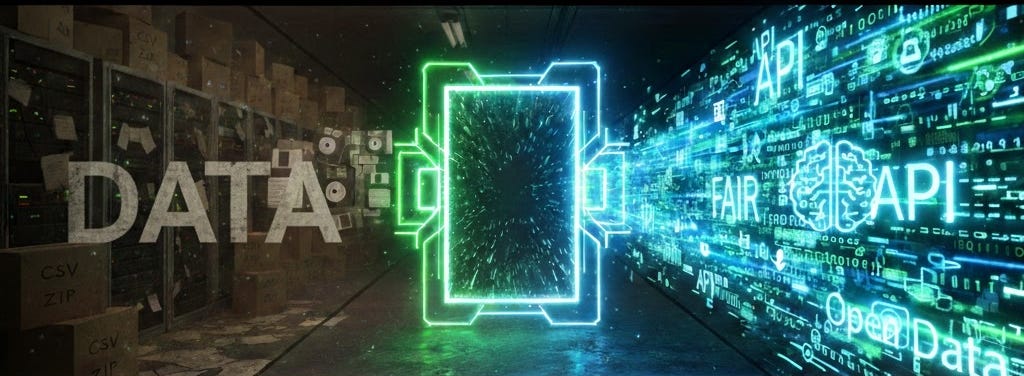
Is your dataset truly “AI-Ready”? How do you stop billions of dollars in annual waste on storage and data wrangling? How can you meet the needs of the next generation of data scientists, developers, and AI agents?
This article explains why static file downloads are an economic drain and why switching to dynamic APIs is the essential step for data modernization, achieving FAIR principles, and paving the way for machine-actionable intelligence.
Supporting this vision is a primary goal and a core objective of my open-source initiatives and the High-Value Data Network. Please feel free to reach out if you need professional expertise or guidance on this topic.
The Data Dissemination Dilemma
In the modern digital economy, data is the most valuable commodity. High-value datasets — from public health metrics and environmental monitoring to financial market indicators and scientific research — are the engines of innovation, and the essential fuel for today’s rapidly evolving Artificial Intelligence (AI) and Machine Learning (ML) systems. Yet, the waywe distribute this data often lags behind its inherent value, creating unnecessary friction and limiting its impact. To unlock the full potential of AI-driven insights, we must revolutionize how this data is accessed, ensuring it is real-time, high-fidelity, and easily ingestible by automated systems.
For decades, the dominant paradigm for sharing high-value datasets has been the static download. This approach, while simple and straightforward, presents significant bottlenecks in an age defined by machine learning, real-time analytics, and data-driven decision-making.
To fully realize the value of high-quality data, a critical shift is necessary: static downloads, while useful, must be enhanced—and often replaced—by dynamic and versatile Application Programming Interfaces (APIs). This evolution is essential for achieving FAIR (Findable, Accessible, Interoperable, and Reusable) data principles and creating truly machine-actionable data ecosystems. This article examines this essential transition in data dissemination.
The Overwrought Legacy of the Static Download
The simplicity of the static download is its primary allure. You package a dataset, often in a standard format like CSV (Comma-Separated Values) or a proprietary format (such as those used by statistical software like SAS, Stata, or SPSS), and make it available for download. It’s a method that works, but only up to a point.
The ideation behind this approach is rooted in an era of smaller datasets and less sophisticated analytic capabilities. Today, these methods exhibit significant limitations that are no longer tolerable for high-value, high-frequency, or complex data.
The Burden of the Block: Inefficiency and Duplication
The fundamental flaw of the static download is its “all-or-nothing” nature. Users rarely need the entire dataset. A researcher might only require the data points for a specific geographic region, a narrow time window, or a select group of variables. Furthermore, datasets are often used to simply produce aggregated tables or time series.
The file-based data distribution has two major flaws:
Storage Overheads: For a dataset, downloading the whole file to extract a subset is an inefficient process. It leads to incredible computational duplication—hundreds or thousands of organizations downloading and storing the exact same data block on their own servers. This unnecessary storage/duplication is a major contributor to rising operational costs and environmental impact, as vast data centers are required simply to store redundant copies of public information.
Data Wrangling Fatigue: Once the file is downloaded, the user is immediately saddled with the task of data wrangling—cleaning, subsetting, and reshaping the data before a single analytical insight can be drawn. This process is time-consuming, requires specialized expertise, and distracts analysts from their core mission of analysis.
In fact, the combined cost of these two factors—redundant storage and excessive data wrangling—is a globally recognized economic drain. A 2018 European Commission report on the costs of not having FAIR (Findable, Accessible, Interoperable, and Reusable) data estimated the annual loss to the EU economy at €10.2 billion, with these manual, inefficient processes being the leading cause. This estimate is considered conservative, as the inclusion of hard-to-quantify elements could add up to an additional €16 billion. When projected globally, this potentially amounts to over $150 billion in wasted resources every year.
The Format and Synchronization Trap
Beyond size, static downloads impose constraints on format and timeliness:
The ‘Out of Sync’ Crisis: For any dataset that is updated regularly—daily, hourly, or even in real-time—the static download immediately creates a synchronization problem. Different users may use different versions without realizing it, potentially leading to contradictory conclusions across reports, academic papers, or policy recommendations. This is particularly dangerous for live or high-frequency data, where decisions must be based on the latest available information. While this may not matter much for small datasets, the margin for error grows exponentially with data volume and update speed.
Format Inflexibility: Data providers often choose one format, which may not be in the format the user needs. A data scientist might prefer Parquet (recommended for its open, columnar, and compact nature), a web developer might need JSON, and a traditional statistician might prefer SAS, Stata, or SPSS. The static approach forces the user to manually convert the data, introducing another layer of complexity and potential error.
The Dynamic Promise of APIs
The API approach is a fundamental reframing of data access. It treats data not as a static product to be handed over, but as a living service to be interacted with. This shift delivers benefits across efficiency, flexibility, machine-readability, and security.
Granular Control and Flexibility
APIs empower the user by giving them control over what they receive and how they receive it.
Targeted Retrieval: An API can subset the data and meet users’ specific needs with a single query. Instead of downloading a continent’s worth of data, the user queries the server for rainfall data for the last week in a specific city. This vastly reduces download times, storage needs, and the subsequent data wrangling effort.
On-the-Fly Processing: APIs can offer on-the-fly aggregation or transformation services. The server itself can handle computationally intensive tasks—such as calculating a 7-day rolling average, aggregating data to a higher geographic level, or transforming units—before the data is even sent. This offloads work from thousands of individual users and ensures consistency in calculations.
Format Versatility: A well-designed API can deliver data in different formats (JSON, XML, CSV, Parquet) based on a request header, ensuring the data is immediately usable in the user’s chosen environment.
The FAIR Principles and AI Readiness
The move to APIs is a crucial step toward achieving data modernization and adhering to the FAIR (Findable, Accessible, Interoperable, Reusable) data principles.
Metadata and Documentation: APIs can provide concurrent access to metadata and documentation. More importantly, they can generate personalized documentation based on the specific query, only showing documentation for the variables, filters, and formats requested. This is a significant leap in user-friendliness and supports all the FAIR principles.
Code Integration and Reusability: APIs facilitate immediate actionability. They can generate code to integrate CSV/parquet into various environments (Python, R, JavaScript, etc.), providing users with a ready-to-run snippet that instantly connects their workspace to the dataset. This creates reusable data that is easy to share and integrate into complex pipelines.
Machine Actionability: This is arguably the most critical benefit. APIs are a must-have for machine actionability and AI integration. Agents and MCPs need interactive APIs to access data. LLMs’ context window constraints limit the amount of information they can process. Machine learning builds upon both data and metadata. All require reliable, automated, and interactive data feeds. The API enables algorithms to consume and customize data directly, ushering in true AI readiness.
Security and Insights
The server-side control inherent in APIs offers superior security and analytical feedback.
Enhanced Security: Unlike a downloaded file, which is entirely outside the provider’s control, an API can offer fine-grained security and access control. Access can be managed per-variable, per-user, or rate-limited via secure tokens. This is significantly more robust than protecting a single download link.
Usage Monitoring: The API acts as a gateway, allowing providers to offer data usage monitoring and better insights. They can track which datasets are most popular, which specific variables are being queried, and how different user segments are interacting with the data. This feedback loop is essential to continuously improving data products and tracking dataset/variable popularity.
Web Integration: APIs can be used to integrate data on other websites or applications, ensuring that data visualizations or tables embedded on partner sites are always live and up to date.
Addressing the “Cons” and Finding the Compromise
While the benefits of APIs are overwhelming, their challenges must be acknowledged.
An API environment can be more challenging to set up than simply hosting files on a download server. It requires infrastructure for query processing, authentication, and caching, along with specialized IT expertise. However, this challenge is one-time for the data provider, whereas the complexity of wrangling static data is incurred thousands of times by every user.
Thankfully, the complexity has been mitigated by specialized platforms. Providers today have options to streamline deployment. The Socrata platform (now Data Insights), for example, has been adopted by numerous cities and other organizations in North America to power their open data portals. Solutions like MTNA Rich Data Services or Dreamfactory abstract away much of the underlying server management and security complexities.
In addition, the rise of vibe coding has reduced many of the complexities of wrapping APIs around your data infrastructure, enabling rapid implementation and deployment.
The realization is that the setup challenge is an investment in the future of data access, shifting the burden from the consumer to the provider, which is the correct economic model for high-value public resources.
The “Both/And” Solution
The path forward is not about choosing one method over the other, but about sensible integration. The ultimate answer to “Which one to use?” is Both!
While API use should be promoted, we do not want to deprive traditional users of data access or disrupt existing processes.
The most effective strategy is a Dual-Access Paradigm that leverages the strengths of each method:
Discovery and Static Option: Provide a discovery catalog that clearly documents all datasets. For users who still require legacy access or a simple, unsegmented download, offer optional static downloads. These should be limited to pre-canned, most popular data products that are computationally expensive to generate on demand, or for users with deeply entrenched workflows. The catalog, however, should point users to the API as the primary access tool.
API as the Primary Gateway: Offer an API for interactive exploration and nearly all other data retrieval tasks. The API should be the default, recommended method for all new users, data scientists, and machine-driven workflows.
By highly recommending supplementing and deploying APIs for data access, data stewards fulfill their mandate for modernization, ensure adherence to FAIR principles, and achieve crucial AI readiness.
APIs do not need to entirely replace static downloads or change the way traditional users work. They tremendously improve the user experience—particularly for the next generation of users, data scientists, familiar with APIs. They make data developer-friendly and accessible to the AI communities, turning a static resource into a dynamic, flowing asset that can be used to its full potential. APIs also make data open to AI agents and machine-actionable. The future of data access is granular, real-time, and interconnected—a future enabled by the FAIR and open data APIs.
