Product-led growth has evolved from a buzzword into a fundamental business strategy. But as more companies attempt to adopt PLG, many struggle to translate theory into practice.
Amplitude has spent years refining their own PLG approach and identified essential principles that separate successful PLG implementations from those that fall short.
These aren’t abstract concepts but hard-won insights from companies like WeMoney, NBCUniversal, Parabol, and Amplitude’s own experience building its product.
Whether you’re just starting your PLG journey or looking to optimize an existing motion, these principles provide a foundation for sustainable, scalable growth.
Principle 1: Put the product at the center of every customer journey stage
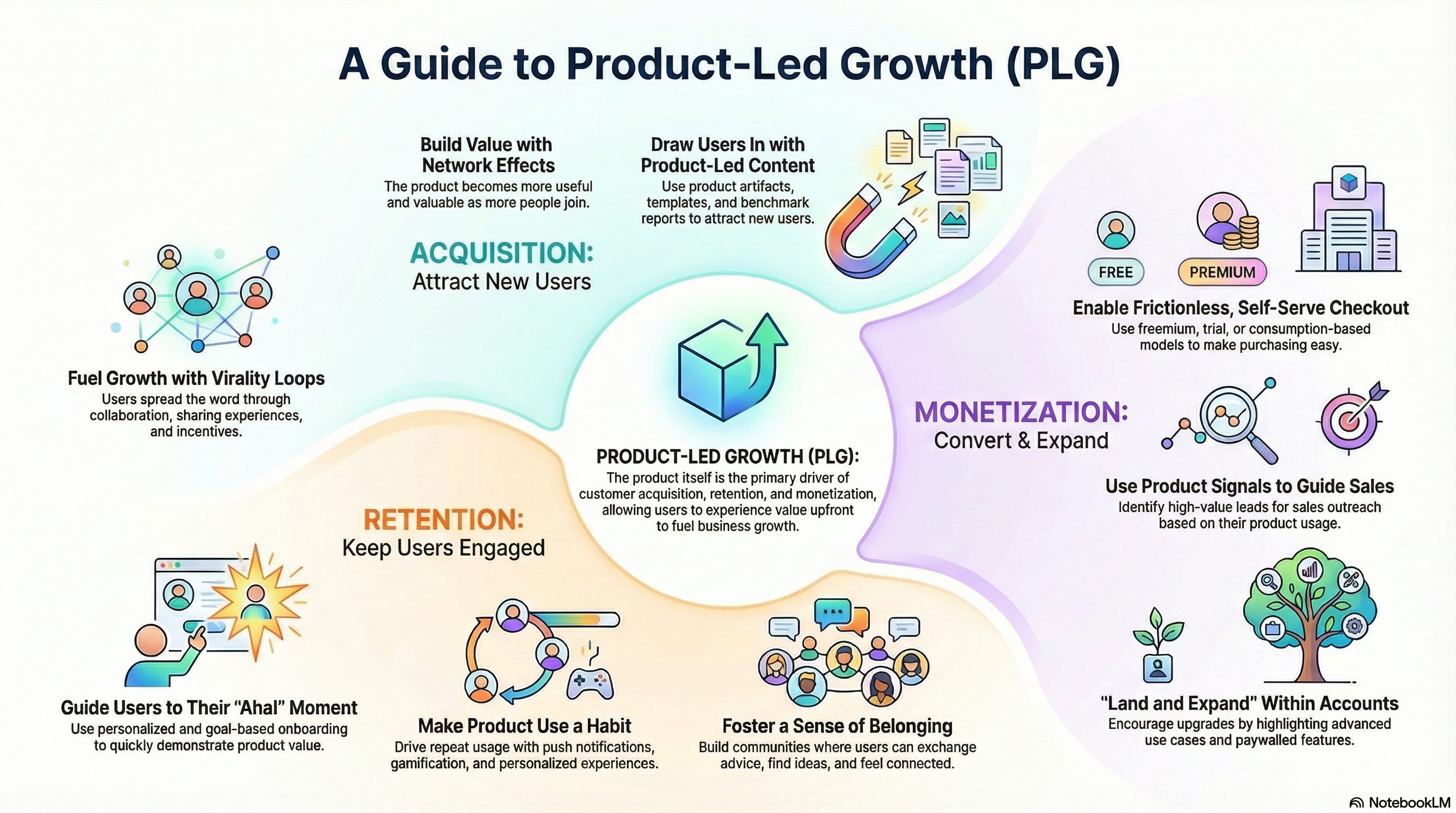
The most fundamental principle of product-led growth is right in the name: the product itself drives acquisition, retention, and monetization.
This principle goes beyond simply offering a free trial. It means the product must deliver value independently at each stage:
At acquisition: Your product should naturally attract users through mechanisms like virality loops, network effects, or user-generated content. When someone uses Zoom, they create meeting links that introduce new users to the product. When developers use Snyk, they generate pull requests with Snyk branding that reach other developers. The product itself becomes the primary acquisition channel.
At activation: Users must reach their “aha moment” without human intervention. Amplitude has simplified its onboarding journey, reducing signup flow pages by 60% to help users experience product value faster. The product guides users to discover value on their own through personalized onboarding, profiling questions, and progress tracking.
At engagement: The product keeps users coming back through push notifications, personalized experiences, communities, and integrations. When Calm prompts users to set daily reminder notifications, retention increases by 3X, the product itself creates the habit loop.
At monetization: Users can self-serve checkout and purchase without sales involvement. The product makes the value so clear that upgrading becomes the natural next step.
Most companies blend product-led motions with marketing-led and sales-led approaches, with different weights at each stage. The key is ensuring the product can stand on its own merit at every touchpoint.
Principle 2: Build on a foundation of behavioral data
You cannot execute product-led growth without deep visibility into how users actually interact with your product.
Former Amplitude Head of Growth Elena Verna emphasizes:
“You need to have a data-driven environment, so you’re not just working from intuition or the opinions of the highest-paid person in the organization.”
Behavioral data reveals both what users do and the psychology behind their actions. This data foundation enables:
Understanding the true customer journey: PLG requires mapping the actual paths users take not the ones you assume they take. Amplitude customers use the platform to identify where users experience friction during onboarding, which features drive retention, and what actions predict higher conversion and lifetime value.
Identifying “Aha Moments”: Every product has critical moments where users discover value. For Amplitude, this includes set up moments (connecting a data source and creating a chart) and “aha” moments (saving or sharing a chart). WeMoney discovered that users who set money goals within the first three days had significantly higher 12-month retention—a finding that only emerged through behavioral analysis.
Enabling Product-led Sales: Product usage signals tell your GTM teams when to engage. Amplitude’s sales team is equipped with product usage data and product-qualified account (PQA) scores. Sales is three times more likely to convert PQAs than any other lead type. This isn’t possible without robust behavioral data.
Democratizing insights: When you make self-serve data accessible across teams, anyone can leverage insights without waiting for analysts. This accelerates decision-making and aligns organizations around what actually drives growth.
Principle 3: Embrace experimentation as your core decision-making process
PLG represents an opportunity for product and growth teams to directly impact the bottom line.
But with that opportunity comes increased accountability. Experimentation provides the reliable, repeatable process for making high-stakes product decisions.
The 7-step experimentation framework
Elena Verna’s framework guides teams through rigorous experimentation:
Define a growth lever: Align experiments with business priorities (acquisition, retention, or monetization)
Define the customer problem: Ground your work in actual customer needs
Develop a hypothesis: Interpret why the problem exists
Ideate possible solutions with KPIs: Generate multiple approaches and define success metrics
Prioritize solutions: Consider cost, impact, and confidence
Create an experiment statement and run tests: Frame your experiment clearly and execute
Learn from results and iterate: Update your understanding and continue the loop
This framework ensures experiments benefit users and the business. It bridges the gap between perception and reality, especially critical as you scale and direct customer feedback becomes harder to gather.
Principle 4: Design for self-service activation
If users can’t activate your product without human intervention, you don’t have product-led growth. This principle is non-negotiable.
Ben Williams of Product-Led Geek notes: “I like to think of the activation process as something that starts really early, probably before they get to your web presence. When you talk about the product in PLG, it encompasses the entire user journey, not just the application.”
Key tactics for self-service activation
Personalized, goal-based onboarding: Dave Rigotti from Inflection.io emphasizes using micro-surveys and historical data to tailor onboarding paths. Amplitude has profiling questions during onboarding to customize the user journey based on what users want to achieve.
Good friction: Not all friction is bad. Williams advocates for eliminating bad friction while cultivating good friction through gamification and thoughtful profiling questions that help tailor experiences.
Social proof and use cases: Demonstrate how your product solves problems for customers with similar needs. This builds trust and helps users see themselves succeeding with your product.
Progress visualization: Show users where they are in the onboarding journey. Airtable’s progress bar and LinkedIn’s profile completion indicator motivate users to reach full activation.
Skills certifications: Reward users for completing trainings. INDMoney’s IND Learn program helps users earn finance certifications in five minutes, lifting activation rates while building trust.
Amplitude has invested heavily in activation through simplified onboarding, Sales Assist programs, goal-oriented email nurtures, Amplitude Academy for skills training, and one-click integrations to speed up setup.
Principle 5: Build retention through product habit loops
PLG is more than an acquisition strategy.
It’s essential for keeping users engaged and returning. The product itself must create habit loops that bring users back.
Effective retention tactics
Push notifications: Timely reminders bring users back to the product. When implemented thoughtfully, they significantly impact retention.
Personalization: Wrike customizes dashboards for each user and augments them with AI-recommended tasks. When experiences align with individual needs and expectations, users stay engaged.
Communities: Create spaces where users exchange advice and find belonging. Amplitude’s Cohort community exemplifies this, giving users reasons to return beyond the product features themselves.
Game mechanics: Reward users with a sense of accomplishment. This motivates continued engagement and builds loyalty.
Integration: Make your product work seamlessly with tools users already rely on. As former Amplitude Director of Product Management Hiral Shah notes about Atlassian: “When I’m creating a roadmap using Jira, I can pull that into Confluence very easily without leaving the tool.”
At-scale customer success: Vic Davis, SVP of Customer Success at Inflection.io, emphasizes solving for scale: “We tend to over-pivot towards high-touch programs aimed at high-value customers… Solving for scale is what drives value when and where humans can’t.”
Principle 6: Align monetization with actual product value
In PLG, monetization happens when the product’s value becomes so clear that upgrading is the natural next step. This requires careful alignment between pricing, value delivery, and user experience.
The monetization spectrum
Trials: Offer time-based access to paid features. Credit card trials create urgency but may deter some users. Free trials lower barriers but may attract less committed users.
Freemium: Provide limited functionality forever. Users upgrade when they need more features, usage, or benefits. LinkedIn’s InMail Messages feature demonstrates this: free users can’t send InMails, while paid tiers range from 5 to 50 per month.
Reverse trial: Combine freemium with temporary access to paid capabilities. After the trial, users revert to the freemium experience with a clear understanding of premium value.
Choosing the right model
Dave Rigotti from Inflection.io outlines key considerations:
Usage variability: Consistent usage patterns suit time-based trials. Significant variation works better with consumption-based models.
Adoption cycle: Quick value realization supports time-based trials. Complex products with longer cycles need usage-based or extended trials.
Conversion optimization: Time-based trials create urgency, potentially increasing conversion. But if value requires deeper adoption, users may feel rushed.
CleverTap experimented to find their ideal trial duration, landing on 30 days, enough time to discover value while maintaining urgency.
Product-Led Sales: Usage signals indicate when sales should engage. Amplitude empowers sales with product usage data and PQA scores to identify the most promising accounts. This product-led approach to sales converts at rates five times higher than traditional leads.
Principle 7: Scale through organizational alignment
PLG requires alignment across product, marketing, sales, and customer success. Each function plays a specific role in the product-led motion.
Organizational models
Product-led: Growth teams report to the product organization, positioning PLG as core to product strategy.
Growth: A VP of Growth oversees growth marketing, product growth, and analytics: all responsible for self-serve revenue. Canal+ Poland’s Bartłomiej Leszczyńśki recommends this approach, with the growth team working across organizations to incorporate new methodologies.
Dual model: Amplitude uses this approach, with growth marketing and growth product teams co-owning growth across functions. Both report to their respective VPs, with shared product metrics reinforcing alignment.
Shared metrics drive alignment
At Amplitude, aligned teams share metrics for:
Acquisition: New relevant signups from business domains
Retention: Number of activated accounts (data source connected, chart created, chart saved or shared)
Monetization: Free-to-paid conversion rate over rolling 28-day windows
Principle 8: Acknowledge PLG’s limits and prerequisites
Not every company should adopt PLG, and successful practitioners are honest about when it’s not the right fit. Elena Verna identifies clear conditions that signal you should wait.
When NOT to adopt PLG:
Unpredictable current motions: If existing sales and marketing approaches aren’t predictable and sustainable, there’s likely a gap between what you think users want and what they actually want. Close this perception-reality gap before attempting PLG.
Users can’t self-activate: If your product requires sales or customer support for activation, PLG won’t work. Complex enterprise tools that need backend system connections aren’t ready for product-led approaches, at least not without significant product evolution.
Value isn’t immediately apparent: Passive products like cybersecurity software that work invisibly can’t drive engagement loops. Without engagement, there’s no path to retention or monetization through product-led motions.
Enterprise buyers control all decisions: In highly regulated industries like healthcare, government, and law, end users may not have purchase authority. PLG requires end users to discover value and bring others along, which isn’t possible when enterprise buyers gate all decisions.
Principle 9: Measure what matters at each journey stage
You can’t improve what you don’t measure. PLG requires specific metrics for each customer journey stage:
Acquisition
Number of new signups and qualified leads
Customer acquisition cost (CAC)
Payback period
Activation
Activation rate
Time to activate
Free-to-paid conversions
Engagement
Monthly, weekly, daily active users (MAU, WAU, DAU)
Stickiness (DAU/MAU)
Feature usage
Retention
Retention rate
Churn rate
Customer lifetime value (CLV)
Monetization
Net revenue retention (NRR)
Monthly recurring revenue (MRR)
Average revenue per user (ARPU)
Conclusion: PLG as a continuous journey
Product-led growth isn’t a destination. It’s an ongoing journey of optimization, experimentation, and learning.
Success doesn’t require perfection across all principles simultaneously. Start with one or two, build confidence, and expand from there.
Amplitude has applied these principles to guide their own PLG journey while helping thousands of customers optimize theirs.
The companies that succeed with PLG share a common thread: they put users first, let data guide decisions, experiment relentlessly, and recognize that the product must deliver value at every touchpoint.
Whether you’re just beginning your PLG journey or optimizing an existing motion, these principles provide a framework for building products users love, and ones that sustainably grow your business. Love to hear your experience with PLG!