Ever since ChatGPT burst onto the scene in late 2022, I’ve seen AI evolve from a novelty chatbot into something that’s reshaping how we interact with the web.
What started as a tool for answering questions has morphed into what the industry now calls agentic browsing. And if you’ve been paying attention, you’ll have noticed a sudden flood of AI browsers hitting the market.
But this war of agentic browsing hasn’t just begun. We know who has the upper hand.
Beyond co-pilot: AI now gives commands
Searching used to be about finding sources and reading through them myself.
Now with AI search, I get information squeezed into bullet points and summaries whilst barely touching the actual articles. The accuracy and credibility of these summaries remain questionable at best.
They lean on whichever proprietary model is being used, introducing bias at every turn. While we have our own judgement, there’s a massive gap between what information we are actually looking for and what the language model chooses to present.
Zero-click searches have jumped from 56% to 69% in just a year. People aren’t visiting websites anymore because the AI has already decided what they need to know.
More or less, AI has gone beyond being a co-pilot or companion. Now it starts giving commands on our behalf.
Microsoft’s Sales Development Agent operates entirely autonomously, building pipelines and nurturing leads 24/7 without human intervention. ChatGPT Atlas can receive a command like ‘plan a birthday dinner for six people Saturday’ and will search restaurants, check availability, make reservations, and send invites whilst controlling the cursor and navigating sites without you lifting a finger.
This brings forth another implication for how websites present information.
We’re at the beginning of a paradigm shift where websites will eventually be optimised for machine readability, not human eyes.
Publishers are being forced to implement schema markup, JSON-LD files, and what’s being called Generative Engine Optimization (GEO). Those who don’t adapt risk being overlooked entirely by AI systems that can’t parse their content properly.
A generation that lives on the web
Everyone literally lives inside their browsers these days. From searching information to shopping, booking flight tickets, and millions of other trivial tasks.
Unlimited data from user behaviours is the next great treasure trove that AI companies are hunting for.
Beyond mammoth training data and reinforcement learning, capturing browsing patterns and personal data proves far more valuable.
Perplexity’s CEO Aravind Srinivas stated candidly that their Comet browser was built specifically to ‘get data even outside the app to better understand you. What are the things you’re buying, which hotels are you going to, which restaurants are you going to, what are you spending time browsing, tells us so much more about you.’

The company’s valuation exploded from $520 million in early 2024 to $14 billion by May 2025. That’s the value of surveillance infrastructure masquerading as browser innovation. Academic research from UCL, UC Davis, and Mediterranea University documented exactly what this means in practice. AI browser assistants are collecting medical records from health portals, social security numbers, banking details, and full webpage content transmitted to servers. They’re tracking IP addresses and sharing them with Google Analytics for cross-site profiling. They continue recording even in private browsing mode, when all tracking should cease.
My great concern is data privacy being at risk on an unprecedented scale. How trustworthy is an AI that can access your banking information, your medical records, your private messages? And how deep should they have access?
Another reason companies are racing into this space: look no further than a future of tiered web browsing, where you pay subscription fees for the AI browser experience and settle for basic search if you can’t afford it.
The Browser Company’s Dia charges £20 per month for full AI features. Perplexity offers tiers ranging from free to £200 monthly for their Max subscription. OpenAI’s Atlas breaks three decades of convention by charging for what’s always been free.
I wonder what people will be more familiar with at that point, given how reliance on AI is being forced upon us. When OpenAI increases your ChatGPT rate limits as an incentive for making Atlas your default browser, that’s not offering choice.
That’s manufacturing dependency through artificial scarcity.
Landscape of AI browsers
The 2024-2025 period saw virtually every AI company release a browser. Perplexity launched Comet. OpenAI released ChatGPT Atlas. The Browser Company pivoted from Arc to Dia. Microsoft responded with Edge Copilot Mode. Each promises to revolutionise how we interact with the web through autonomous agents and AI-powered assistance.

But here’s the uncomfortable truth that the industry doesn’t want to acknowledge: Google has already won this war before it properly started.
Chrome commands 67% of global browser market share. Rather than launching a separate AI browser, Google simply embedded Gemini throughout Chrome’s existing infrastructure, delivering AI capabilities to billions of users at zero acquisition cost. They don’t need you to switch browsers or change behaviours.
Google’s strategy represents what analyst Ben Thompson calls sustaining innovation rather than disruption. They leverage behavioural data from 14B+ daily searches, their own tensor processing units for compute advantages, and seamless integration across Workspace, Calendar, Photos, and YouTube. Most critically, they maintain ads revenue through AI interfaces whilst challengers must convince users to pay subscriptions for previously free functionality.
The standalone AI browsers face insurmountable disadvantages.
They must build adoption from zero whilst simultaneously competing on AI capabilities.
They lack the behavioural data that incumbents possess.
They can’t integrate natively with existing tools without partnerships.
They’re asking users to pay $20-200 monthly for something that’s always been free.
Current evidence strongly suggests incumbents win this battle.
Chrome, Safari, and Edge combine for over 90% market share, all rapidly adding comparable AI features.
Users aren’t switching despite AI-native alternatives offering theoretically superior functionality.
Google extends its search monopoly into the AI era without requiring any behaviour change from users.
The only wildcard remains antitrust intervention. The August 2024 federal ruling found Google illegally maintained search monopoly through default placement deals. Potential remedies include forcing Chrome divestiture or separating search from browser operations. Both OpenAI and Perplexity offered to buy Chrome, recognising this rare window to challenge Google’s position.
But even if Chrome gets divested, would it matter? The integration advantage remains with whoever controls the most users and data. Microsoft owns 60% of enterprise browser penetration through Edge. Apple controls Safari on all iOS devices. The window for disruption appears to have already closed.
The web we’re losing
Perhaps the most troubling aspect isn’t who wins the browser wars. It’s what we’re sacrificing in the process. The fundamental problem is simple: AI summaries eliminate the need to visit source websites.
Publishers are experiencing what NPR characterised as an ‘extinction-level event’. Traffic to the world’s 500 most visited publishers declined 27% year over year. CNN lost approximately 30% of traffic. Business Insider and HuffPost around 40%. Travel blog The Planet D suffered a 90% collapse and shut down entirely. These aren’t minor adjustments. This is the structural collapse of the economic model supporting digital journalism for two decades.
When users get answers without clicking through, nobody views ads. When nobody views ads, publishers can’t fund investigative reporting, fact-checking, or original content creation. The web becomes a wasteland where AI systems train on content nobody has incentive to produce.
Prompt injection has becomes the new (unsolvable, malicious) frontier. Security experts across industry and academia agree on another disturbing reality: prompt injection represents an unsolved, potentially unsolvable security problem.
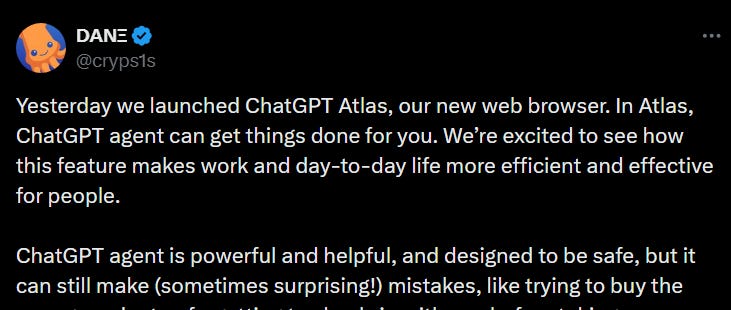
Dane Stuckey, OpenAI’s Chief Information Security Officer, acknowledged on Twitter that prompt injection remains a frontier, unsolved security problem. Hidden malicious instructions embedded in web pages can make AI systems execute them as legitimate commands. You could literally get your bank account drained by scrolling through Reddit.
Enterprise security testing found that traditional browsers stop 47-53% of web vulnerabilities, but Perplexity Comet stopped only 7% and ChatGPT Atlas stopped only 5.8%. That leaves users up to 90% more exposed than with Chrome or Edge. Yet these products continue releasing to millions despite unanimous expert consensus on the danger.
Brave shared an interesting article about unseeable prompt injections.
The productivity benefits are real: users genuinely save hours daily; organisations achieve measurable efficiency gains. However, we’re creating a tragedy of the commons where rational individual adoption produces collectively catastrophic outcomes for information ecosystems.
Final verdict
The AI browser wars represent a genuine inflection point, but not the one companies are advertising. This isn’t about which startup can dethrone Google or whether subscriptions replace advertising. It’s about whether we can build AI-mediated browsing that delivers productivity gains without destroying the economic foundations of the web.
So far, the answer appears to be no. Google maintains monopoly through integration. Challengers struggle with adoption and security. Publishers face existential crisis. Users gain convenience whilst losing privacy, security, and access to quality information sources.
By late 2025, every major player has made their move. The outcome will determine whether the web evolves into sustainable AI-mediated infrastructure or collapses into an economic wasteland incapable of supporting the content we claim to value.
The browser wars have been won. We just haven’t realised yet that everyone lost.
Have you tried any of these AI browsers, or are you sticking with your current setup? Drop your thoughts in the comments. I’m particularly curious whether the privacy concerns outweigh the convenience for you.