Recent articles
Fully solving JSON Schema and JSON-LD interoperability
TL;DR: The same JSON Schema that validates
your data can now declare what that data means. We built a ten-keyword
extension vocabulary (x-jsonld-*) that promotes instances to
JSON-LD (the JSON serialisation of
RDF). Annotate the schemas you already have, and
every payload they validate becomes knowledge-graph-ready. Over the past
decade, everyone from
MuleSoft to
Adobe to
the Italian
government
attempted some version of this bridge, and every attempt fell short of the
same hard part: composition. We solved it, and it ships today in the JSON
Schema
CLI
and in the Sourcemeta One registry.
There is a fair chance JSON-LD lives in your head as
“the schema.org blob you paste into a web page so Google
shows rich
results”.
But JSON-LD is much more than that. It is
one of the credential formats the EU Digital Identity
Wallet accepts, which all 27 member
states must ship by December 2026. It is the foundation of Microsoft’s Digital Twins
Definition
Language.
It is how hundreds of thousands of machine-learning
datasets
describe themselves on Hugging
Face and
Kaggle, how all of EU
law is published, and how
websites talk to AI
agents.
JSON-LD is what JSON looks like when it graduates into a
knowledge
graph.
And yet, from where the JSON Schema world sits,
JSON-LD might as well be on another planet. It does not
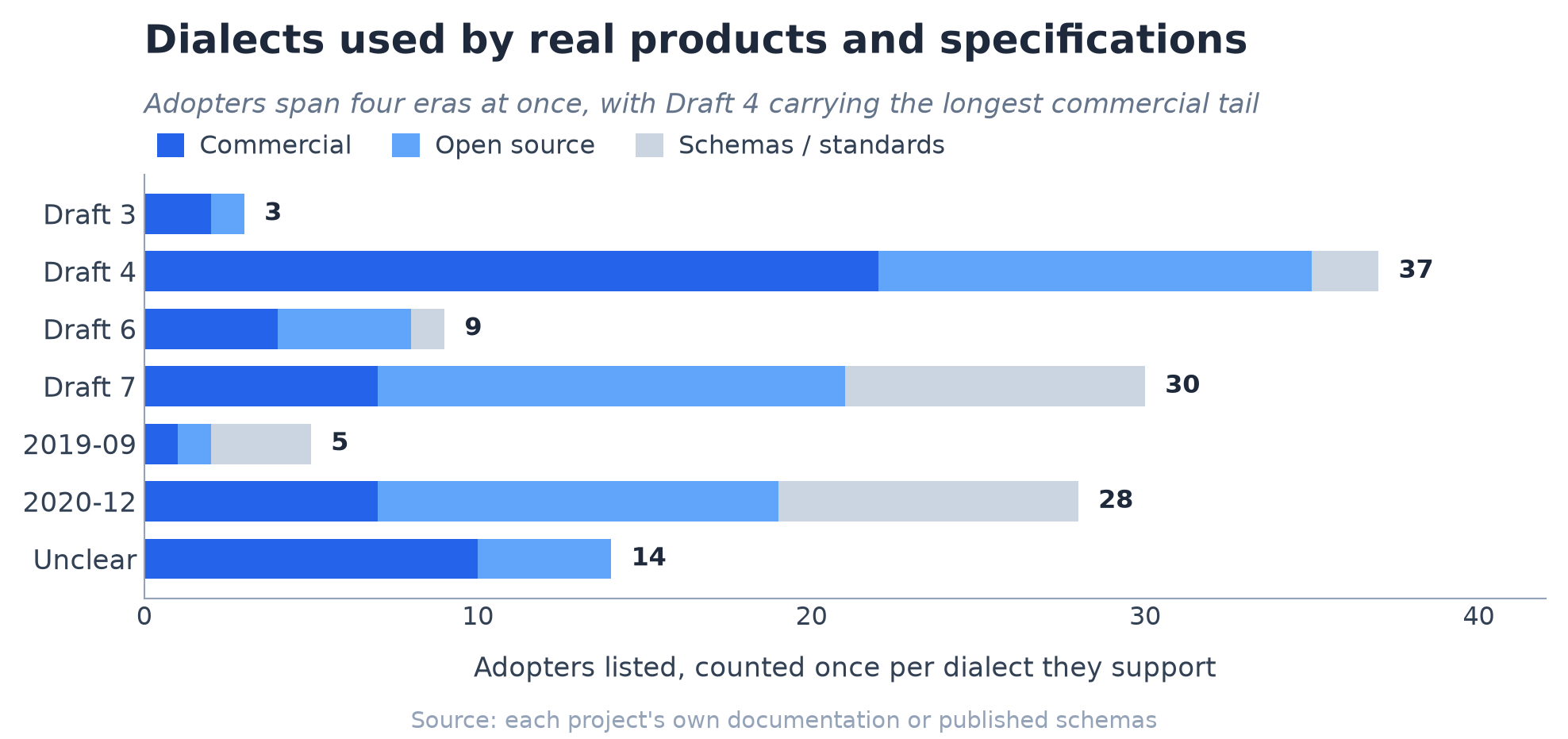
matter which door brought you to JSON Schema: OpenAPI specifications (76% of
the modern ones are majority JSON Schema by
volume),
AsyncAPI message payloads, MCP tool
definitions, W3C
Web of Things Thing
Descriptions, the
IETF’s Semantic Definition
Format for the
Internet of Things, or plain standalone data models of the kind governments
now publish in national
registries. Sooner
or later the same need appears: joining JSON
Schema’s validation strengths with
JSON-LD’s semantic strengths.
The rest of this article covers how the two languages each won their own layer
of the data world, who tried to bridge them over the past decade, where every
attempt fell short, and how we made it work.
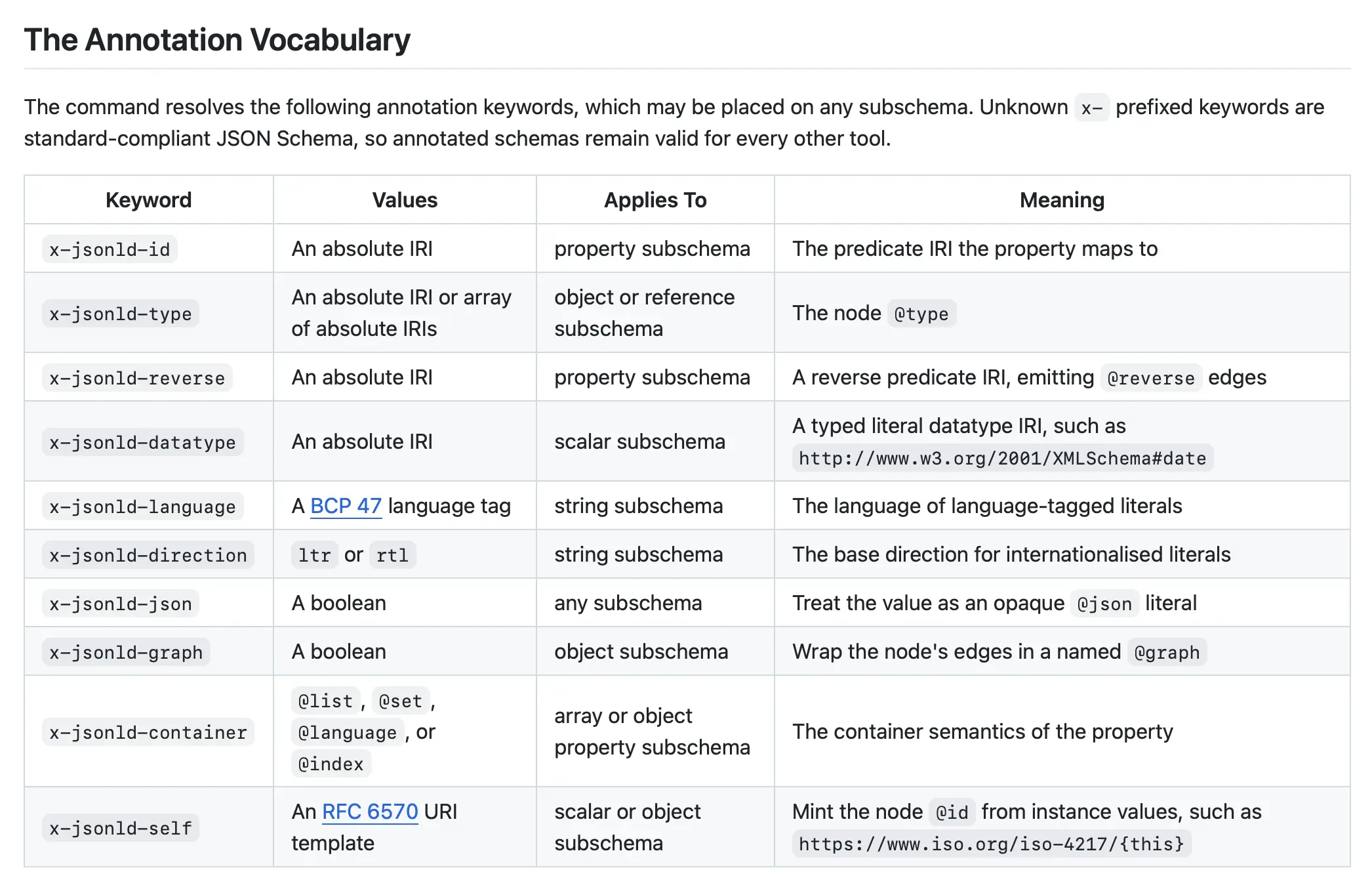
Our JSON-LD extension vocabulary
We built the bridge as a JSON Schema extension
vocabulary: ten annotation keywords under the x-jsonld- prefix, deliberately
continuing the convention introduced by the Italian government’s REST API
Linked Data Keywords IETF
draft.
Because the keywords are plain x- extensions rather than a formal JSON
Schema
vocabulary,
annotated schemas remain valid for every implementation, including the many
with no vocabulary support at all.
Here is a schema that describes a
schema.org/Order whose seller and customer
reuse a single party definition through
$ref, where a party
reuses a shared address, and where a party is a
schema.org/Person or a
schema.org/Organization depending on its
kind.
{
"$schema": "https://json-schema.org/draft/2020-12/schema",
"type": "object",
"x-jsonld-type": "https://schema.org/Order",
"properties": {
"orderNumber": {
"type": "string",
"x-jsonld-id": "https://schema.org/orderNumber"
},
"seller": {
"$ref": "#/$defs/party",
"x-jsonld-id": "https://schema.org/seller"
},
"customer": {
"$ref": "#/$defs/party",
"x-jsonld-id": "https://schema.org/customer"
}
},
"required": [ "orderNumber", "seller", "customer" ],
"$defs": {
"party": {
"type": "object",
"properties": {
"kind": { "enum": [ "person", "organization" ] },
"name": { "type": "string", "x-jsonld-id": "https://schema.org/name" },
"address": {
"$ref": "#/$defs/address",
"x-jsonld-id": "https://schema.org/address"
}
},
"required": [ "kind", "name" ],
"if": { "properties": { "kind": { "const": "person" } } },
"then": { "x-jsonld-type": "https://schema.org/Person" },
"else": { "x-jsonld-type": "https://schema.org/Organization" }
},
"address": {
"type": "object",
"x-jsonld-type": "https://schema.org/PostalAddress",
"properties": {
"country": {
"type": "string",
"x-jsonld-id": "https://schema.org/addressCountry",
"x-jsonld-self": "http://publications.europa.eu/resource/authority/country/{this}"
}
}
}
}
}
And here is an order payload, one company selling to one individual, the kind
that would flow through a commerce API:
{
"orderNumber": "AC-2026-0042",
"seller": {
"kind": "organization",
"name": "ACME GmbH",
"address": { "country": "DEU" }
},
"customer": {
"kind": "person",
"name": "Erika Mustermann",
"address": { "country": "ITA" }
}
}
Now let’s run this through the Sourcemeta JSON Schema
CLI:
$ jsonschema rdf schema.json instance.json
Both parties come out of the same
$ref with different
RDF types, the seller an
Organization and the customer a
Person, each carrying an address typed as a
schema.org/PostalAddress with its country
promoted to the EU country
authority IRI:
[
{
"@type": [ "https://schema.org/Order" ],
"https://schema.org/orderNumber": [ { "@value": "AC-2026-0042" } ],
"https://schema.org/seller": [
{
"@type": [ "https://schema.org/Organization" ],
"https://schema.org/name": [ { "@value": "ACME GmbH" } ],
"https://schema.org/address": [
{
"@type": [ "https://schema.org/PostalAddress" ],
"https://schema.org/addressCountry": [
{ "@id": "http://publications.europa.eu/resource/authority/country/DEU" }
]
}
]
}
],
"https://schema.org/customer": [
{
"@type": [ "https://schema.org/Person" ],
"https://schema.org/name": [ { "@value": "Erika Mustermann" } ],
"https://schema.org/address": [
{
"@type": [ "https://schema.org/PostalAddress" ],
"https://schema.org/addressCountry": [
{ "@id": "http://publications.europa.eu/resource/authority/country/ITA" }
]
}
]
}
]
}
]
The seller and customer were typed differently from the same definition, and
the address mapping, written once, applied to both, because the annotations
compose through $ref
exactly as validation does. One schema. One pass. If the instance is invalid,
no RDF comes out at all. That output is in standard
JSON-LD expanded
form, canonical and
context-free.
If you would rather keep the document looking like the JSON your
consumers already parse, compact it against a context of your choosing. For
example, consider this context.json:
{
"@context": {
"schema": "https://schema.org/",
"orderNumber": "schema:orderNumber",
"seller": "schema:seller",
"customer": "schema:customer",
"name": "schema:name",
"address": "schema:address",
"country": {
"@id": "schema:addressCountry",
"@type": "@id",
"@context": { "@base": "http://publications.europa.eu/resource/authority/country/" }
}
}
}
You can convert to JSON-LD emitting the shape your consumers already know how
to parse, with its semantics embedded, as follows:
$ jsonschema rdf schema.json instance.json --compact context.json
{
"@type": "schema:Order",
"orderNumber": "AC-2026-0042",
"seller": {
"@type": "schema:Organization",
"name": "ACME GmbH",
"address": { "@type": "schema:PostalAddress", "country": "DEU" }
},
"customer": {
"@type": "schema:Person",
"name": "Erika Mustermann",
"address": { "@type": "schema:PostalAddress", "country": "ITA" }
},
"@context": {
"schema": "https://schema.org/",
"orderNumber": "schema:orderNumber",
"seller": "schema:seller",
"customer": "schema:customer",
"name": "schema:name",
"address": "schema:address",
"country": {
"@id": "schema:addressCountry",
"@type": "@id",
"@context": { "@base": "http://publications.europa.eu/resource/authority/country/" }
}
}
}
In other words, the context is your choice of projection. The schema
annotations remain the single source of truth.
JSON-LD and the knowledge graph economy
Look again at what came out of that command. The expanded form is
JSON-LD, which is the JSON serialisation of
RDF, the W3C’s model for
describing anything as a graph of subject-predicate-object (triple) statements.
Build enough of those statements and you have a knowledge graph. The idea is
simple: give every thing (such as a person, a country, a product, etc) one
shared identifier, and record every fact as a link between those identifiers.
Do that, and data scattered across systems, formats, and organisations becomes
a single connected web that anyone, and any machine (including AI), can query
across sources and reason over as a whole. That is the door our example
quietly opened, and it leads somewhere very large.
Almost everything you would call authoritative knowledge is already living in
this way. Wikidata holds 1.65 billion
statements. UniProt, the reference database of
protein knowledge, exposes over 190 billion
triples through what
is widely cited as the largest public
SPARQL endpoint on earth, and the US
National Institutes of Health
publishes its PubChem chemistry database as more than 130 billion triples of
its own. Both are nodes in a life-sciences web that interlinks through the
Linked Open Data cloud and its 1,658 connected
datasets. Governments are wired
the same way: every EU legal act is
RDF behind a public
endpoint, and France’s statistics office, its
national library, and
Europeana’s 50 million cultural objects all publish
in it. Healthcare does the same through HL7
FHIR, which defines an RDF form for the
records it moves between systems. So does big tech: Google, Microsoft,
Facebook, eBay, and IBM each run their
own. And it
is how AI now gets its facts, since a model on its own is a parametric memory
that hallucinates and the fix is to
ground it in a graph, the pattern behind
GraphRAG.
France’s national library publishes its entire catalogue as linked data. Every record, like this one for Victor Hugo, the 19th-century French novelist behind Les Misérables, is a node in a knowledge graph, downloadable as RDF and JSON-LD (highlighted). Source: Bibliothèque nationale de France.
None of them do this for tidiness. They do it because the graph is where data
turns into value. We know that data is a valuable asset, but raw data is worth
only what you can refine it into, and the knowledge graph is the refinery. When
Google launched its Knowledge Graph in
2012 under the
slogan “things, not strings”, search stopped matching text and started
understanding entities. By 2016, Google reported that it held 70 billion facts
and answered roughly a third of its 100 billion monthly
searches straight from
it. The mechanism is
RDF’s shared identifiers. They allow independently
produced data to become joinable, so the graph is worth more than the databases
poured into it, and every entity added compounds the value of the ones already
there. And this compounding now has a price. A data.world
benchmark measured a language model at 16%
accuracy over a raw SQL database and 54% over the same data as a knowledge
graph.
Gartner
finds the organisations with the most mature data foundations achieve up to 65%
greater business outcomes. And the knowledge graph market is projected to grow
from $1.06 billion in 2024 to $6.93 billion by
2030.
Bridging JSON Schema and JSON-LD
Zooming out, structure and meaning are things you constantly need at once, and
today they live in different languages. JSON Schema
owns structure, whether the container is an OpenAPI
specification,
an AI tool
definition, or a
national data
registry. Then,
JSON-LD owns meaning, as the last section showed. The
catch is that a single JSON document routinely needs both at once, and inside
that document the two languages cannot see each other. A JSON
Schema cannot say that family_name means
schema.org/familyName, and a
JSON-LD context cannot say that family_name is a
required string conditional on the presence of first_name.
A real Thing Description from the W3C Web of Things standard (Example 2). Most of it is JSON Schema (properties, type), sprinkled with JSON-LD to add meaning (@context, and @type: saref:LightSwitch pointing at a semantic vocabulary). The two languages sit in one document but do not integrate: the schema keywords cannot see the semantic ones, or the other way round. Source: W3C WoT Thing Description 1.1, Example 2.
Now picture closing that gap. For example, the EU wallet
schema
already validates every credential a wallet API handles. Put the meaning inside
it, and that one file also emits the knowledge graph. No second artefact to
author, review, version, or keep in sync. The meaning is defined exactly once
next to its validation constraints, and every payload pours into the graph for
free. In other words, intermixing JSON Schema and JSON-LD gives the
RDF world a powerful validation story, and it gives
the JSON Schema world a significant upgrade in
semantics and knowledge graph integration.
The reason to state the prize so plainly is that the alternative, two artefacts
kept in sync by hand, is everywhere, and it is a heavy tax. The Common
Workflow Language project named it in 2015, when it
abandoned existing schema languages because “none understand linked
data”:
“one must maintain separate JSON schema, JSON-LD context, RDF schema, and
human documentation, despite significant overlap of content and obvious
need for these documents to stay synchronized.”
A decade later that tax is institutional:
W3C Verifiable Credentials
2.0: the standard beneath the EU
wallet, carries a JSON-LD @context for meaning and a
separate credentialSchema for
structure in every single credential. It takes a whole
appendix
to hold the two apart, a credentialSchema defining “the contents and
structure of a set of claims” while a @context is “best used only for
conveying the semantics and term definitions of the data”, and it takes the
two “used in combination” before “both producers and consumers can be more
confident about the expected contents and data types”. Nothing links them,
so the companion specification can only advise the
author:
“It is advised to associate all properties that have a semantic mapping with
a property in a credential schema.” That advice is the entire binding, and
implementations show what it is worth.
Credo, the OpenWallet
Foundation’s wallet framework, ships the whole JSON-LD stack down to RDF
canonicalisation and nineteen hand-authored context
documents,
while credentialSchema is modelled as an id and a
type
that it never fetches or evaluates.
WE BUILD: one of the
EU-co-funded Large Scale Pilots now building that wallet, keeps its credential
JSON
Schemas
in one repository owned by one working group, while a second
group
hand-maintains the SKOS terminology, OWL vocabulary, and JSON-LD
context
in another. Nothing in the schemas points at the vocabulary, so the mapping
between them survives in a third artefact: a Markdown table in the
human-readable
rulebook,
under a column headed “Semantic Reference”, recording that family_name
means w3id.org/ebwv#familyName while
the schema next
door
can only call it a string.
GS1’s EPCIS: the global supply-chain
standard, ships EPCIS-JSON-Schema.json and epcis-context.jsonld side by
side in one repository.
FIWARE’s Smart Data
Models: keep a schema
for every entry in the catalogue, paired with a JSON-LD context.
Gaia-X:
Europe’s flagship cloud-federation project, pairs a
JSON-LD self-description with a separate SHACL shape
for every participant.
Beckn: the open-commerce protocol from the architects
of India’s Aadhaar and UPI, and the backbone of India’s government-backed
ONDC network and its 200 million
transactions,
goes further still: it normatively
requires
every one of the 300+ concepts in its schema
repository to ship four artefacts side by
side, an OpenAPI envelope, a JSON Schema, a JSON-LD context, and an RDF
vocabulary.
Adobe:
specified its Experience Data Model in both grammars at once, then had to
bolt on a “Compatibility
Mode”
that flattens the JSON-LD namespacing out for its own
platform.
And the request to fix this at the source has sat open on the JSON Schema
issue tracker since April
2017.
Everyone pays the tax. Nobody has figured out how to fully remove it.
The double edge of expressiveness
So now you might wonder, with the prize this clear and the demand this old, why
has this stayed unsolved?
Because the obvious fix, embed the @context in the schema, only works on the
easy case. That is what the Italian government’s REST API Linked Data
Keywords IETF
draft does.
This is often enough for standalone simple schemas. But in practice, schemas
are very often not standalone, and very often not simple. At scale, models of
rich cross-referenced schemas are extremely common for schema reusability and
data governance purposes.
What makes it hard to solve this for complex schemas is the very thing JSON
Schema is best at. JSON Schema is a remarkably expressive
language. The meaning of a
property can be split across files with
$ref, combined through
logical applicators like
anyOf, or made
to depend on the data in complex ways through
if/then/else,
and other similar keywords. With
$dynamicRef a
schema even resolves a reference differently depending on the context it is
evaluated in, so there is no static document to analyse ahead of time and the
meaning is decided during evaluation, against the data. This is why validating
Modern JSON Schema is PSPACE-complete. In
comparison, a JSON-LD context has none of this. It is a
flat table of names, and it cannot follow a schema whose properties change
meaning by position or by data. It could never, for instance, produce the order
from our example, where the very same party definition became a
Person or an
Organization depending on a property in
the payload.
If you take this as a criticism, that JSON Schema is simply too complicated, you
have it backwards. The complexity is not over-engineering. It is the language
earning its keep. Most people who resent JSON Schema for its constraint-driven
complexity have simply not yet met the problems that demand such complexity.
And when they do, they are thankful that the expressiveness exists.
A decade of attempts
But all of that expressiveness is what a bridge to
JSON-LD has to carry across, and it is why no one had
built one that holds. Everyone who tried faced the same fork: strip the
expressiveness away so the mapping to RDF turns
easy, or keep it and try to pay the price. A decade of attempts went both ways,
and came up short in both cases.
The strippers made the problem vanish by not having it. The Common Workflow
Language’s Schema Salad
rebuilt the schema language on top of Avro, while
LinkML and the
automotive industry’s
Catena-X
generate JSON Schema from a separate RDF model you must author first. This
path has real public-sector uptake: Switzerland’s
eCH e-government standards group authors the data
standards for the Swiss political system in LinkML precisely so that JSON
Schema and OWL can be regenerated side by side on every
commit, further proof
of how badly the two worlds need each other. A simpler
language projects into RDF more cleanly, but simplicity is the price: you
surrender the conditionals and constraints that are the reason to reach for
JSON Schema at all, and that no other mainstream schema language
matches. “Those languages define
structure”, as Charlie Holland puts it, while “JSON Schema defines structure
and constraints”.
The embracers kept JSON Schema and hit the wall head-on. The Open Geospatial
Consortium’s tooling assembles
the context from the schema at build time, and its own source carries a
thirty-line comment about “binding
bubbling”,
where a referenced schema’s mappings silently overwrite the parent’s. India’s
Beckn walks the same path today: its generator
scripts scrape property
names out of a schema and map each one to a flat beckn: IRI, blind to
$ref (in one typical
concept,
four of the five terms in the published context sit behind references the
generator cannot see), which is why the repository also carries scripts named
schema_parity_audit.py and identify-and-fix-missing-context-vocab.py to
patch the artefacts back into agreement.
The credential world built the same thing and stopped in the same place:
schemasToContext,
from Transmute, which holds an editor’s seat on
the VC JSON Schema specification,
reads $linkedData annotations off a schema’s properties and flattens them
into a context, and that design is the ecosystem’s convention: Hedera’s
Guardian vendors the file itself, and
the W3C CCG traceability
vocabulary
builds its context from its own copy of the same design. Each reads a single
level of properties and resolves no
$ref, leaving the caller
to hand over every subschema up front, and Transmute’s source marks where it
stops with a commented-out stub: // Need to handle anyOf and oneOf better....
Others went sideways:
MuleSoft validated existing
JSON-LD with JSON Schema before being archived at “pre-alpha”, and
RML and the AI-assisted
MetaConfigurator add a third artefact to
drift from the other two. Even
Adobe and
Autodesk
took runs at this JSON Schema and JSON-LD interoperability problem.
How OGC’s tooling builds the JSON-LD context: a static second pass walks the compiled schema tree through every $ref, allOf, anyOf, and oneOf, collecting mappings into one flat @context. In their own words, “the assembly is really schema traversal”. It is re-creating evaluation at build time, and that is why it cannot follow a schema whose meaning depends on the data: with no instance to run against, a static walk has no way to know which if/then/else branch or $dynamicRef target applies. Source: OGC Building Blocks, semantic uplift documentation.
Five ways to fall short
For all their differences, the attempts share the same gaps. None couples
validation and emission in one pass. None reproduces the composition inside the
schema itself, and the closest do it as a lossy build step. None handles
conditional meaning, and none mints identifiers from the data.
The most serious attempt is telling in where it came from. Italy runs both
worlds at national scale: a network of RDF
ontologies
that models its public administration as a knowledge graph, and a national
platform of services
described in OpenAPI and JSON Schema. It felt the collision before anyone else
and set out to close it.
Italy’s Core Person Vocabulary, one of the government RDF ontologies in its national semantic catalogue. It defines the concept of a Person, the same concept our example mapped, and is authored by the national statistics office (ISTAT) and digital agency (AgID). Running a whole network of these alongside a national JSON Schema API platform is why Italy hit the collision first. Source: schema.gov.it, Catalogo Nazionale della Semantica dei Dati.
Even so, Roberto Polli’s REST API Linked Data Keywords IETF proposal for this
problem
(now at its ninth revision) admits the limit:
“Automatic composability is not an explicit goal of this specification
because of its complexity. […] These issues can be tackled in future
versions of this specifications.”
Against what a working solution actually needs, the pattern is stark:
Attempt
Standard JSON Schema
Single evaluation pass
Composition
Conditional meaning
IRI minting
Polli draft (embed context)
yes
no
no
no
no
OGC (generate context)
yes
no
partial
no
no
Transmute, W3C CCG traceability (generate context)
yes
no
no
no
no
Schema Salad (new language)
no
no
no
no
partial
LinkML / Catena-X, automotive (separate model)
no
no
no
no
no
MuleSoft, Salesforce (validate JSON-LD)
partial
no
$ref only
no
no
RML / MetaConfigurator (mapping)
no
no
no
no
yes
Adobe XDM (maintain both by hand)
partial
no
no
no
no
Beckn / ONDC, India’s DPI (four parallel artefacts)
yes
no
no
no
no
Sourcemeta
yes
yes
yes
yes
yes
After a decade of attempts, from academic prototypes to Adobe, Salesforce, and
the automotive industry, the wall was still standing. That is where we come in.
How we cracked it
So how do you carry all of that expressiveness into
RDF? Every prior attempt treated the schema as a
document to be parsed and mapped. We treat it as a program to be run.
Sourcemeta maintains Blaze, a
high-performance C++ JSON Schema
validator that compiles a
schema into a low-level program and executes it against an instance. Around
that execution we built a full custom JSON-LD engine
that rides along, producing the RDF in lockstep with
the validation itself. So the meaning is built during evaluation, as part of
the process, and the dynamism that defeated every static approach is carried by
the run instead of fought.
The result is full support for every construct JSON Schema has, in one file and
one pass, with no second artefact to drift. The order from our initial example,
which no prior tool could produce due to its use of some advanced keywords, is
not a special case. It is simply what the engine does. If a schema can validate
your data, it can now describe what that data means.
Use it today
The vocabulary is ten keywords under the x-jsonld- prefix, and the CLI
documentation
is for now the full reference (we are aiming for a proper spec around it soon).
You can use it today from the command line by pointing jsonschema rdf at
a schema and an instance, and get JSON-LD back, exactly
as we did above.
The ten x-jsonld-* keywords of the vocabulary, from the JSON Schema CLI documentation. Each annotates a subschema to map it into JSON-LD: x-jsonld-id for the predicate IRI a property maps to, x-jsonld-type for the node @type, x-jsonld-self to mint a node @id from instance values, and so on. Because they are plain x- extension keywords, annotated schemas stay valid for every other JSON Schema tool. Source: JSON Schema CLI RDF documentation
But the command line is the small version of the idea. The same engine ships in
Sourcemeta One, our flagship schema
registry, where it runs over HTTP. Every schema the registry governs can turn
an instance into JSON-LD on request, making meaning an
API call (available through MCP too).
With this, you can send your data to the registry and know what that data
means, resolved against the schemas your organisation has already agreed on, so
the transformation happens once, at the infrastructure layer, instead of being
rebuilt inside every service.
The idea is for schemas, their governance, and now their meaning to finally
live in one place. So if you have data and you want to know what it means, you
ask Sourcemeta One.
Juan Cruz Viotti3 months ago
Every G7 government already runs on JSON Schema
TL;DR: Every G7 government (United States, United Kingdom, France, Germany,
Italy, Japan, and Canada) runs its digital public infrastructure on JSON
Schema. So do nine out of ten of the OECD’s top digital governments in
the 2025 ranking. France and Italy already operate national registries that
support JSON Schema, and the Netherlands is building one. From December 2026,
every EU country will run mandatory digital identity infrastructure on JSON
Schema,
under eIDAS 2.0.
The public sector runs on APIs
In 2015, TechCrunch
declared
that APIs fuel the software that’s eating the world. And as you probably
know, the public sector is no exception. For example, the UK’s API
Catalogue currently federates 1,791
API
entries
across UK public-sector publishers. The Netherlands’ national API
registry currently lists 302 APIs. The
community-run bund.dev portal currently indexes more than
60 German federal APIs. Italy publishes its API
catalogue, which currently carries 14,672
e-services across 9,398 adhering public and private entities.
Top PDND e-services by number of enabled entities, filtered to central
public administrations as providers. PagoPA’s SEND digital-notifications
service leads with around 7,000 enabled entities, followed by four ANNCSU
address-registry services from Agenzia delle Entrate (around 5,032, 3,070,
2,509, and lower), then Ministero dell’Interno’s residence, family, and
citizenship verification services, and AgID’s INAD digital-domicile registry.
Source: PDND interop dashboard
In terms of scale, Denmark’s Central Data Distribution
Platform API “processes more than 70 million calls
daily, and handles a daily data volume of 2.5
terabytes”.
The United States data API is “used by 25 agencies
for over 450 APIs”. South Korea’s data
API offers “87,000 public data sets and
11,000 open
APIs”.
The UK Government Digital Service publishes an API exposing more than 8.4
million UK legal documents. Beyond datasets,
the GOV.UK Notify API sent 12
billion messages by February
2026
on behalf of more than 11,000 public-sector services. Estonia’s
X-Road API exchange links “more than 1,000
inter-connected databases covering some 1,700 services” and answers “more than
50 million enquiries every
month”.
In the US, the Law Enforcement Information eXchange (LInX) connects “thousands
of law enforcement agencies” sharing “1.8 billion records amongst each
other”.
The AI wave is only reinforcing the fact that the public sector runs on APIs.
As Kin Lane puts it, “MCP is an
API”, and adoption
within the public sector has already started. For example, consider the US
GovInfo MCP, the US
Census Bureau
MCP, France’s
data.gouv.fr
MCP,
Japan’s Digital Agency
jgrants-mcp-server, and
the UK Government Digital Service’s Parliament
MCP.
OpenAPI becomes national policy
Like the rest of the industry, the public sector has also settled on
OpenAPI as the format for describing APIs in a
machine-human readable way.
Many governments have explicitly written “use OpenAPI” into national API
standards documents. For example, Canada mandates OpenAPI for all federal
RESTful
APIs.
The United Kingdom’s Open Standards Board states that “Describing RESTful
APIs with OpenAPI 3 is recommended by the government Open Standards
Board”.
Italy goes a step further: every API published on the National Digital Data
Platform (PDND) is validated by “running the OAS Checker with the Italian
Guidelines Full profile and obtaining 0
errors”. Japan’s Digital
Agency states that “Government agencies are expected to adopt OAS […] to
make development more
efficient”.
The following table offers a more exhaustive summary:
Country
Mandate or standard
Source
🇨🇦 Canada
Federal RESTful API mandate
Standards on APIs
🇬🇧 United Kingdom
Open Standards Board recommendation, GDS API technical and data standards guidance
gov.uk
🇫🇷 France
OAS required for national API registry submissions
SEMIC 2024
🇮🇹 Italy
Zero-error PDND validation gate (AgID)
api-oas-checker-rules
🇯🇵 Japan
Digital Agency DS-464-2 (Sept 2024)
DS-464-2
🇦🇺 Australia
NAPIDS MUST
api.gov.au, source repo, architecture standard
🇳🇿 New Zealand
Digital.govt.nz RECOMMEND, Te Whatu Ora HISO 10108 MUST, Draft NZ API Standard v1.0 (Nov 2025)
API Guidelines, HISO 10108
🇫🇮 Finland
OpenAPI 3 required at Suomi.fi DEL
Suomi.fi DEL
🇪🇪 Estonia
RIHA describes machine interfaces in OpenAPI
RIHA-Index, Tehnoloogiavalikud
🇸🇬 Singapore
APEX Cloud + GovTech OpenAPI Linter as a service, GovTech recommends modern standards such as OpenAPI
apex.gov.sg
🇪🇸 Spain
2025 Practical Guide for publishing Open Data with APIs
datos.gob.es
🇨🇭 Switzerland
Federal guidelines MUST
swiss/api-guidelines
🇧🇪 Belgium
Belgif Federal Interoperability Framework, OpenAPI 3.0
Belgif
🇳🇱 Netherlands
API Design Rules on Forum Standaardisatie’s comply-or-explain mandatory list since 2019
logius-standaarden
Even beyond mandates, the European Commission found that “OAS was used by
almost half of all reviewed API
portals”
across the European public-sector portals it surveyed.
The picture extends across borders too. X-Road, an
open-source data-exchange platform that uses OpenAPI to describe its REST
services, was jointly founded by Estonia, Finland, and Iceland through the
Nordic Institute for Interoperability Solutions
(NIIS). Estonia operates it domestically as
X-tee
and Finland as the Suomi.fi data exchange
layer. X-Road has
been adopted as the national data exchange in Cambodia (as
CamDX),
Japan (via PlanetCross at
Nichigas),
El Salvador,
and Kyrgyzstan (as
Tunduk).
Both OpenAPI and MCP are all about JSON Schema
We have established that public-sector API adoption runs through OpenAPI and
MCP. What is easy to miss, but more consequential, is that both share the same
substrate: JSON Schema.
More precisely, OpenAPI builds on top of JSON Schema. While OpenAPI offers
syntax to declare endpoints and top-level metadata, what you use to actually
describe request bodies, responses, headers, and query parameters is JSON
Schema embedded within OpenAPI. In fact, we previously found that “in 76% of
modern OpenAPI specs, JSON Schema dominates the specification”. So when governments work on
OpenAPI at the scale we have just seen, they are, in the large majority,
working on JSON Schema. A government OpenAPI mandate is, on closer reading, a
JSON Schema mandate.
From our study of public OpenAPI specifications across industry, the JSON
Schema content embedded within an OpenAPI document often dominates the file.
For well-known production APIs such as Mailchimp, the embedded JSON Schema can
exceed 90% of the contents of the file. From In 76% of modern OpenAPI specs,
JSON Schema dominates the specification
The same principle holds for MCP. The official
specification is
built on JSON Schema 2020-12, and
every MCP tool exposes its inputs as a JSON Schema object. The pattern reaches well beyond MCP. As we previously argued, “the only
schema language AI speaks is JSON Schema”. Every major LLM provider’s
tool-calling interface, every AI product, and every agent framework has
converged on the same substrate.
As Charlie Holland puts it, JSON Schema has become “the interface definition
language for AI tools”.
A government MCP server is, on closer reading, a JSON Schema deployment.
We are not the only ones making this observation. When Kin Lane inventoried
the API specifications stewarded by the Linux
Foundation, he concluded that JSON Schema
is the connective tissue across the whole
catalogue:
OpenAPI, AsyncAPI, CloudEvents, and others all build on it, and “JSON Schema
is the substrate the other specifications are built on top of”.
Taken together, public-sector use of OpenAPI and MCP rank among the largest
JSON Schema deployments in the world.
The rise of national schema registries
If OpenAPI and MCP are both about JSON Schema, it is no surprise that
governments are starting to treat schemas as their own layer, separable from
any particular API specification and reusable across OpenAPI, MCP, and
potentially other future consumers. They operate their schemas as standalone
national assets.
France runs schema.data.gouv.fr as a national
multi-format schema registry. Among its JSON Schemas, the public procurement
format maintained by the
Ministry of Economy and Finance is used by every French state entity to publish
all public contracts above €40,000. The data inclusion
schema backs the
national platform aggregating
social-services data across France Travail, CAF, and local social services. And
the cycling facilities
format
feeds the Base Nationale des Aménagements Cyclables, France’s mandatory
contribution to the EU Regulation 2017/1926 multimodal-travel National Access
Point at transport.data.gouv.fr.
The schema.data.gouv.fr
registry filtered to JSON Schema entries. Visible cards include the
cycling-facilities format, the essential data of French public contracts, and
on-street parking footprints
Italy runs schema.gov.it providing JSON Schemas
packaged as OpenAPI components, with each schema’s properties cross-referenced
to Italian government RDF ontologies. For example, the
INPS National Data Catalog publishes the JSON
Schemas backing core social-security workflows: NASPI unemployment-benefit
applications,
pension credit purchase
requests,
and the A1 certificate for cross-border workers under EU Regulation
883/2004.
Italy is also pioneering the IETF draft REST API Linked Data
Keywords,
which defines two new JSON Schema keywords for embedding JSON-LD context
directly into OpenAPI and JSON Schema documents.
The schema.gov.it
national semantic catalogue, jointly operated by the Dipartimento per la
Trasformazione Digitale and Istat, filtered to entries of type
Schema
The Netherlands announced in April
2026 that they are
building schemas.overheid.nl, a central register for reusable JSON Schemas
and OpenAPI components.
The registry pattern is not confined to the G7 or the OECD. India, whose
Aadhaar and UPI made it the global reference case for digital public
infrastructure, initiated ONDC, the open
e-commerce network incorporated by the government in December 2021, which
crossed 200 million transactions in March
2025.
ONDC runs on the Beckn protocol, designed by the
architects of Aadhaar and UPI themselves, and the Beckn ecosystem operates
its own schema registry of over 600 schema types,
offered “as a public infrastructure to enable interoperable value-exchange
flows”, with each concept published as an OpenAPI
3.1 component alongside its JSON Schema
2020-12 document. The same
protocol is carrying the model beyond India: the ITU’s GovStack
e-marketplace building
block was “adapted
from Beckn protocol APIs and
schema”, and
Beckn-based networks are live at national scale in Gambia and
Nepal.
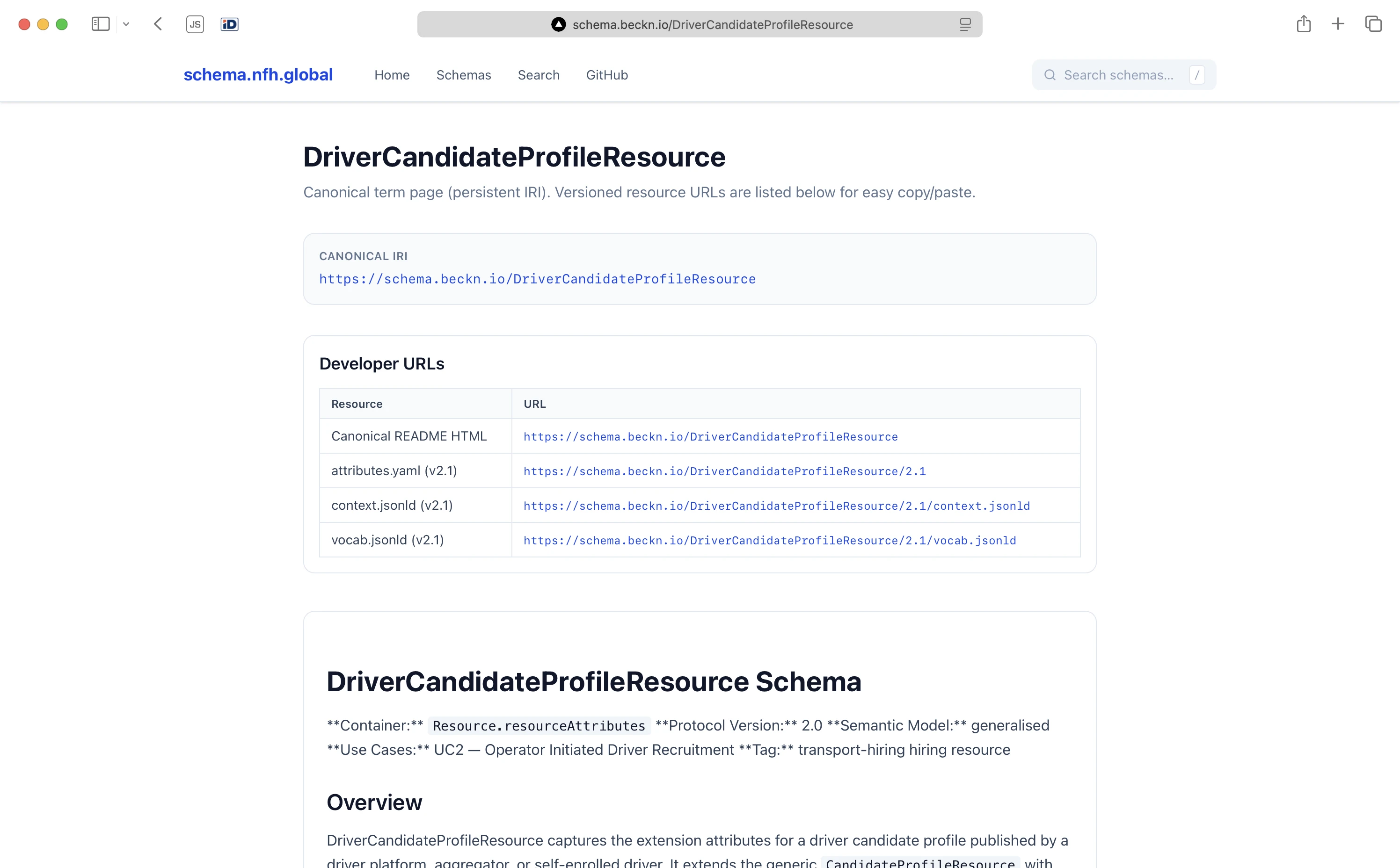
The Beckn schema registry entry for
DriverCandidateProfileResource,
a driver recruitment concept from Beckn’s transport-hiring domain. Every
concept gets a persistent canonical IRI plus versioned developer URLs for
each of its faces: the OpenAPI document (attributes.yaml), the JSON-LD
context, and the RDF vocabulary. Source:
schema.beckn.io
The rise of national schema collections
One tier down, individual agencies and research bodies operate their own
reusable pure JSON Schema collections, often spanning entire scientific or
regulatory domains.
NASA uses JSON Schema across multiple missions and platforms. It publishes
JSON Schemas for the General
Coordinates Network alert format. When LIGO detects a
gravitational wave or Swift detects a gamma-ray burst, alerts in this format go
out within seconds so observatories around the world can slew toward the source
while it is still visible. NASA also maintains the Common Metadata
Repository (CMR), which
defines the Unified Metadata Model in JSON Schema and underpins the entire
EOSDIS Earth-science catalogue. Any
researcher querying NASA Earthdata for satellite imagery, climate datasets, or
atmospheric measurements hits records validated against this model.
The NASA General Coordinates Network Schema
Browser for v7.0.0,
showing mission-specific JSON Schema folders for BOOM, BurstCube, CHIME,
Einstein Probe, Fermi, Glowbug, HEASARC, IceCube, KM3NeT, and
others
NIST publishes OSCAL,
the Open Security Controls Assessment Language, as the JSON-Schema-backed
control language behind
NIST 800-53, NIST
800-171, NIST
800-218, and CSF
v2.0. Cloud providers seeking FedRAMP
authorization, defense contractors handling
Controlled Unclassified Information, and any
organisation aligning with the US Cybersecurity Framework can now express their
entire compliance posture as JSON validated against OSCAL.
The US National Cancer Institute (part of
NIH) publishes the GDC Data
Dictionary, 89 JSON Schemas defining
every entity in the Genomic Data Commons, the
federal cancer-genomics platform pooling harmonised tumour data from across NCI
programmes. Every biospecimen, patient case, sequencing aliquot, mutation call,
and clinical record submitted to the GDC has to validate against one of these
schemas.
The GDC pathology-report
schema,
a JSON Schema defining the structure of pathology-report records
submitted to the Genomic Data Commons
The UK Atomic Energy Authority publishes fusion-research metadata
schemas in JSON Schema
2020-12, covering dataset,
experiment, instrument, sample, and equipment records, plus dedicated schemas
for the
HIVE
and MRF
facilities. These describe data across UKAEA’s fusion programme, including the
JET tokamak,
MAST-U, and the upcoming
STEP prototype fusion power plant targeting grid
connection in the 2040s.
The UK government uses JSON Schema across multiple departments. The Government
Digital Service describes every content type published on
GOV.UK as a JSON Schema through the publishing-api
content
schemas,
50+ formats covering case studies, consultations, detailed guides, document
collections, fatality notices, and statistics, with every page validated
against a JSON Schema before publishing. The Home Office maintains several JSON
Schema repositories across its operational services, including
booktravel_schema, which
defines the contract between the Home Office’s Book Travel service and
third-party escort and travel providers handling immigration removals. The
Driver and Vehicle Licensing Agency (DVLA) has publicly described how it has
“invested in tooling and processes that make heavy use of JSON
Schema”,
using it to describe its data models, generate human-friendly documentation,
validate data, and code-generate Java and TypeScript representations of those
models.
JSON Schema across jurisdictions
JSON Schema does not stop at national borders. When governments coordinate
across jurisdictions and need to write down the shape of the data they
exchange, the format they reach for is, increasingly, JSON Schema.
The most consequential example is the European Digital Identity (EUDI)
Wallet, the flagship
digital-identity initiative under eIDAS
2.0, mandatory across all 27 EU Member
States by December 2026. Its reference data model is published by the EU Wallet
Consortium (EWC) as 14 versioned JSON
Schemas
covering the EU company certificate, IBAN attestation, signatory rights,
legal-person identification, ferry boarding pass, ultimate beneficial owners,
payment wallet, payment-data confirmation, personal contact details, student
ID, vReceipts, person identification data, photo ID, and ID-proofing ETSI
461.
The upstream W3C Verifiable Credentials Data Model
2.0, on which every national EUDI
Wallet implementation depends, defines its credentialSchema property with
JsonSchema as a type.
The EWC consortium’s Legal Person Identification Data
schema,
one of the 14 JSON Schemas (2020-12) underpinning the EUDI Wallet reference
data model
The pattern extends beyond the EU itself. Switzerland is not a member state
and is not bound by eIDAS 2.0, yet its national e-ID, approved by referendum
in September 2025, independently landed on the same substrate. The Swiss
Confederation’s swiyu wallet validates every
credential type-metadata schema against the official JSON Schema 2020-12
meta-schema,
which it ships embedded in the app, and the DID
resolver of its trust
infrastructure validates DID log entries against dedicated “e-ID-conform”
JSON Schemas
(2020-12).
In the United States,
NIEM (the National Information Exchange Model)
plays an analogous role.
NIEM 6.0 and the NIEMOpen Naming and Design Rules 6.0 were approved as
OASIS Standards on 9 December 2025.
The model harmonises “the 20,000+ data elements” used across
US-government data exchanges (per the
Book of NIEM 2025),
with
JSON Schema as its bindings vocabulary
for JSON-encoded payloads.
NIEM is used by the FBI, the Department of Defense, all 50 US states,
and Employment and Social Development Canada (ESDC).
Additionally, several intergovernmental research bodies publish their own JSON
Schema data models, each spanning many member states. The World Meteorological
Organization, a United Nations
agency with 193 member states and territories, publishes
WCMP2 (Core
Metadata Profile 2 v2.1.0) as the JSON Schema for weather and climate metadata,
with the UK Met Office among its downstream consumers.
The WMO schema repository at schemas.wmo.int,
served as a static directory listing of versioned schema collections including
IWXXM, METCE, WaterML, WCMP, WMDR, and others. Source schemas are developed at
github.com/wmo-im
The European
Organization for Nuclear Research (CERN), an
intergovernmental body with 25 member states, runs its Open Data
portal on
JSON-Schema-validated records. The European Bioinformatics Institute
(EMBL-EBI), the intergovernmental molecular-biology
lab spanning 29 European member states, maintains a versioned JSON Schema
store for biological
samples.
The audit: every G7, and nine of the OECD top ten
Across the previous sections, we have seen many governments using JSON Schema
in three ways: as standalone schema collections, inside OpenAPI specifications,
and inside MCP servers. Returning to the article’s premise, every
G7 member has at least one piece of JSON
Schema infrastructure on the public record:
Country
Evidence
🇺🇸 United States
api.data.gov, Code.gov metadata schema (itself a JSON Schema), NASA General Coordinates Network schemas, NASA CMR/UMM, NIST OSCAL, NCI GDC Data Dictionary, GovInfo MCP, US Census Bureau MCP, NIEM 6.0 OASIS standard with JSON Schema bindings
🇬🇧 United Kingdom
UK API Catalogue, GOV.UK Notify, Open Standards Board OpenAPI 3 recommendation, GOV.UK content schemas, UKAEA fusion-research schemas, UK Home Office booktravel_schema, DVLA tooling and processes that “make heavy use of JSON Schema”, UK GDS i.AI Parliament MCP and Lex API
🇫🇷 France
schema.data.gouv.fr national multi-format schema registry, data.gouv.fr MCP, #1 on the OECD OURdata 2025 index
🇩🇪 Germany
bundesAPI and bund.dev community-curated catalogue documenting 60+ German federal APIs in OpenAPI. On the official side, gematik (the national health-IT body majority-owned by the Federal Ministry of Health) publishes OpenAPI specs for the e-prescription, electronic patient record, and other national health interfaces
🇮🇹 Italy
api.gov.it PDND catalogue (14,672 e-services across 9,398 entities), schema.gov.it national semantic catalogue (JSON Schemas packaged as OpenAPI components), AgID OAS Checker zero-error validation gate
🇯🇵 Japan
Digital Agency DS-464-2 names OAS, jgrants-mcp-server, genai-ai-api government generative AI app platform, one of the four fastest-rising scorers in OECD DGI 2025
🇨🇦 Canada
Government of Canada Standards on APIs federal OpenAPI mandate (in production, for example at api.weather.gc.ca/openapi), Employment and Social Development Canada adoption of NIEM
The OECD Digital Government Index
2025
top ten extends the same pattern beyond the UK (4th) and France (9th). Australia (2nd) mandates OpenAPI through
NAPIDS and auto-extracts JSON Schemas from OpenAPI for
the Consumer Data
Right. Portugal
(3rd) publishes federal OpenAPI specs through
amagovpt, for example
doc-SAFE. Norway (5th) ships OpenAPI
through Altinn
Dialogporten.
Estonia (6th) describes its
X-tee
services in OpenAPI and catalogues them at RIHA.
Ireland (7th) ships the OGCIO MessagingIE OpenAPI
spec.
Denmark (8th) publishes the Danish Health Data Authority NCP
API
in OpenAPI alongside Datafordeleren. And Chile
(10th) operates Mercado Público on the
JSON-Schema-based Open Contracting Data
Standard.
The single holdout is Korea (1st), where no public OpenAPI or JSON Schema
evidence was found despite the country topping the OECD index.
Beyond the OECD top 10 digital governments, the pattern continues.
Switzerland, whose federal API guidelines already mandate
OpenAPI, is now developing the
e-government standards for its political system, covering parliamentary
operations, political actors, and public consultations (eCH-0293 through
eCH-0297), schema-first on the Federal Chancellery’s GitHub
organisation. The
eCH standards group’s stated principle is that “the
data schemata are the primary
artifacts”:
every commit regenerates the JSON Schemas, published under government
identifiers such as
https://ch.paf.link/schema/operations,
alongside RDF artifacts derived from the same sources. Sweden
coordinates the EWC
consortium
behind the EUDI Wallet’s JSON Schemas, and
Statistics Sweden ships its open-source
Balsam research platform with the
OpenAPI generator.
Slovakia’s slovak-egov organisation
publishes Swagger and OpenAPI specs across its national open-data
catalogue and the EU’s Once-Only Technical System pilot, alongside
national JSON Schemas for the Slovak DCAT-AP
profile. Lithuania’s
ivpk maintains national
API specifications and a
universal API in OpenAPI. Israel’s
Ministry of Health and Colombia’s
Alta Consejería TIC publish
OpenAPI specifications across their respective public-sector
portfolios.
The Slovak DCAT-AP catalogue JSON
Schema,
JSON Schema 2020-12, defining the Slovak national open-data catalogue
profile
JSON Schema is now national infrastructure
Across this article, we have seen that the G7, nine out of ten of the OECD’s
top digital governments, and many others, all make use of JSON Schema.
Sometimes directly, through national schema registries and cross-government
data models. Sometimes indirectly, through OpenAPI specifications and MCP APIs.
And this is no longer always a choice. For example, eIDAS
2.0
makes JSON Schema an EU-wide regulatory mandate.
Luke Keller, chief innovation officer at the US Census Bureau, told
FedScoop:
"[MCP is] not the answer. It’s one of many answers." He is right. In 2026,
those answers are OpenAPI and MCP. Tomorrow, they might be something else.
However, the foundational layer they all sit on is the same: JSON Schema. It
is the stable substrate underneath an ever-evolving stack.
For this reason, France and Italy already operate national registries that
support JSON Schema, and the Netherlands joined them as recently as April
2026. The US, the
UK, and EU-wide initiatives like the EUDI Wallet continue to bet on JSON Schema
as the format for the standalone data models they share across agencies,
missions, and borders.
The list will only grow.
Juan Cruz Viotti6 months ago
The only schema language AI speaks is JSON Schema
TL;DR: Every major LLM provider (OpenAI, Google, Anthropic, Mistral, xAI,
DeepSeek), the Model Context Protocol, and the AI products built on them
(agent frameworks and vertical AI APIs) have all converged on the same and
only schema language: JSON Schema.
AI is plumbed into APIs, and APIs speak JSON
AI is delivered through APIs. Every major LLM provider exposes its models
behind an HTTP endpoint. AI also consumes the world through APIs: tool calls
hit REST endpoints and MCP servers expose
capabilities over HTTP. APIs sit on both sides of the boundary.
That observation is not contested. Marco
Palladino, CTO of
Kong, writes: AI traffic is API traffic. Postman’s 2024 State of the API
report recorded a 73%
year-over-year jump in AI-related API traffic across its platform, with OpenAI
alone accounting for 78.5% of it. The 2025
follow-up puts it even more
directly: APIs are no longer just powering applications. They’re powering
agents. Kin
Lane
treats AI agents as just another API consumer.
And those APIs speak JSON. In Postman’s 2025 State of the API
survey of 5,700+ developers, 93%
reported building REST APIs, and REST APIs in practice mean JSON over HTTP.
REST still dominates at 93% (Source: Postman 2025 State of the API)
JSON is what application-layer software uses to move structured data between
processes, services, and organisations. The format question was settled before
LLMs arrived.
From “please respond in valid JSON, I’m begging you” to schema-enforced generation
If AI is delivered through APIs and APIs speak JSON, then naturally users
wanted LLMs to talk JSON too. In 2023, getting it reliably was a notorious
engineering pain. Workarounds piled up: regex extractors, assistant prefills
("Here is your JSON output: {"), multi-step prompting, repair loops, and even
prompts that politely begged the model to comply. Each had its own brittle
edge cases. Charlie Guo’s Stop begging for
JSON is the museum tour,
and captures perfectly what anyone shipping LLM features had lived through:
A prompt asking the LLM to return only valid JSON, followed by the model’s mocking compliance
The community treated the problem as serious enough to need dedicated
infrastructure. jsonformer (~5000 stars
on GitHub), an open-source library released in early 2023, opened its README by
saying current approaches to this problem are brittle and error-prone. The
OpenAI developer forums in 2023–2024 were full of similar
threads.
To solve this, OpenAI famously shipped the Structured
Outputs
feature in August 2024: hand the API a JSON Schema, and the model’s output is
guaranteed to validate against it at the token level. No more begging, no more
retry loops, no more regex extractors. The pain went from a weekly source of
suffering to an API parameter.
The choice of JSON Schema specifically wasn’t accidental. JSON Schema had been
the de facto schema language for HTTP APIs for years.
OpenAPI, the dominant API description standard, is
built on top of it. AI runs on APIs. When OpenAI needed a contract language for
the JSON-output problem, they naturally reached for the one API engineers
already used.
Structured outputs: six providers, one schema language
Structured outputs proved indispensable beyond chat UIs, for any production
pipeline that needed to consume LLM output programmatically. As Julien
Chaumond, CTO of HuggingFace, put it: Structured
generation is the future of LLMs. Within fifteen months of the first such
launch, every major LLM provider had shipped equivalent support. At the time of
this writing, all of them support JSON Schema. Literally all of them:
Provider
Launched
Dialect support
Notes
OpenAI
August 2024
Unspecified
response_format with json_schema
xAI / Grok
December 2024
2020-12 and Draft 7
response_format with json_schema
Mistral
January 2025
Unspecified
response_format with json_schema
DeepSeek
August 2025 (Beta)
Unspecified
Through strict-mode function calling
Google Gemini
November 2025
Unspecified (OpenAPI 3.0 lineage)
response_json_schema parameter
Anthropic
November 2025
2020-12
output_config.format (and strict tool use)
As an interesting data point: every provider supports JSON Schema and only
JSON Schema on the wire. Not Protocol Buffers. Not Apache Avro. Not GraphQL
SDL. Not even Google, despite having invented Protocol
Buffers, supports it in their own AI API.
But while every model now technically accepts JSON Schema, it’s not all rosy
yet. Dialect commitment is uneven, with only xAI explicitly naming the ones
they support. As Ben
Hutton,
a JSON Schema Technical Steering Committee member, writes: You wouldn’t push
your code to a server where you didn’t know what version of the programming
language is installed. So why is this OK for JSON Schema?
And even where the dialect is named, each provider supports a different slice
of the language: there are keyword gaps, varied nested-schema depth limits, and
different limitations on advanced features. Even worse, the providers diverge
on which features they support. For example, OpenAI supports recursive schemas
but rejects allOf,
while Anthropic does the opposite.
The meme has evolved. Yesterday’s pain was begging for valid JSON responses.
Today, we beg that a valid JSON Schema is actually accepted by every provider.
LLM output constraining is hard
This isn’t JSON Schema’s fault. Constraining an LLM’s output to a schema at the
token level is a genuinely hard problem. Each token the model emits has to keep
the output valid, and supporting more of JSON Schema’s advanced features
(logical operators, dynamic referencing and polymorphism, highly circular
schemas, and more) makes it even harder.
And this problem is complex and important enough that an entire research
subfield, constrained decoding, has formed
around it. Open-source libraries like
Outlines (65M+ downloads),
XGrammar, and Microsoft’s
llguidance made the technique
practical at production scale. There is even a published academic benchmark,
JSONSchemaBench, built on 10,000 real-world
JSON Schemas to evaluate competing implementations.
Abstract of the foundational constrained-decoding paper, Efficient Guided Generation for Large Language Models, by Brandon T. Willard and Rémi Louf, who later co-founded dottxt
Even more, the authors of that paper went on to found
dottxt, a French startup that raised
$11.9M
to solve this specific problem. Born from their popular
Outlines library, dottxt aims for
full LLM JSON Schema coverage and already supports far more of JSON Schema
than the major providers do, allowing users to make use of JSON Schema on
arbitrary models without feeling the compatibility pain.
Worth noting that this problem is specific to autoregressive generation. A
newer class of models sidesteps it entirely: non-autoregressive decision
models that return a typed decision in a single forward pass instead of
generating text. There is no token stream to constrain, so nothing needs a
grammar. And yet the contract is still JSON Schema.
Laya, an open-weight (Apache-2.0)
model of this kind, compiles “a JSON schema (or a pydantic
model)”
into its own typed questions, accepting only a flat subset that rejects
arrays, nested objects, and $ref recursion. Even when the hard part goes
away, JSON Schema is what a new architecture reaches for to let developers
declare the shape of an answer.
Tool calling, and how MCP unified it
LLMs are most powerful when they can connect to other systems: query databases,
hit APIs, run computations, fetch documents. To do this they need a way to
declare I want to call this function with these arguments, and every major
provider had to ship one. Unsurprisingly, they all landed on the same answer:
define the tool’s input as JSON Schema. OpenAI’s
parameters,
Anthropic’s
input_schema,
Gemini’s
function_declarations.
Different field names, identical substrate.
Then MCP (Model Context Protocol) came along
to unify it. Announced by
Anthropic in November
2024 and built on JSON Schema
2020-12, MCP is to
AI agents what OpenAPI is to HTTP APIs: a single shared way to describe tools
so any model can discover and invoke them. OpenAI’s official adoption in March
2025
was the inflection point. Monthly SDK downloads jumped from around 8 million to
22 million within weeks. Google DeepMind, Microsoft, Meta, Cursor, Windsurf,
JetBrains, Replit, and ChatGPT desktop followed. In December 2025, Anthropic
donated MCP to the Linux Foundation, the
same body that governs OpenAPI and
AsyncAPI.
One year of MCP: spec releases, ecosystem milestones, and adoption highlights, from the November 2024 launch to the December 2025 Linux Foundation donation. From Anthropic
The adoption is substantial. By March 2026, MCP SDKs had reached 97
million monthly
downloads,
with 13,700+ servers on PulseMCP
alone and 300+ MCP clients across
editors, chat apps, and enterprise platforms. The business case is
concrete. Block reports 50–75% time savings on common
tasks for thousands of employees using their MCP-compatible
Goose agent. Microsoft’s Sales Development
Agent
recorded a 15.1% increase in lead-to-opportunity conversion across
61,734 leads. Zapier’s MCP server connects
9,000+ apps with 30,000+ actions.
The entire LLM tool ecosystem now builds on JSON Schema too.
And the whole AI stack speaks JSON Schema
Beyond the LLM APIs and the MCP/tools layer, the JSON Schema foundation
extended naturally upward to the AI products built on top. Here is a
non-exhaustive list:
Retab. Document AI platform with
$3.5M pre-seed
backed by Eric Schmidt and the CEOs of Datadog and Dataiku, with
500M+ documents processed. Their SDK literally takes a json_schema
argument
LandingAI. Andrew Ng’s document AI
company. Their Agentic Document Extraction takes JSON Schema as
its extraction
format, with
documented support for standard JSON Schema keywords and format
values
Vapi. Voice AI agent platform. Custom tool
definitions take a JSON Schema as the parameters field
AssemblyAI. Speech and transcript
understanding. Their LLM Gateway exposes response_format with
json_schema, OpenAI-compatible
Firecrawl. Web scraping and
extraction. The schema parameter takes a JSON Schema describing
the structured output to extract from a page
Tavily. Deep research API. The
output_schema parameter is “a JSON Schema object that defines
the structure of the research output”
Above the products sit agent frameworks: the libraries and tools developers
use to build programs that compose LLMs with tools, memory, and control flow to
decide for themselves which actions to take. Unsurprisingly, every major one
uses JSON Schema as the contract between the model and the tools it can invoke:
LangChain. The dominant Python agent
framework
CrewAI. Multi-agent orchestration
OpenAI Agents SDK.
OpenAI’s first-party agent framework
Microsoft Semantic
Kernel. Microsoft’s
framework supporting .NET, Python, and Java
Mastra. TypeScript-first agent framework
Vercel AI SDK. The dominant Next.js AI integration
layer
Composio. Tool-integration platform with hundreds
of pre-built integrations
None of these products coordinate on which schema language to use. They
independently arrived at the same answer to the same problem, making JSON
Schema the contract at every layer of the stack.
Even the exception isn’t quite an exception: the A2A hybrid case
You would expect at least one exception to this convergence. Google has every
reason to push Protocol Buffers in their AI
infrastructure. So when Google designed A2A
(Agent-to-Agent), an open protocol for AI agent-to-agent communication, they
made Protocol Buffers the “single authoritative normative definition” of the
spec.
End of story? Not quite. Look at how A2A actually works on the wire and JSON
Schema is still everywhere. Agents communicate using JSON-RPC
2.0 over HTTP. The wire format is JSON,
not binary Protocol Buffers. The spec already generates a JSON Schema at
build time
out of the Protocol Buffers definition, and the authors plan to add an
OpenAPI v3 bundle on top for enhanced tooling. You can explore these schemas at
schemas.sourcemeta.com.
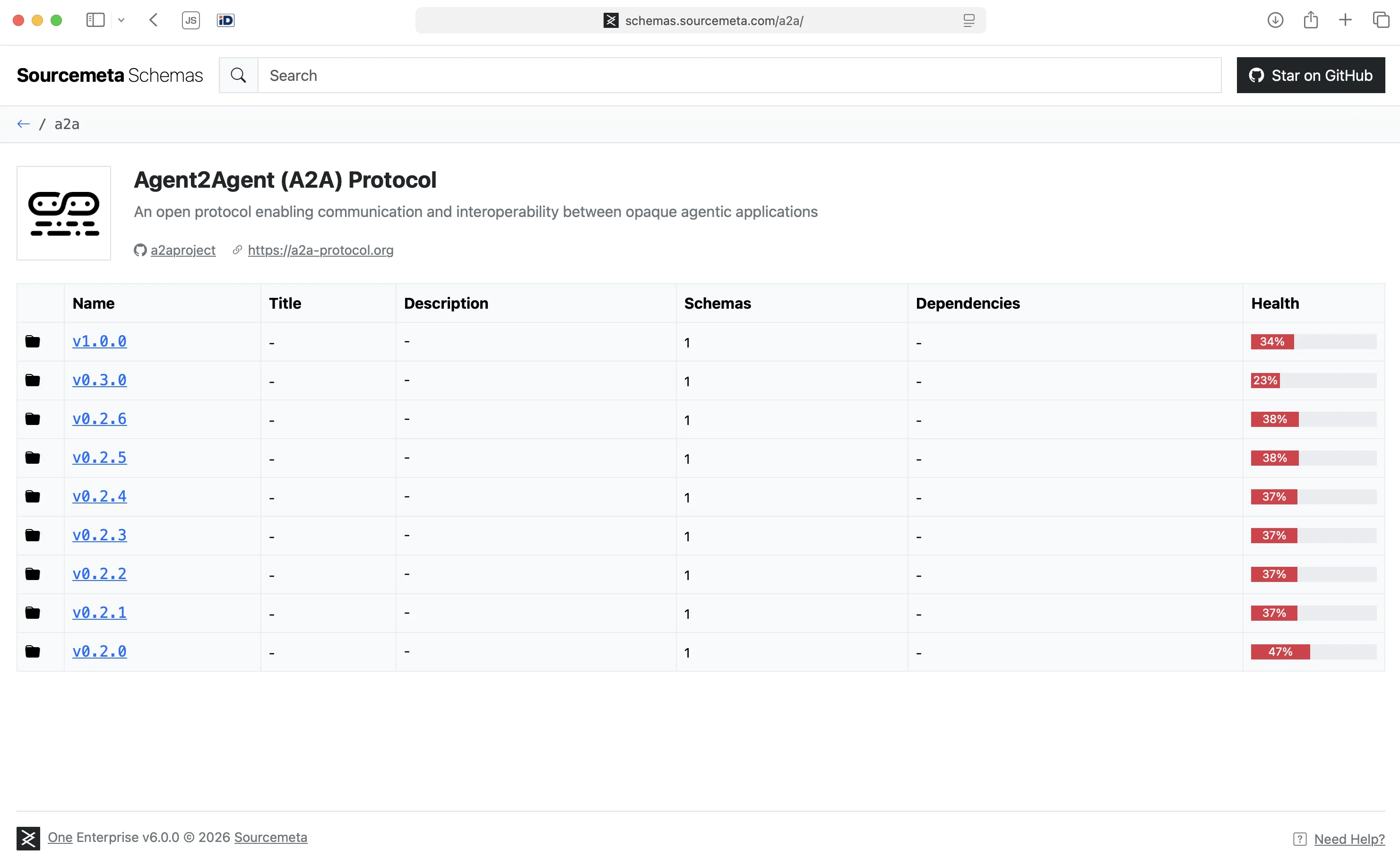
The A2A Protocol schemas in Sourcemeta
Schemas
So even where Protocol Buffers wins as the authoring source, JSON Schema wins
as the interoperability substrate. Charlie
Holland captures the pattern
precisely: “JSON Schema becomes the ‘assembly language’ of schema
definitions” and higher-level languages compile down.
The exception confirms the rule: convergence on JSON Schema is not just visible
at the LLM layer. It reaches even into the protocols designed to avoid it.
The schema layer deserves its own infrastructure
JSON Schema was first proposed in 2007 as a way to annotate JSON documents.
Nobody designed it for AI. It quietly became the dominant API-spec
substrate over a decade and
a half. The AI industry did not pick JSON Schema. It found that JSON Schema had
already been picked, by seventeen years of accumulated convention, and built on
top. As Charlie Holland frames
it, JSON Schema has become the interface definition language for AI tools.
The implication for anyone building APIs or AI-facing software is direct. Your
schema layer is no longer documentation. It is the interface AI systems will
use to consume your software. And the demand for that interface is already
universal. After auditing 989 Fortune 1000 companies, Kin
Lane
found zero without an AI signal: The signal floor is non-zero across every
industry in the Fortune 1000, including the ones I expected to come up empty.
Mining. Tobacco. Specialty retail.
And the next layer of that interface is already taking shape: governance.
Portkey’s review of production MCP
deployments catalogues the security
and trust gaps now surfacing across the ecosystem, and points at a familiar
model for closing them: A better reference is JSON-schema-based registries
used in major cloud platforms, where structure and validation are enforced.
Juan Cruz Viotti6 months ago
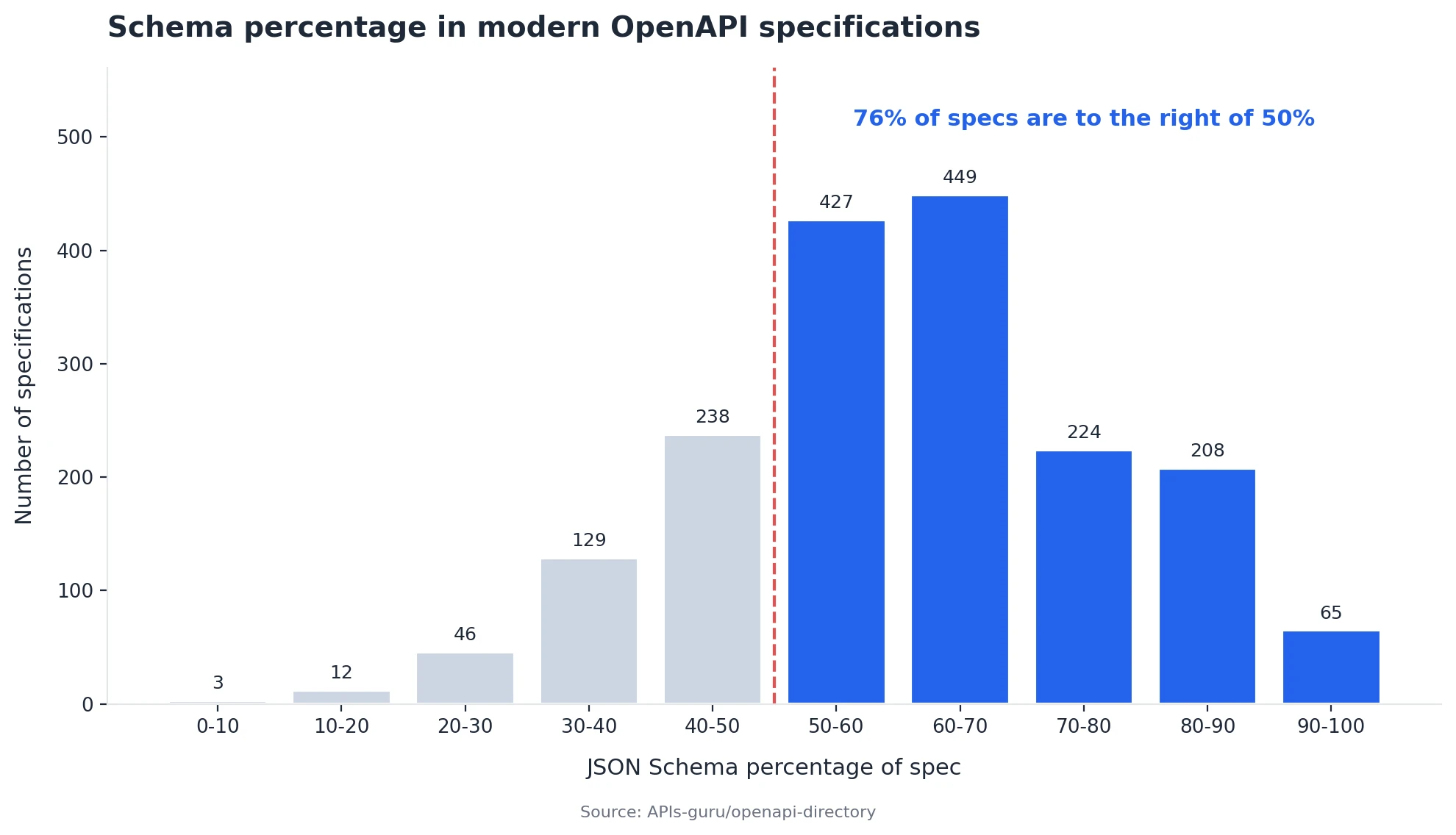
In 76% of modern OpenAPI specs, JSON Schema dominates the specification
TL;DR: We analysed thousands of real-world OpenAPI specifications and found
that in 76% of modern OpenAPI 3.x specs with a typed data model, JSON Schema
is the majority of the file. In the best-known APIs, it routinely exceeds
80%. The schema layer is the substance of every API contract, yet almost no
tool is positioned accordingly.
OpenAPI is, by every reasonable measure, the
dominant standard for describing HTTP APIs. It is a Linux
Foundation project whose founding members
include Google,
Microsoft, IBM, Capital
One, and PayPal. Today
the OpenAPI Initiative counts more than 30 corporate members, and the standard
is the de-facto contract used by Stripe,
GitHub, Mailchimp,
Vercel, Slack,
Twilio, Zoom,
AWS, Azure, Google
Cloud, and effectively every other organisation that
takes its public APIs seriously.
What is much less well known is that most of an OpenAPI document is not,
strictly speaking, OpenAPI at all. It is JSON
Schema.
OpenAPI is the chassis, JSON Schema is the engine
OpenAPI provides the structure for describing HTTP endpoints: paths, methods,
parameters, responses, security, servers. But the actual work of describing
what data flows in and out of those endpoints is delegated to the standard
OpenAPI builds on top of: JSON Schema.
In fact, request bodies, response payloads, query parameter types, header
constraints: each of these is defined as a JSON Schema. In case you haven’t
seen an OpenAPI spec, this is how a trivial one defining a single endpoint
looks like:
openapi: 3.1.0
paths:
/pets/{id}:
get:
parameters:
- name: id
in: path
required: true
# This is a JSON Schema
schema:
type: string
format: uuid
responses:
"200":
content:
application/json:
# This is a JSON Schema
schema:
type: object
required: [ id, name ]
properties:
id:
type: string,
format: uuid
name:
type: string
minLength: 1
This layering is not an OpenAPI quirk. When Kin
Lane inventoried every API specification stewarded
by the Linux Foundation, he found that JSON Schema is the connective tissue
of the entire
catalogue:
The deeper I looked, the more one thread kept showing up underneath
everything else: JSON Schema. OpenAPI uses it. Arazzo and Overlay use it.
AsyncAPI uses it. CloudEvents ships a JSON Schema. OSV and SPDX lean on it.
The OpenAPI metaschema is JSON Schema. […] JSON Schema is the substrate
the other specifications are built on top of.
Let’s measure how big the engine is
We analysed 4,127 real-world API specifications from the
APIs-guru/openapi-directory
repository, the largest curated dataset of public OpenAPI documents. The
dataset is no longer actively maintained, but it remains the de facto industry
corpus, still used in the test suites of well-known tools like
Speakeasy. The dataset and analysis script is
open-source for
anyone wishing to reproduce or extend these results.
Across all 4,127 specifications and 17.6 million lines of YAML, 54.3% of the
content is JSON Schema, and if we restrict the analysis to OpenAPI 3.x
specifications (modern specs), the median rises to 61%. Overall, in 76% of
these specifications, JSON Schema is the literal majority of the file. More
concretely, we can conclude that: in 76% of modern OpenAPI specifications,
JSON Schema dominates the specification.
Distribution of schema percentage across OpenAPI 3.x specifications with
schemas. The 50% threshold is shown as a dashed line, 76% of the distribution
sits to the right of it.
The trend is towards more schema, not less
Comparing Swagger 2.0 to OpenAPI 3.x is interesting. The median Swagger 2.0
spec is 39% schema, while the median OpenAPI 3.x spec is 60%. That is certainly
not because the format suddenly enabled more schema content, but because
OpenAPI 3.x specifications were typically written more recently. For context,
Swagger 2.0 was the dominant format from roughly 2014 to 2017. OpenAPI 3.x
took over from 2018 onwards.
The ~21% jump is the industry learning, year over year, that schemas
matter.
The same pattern shows up when we segment by API maturity. Specifications with
fewer than 10 reusable type definitions have a schema-to-non-schema ratio of
around 0.65:1. Specifications with more than 250 type definitions have a ratio
of 1.79:1. As APIs grow and stabilise, schema takes over.
Schema-to-non-schema ratio plotted against the number of reusable type
definitions per spec. The ratio crosses the 1.0 threshold (where schema equals
everything else combined) around the 25 to 50 type-definition range, and keeps
climbing.
The best-known APIs are almost entirely schema
If you sort the well-known providers in the dataset by how much of their
specification is JSON Schema, the top of the list is striking:
Schema percentage in the top five well-known APIs by schema content.
Mailchimp leads at nearly 94%, with Vercel, Stripe, Zoom and Adyen all above
64%.
The companies known for taking their developer experience seriously sit at the
top of the list.
It is reasonable to conclude that the providers who invest most heavily in API
quality also tend to invest more heavily in rich formal type definitions.
Likely for the purpose of documentation generation, SDK generation, contract
testing, and more.
Two ways the industry hides the schema layer
If JSON Schema is the substance of the API contract, you would expect the
tooling ecosystem to be built around it. But It is not. The schema layer loses
in two distinct ways: it disappears when tools handle it well, and it goes
unnoticed when tools handle it poorly.
When schema work is done well, nobody notices
Take Speakeasy, one of the leading commercial SDK
generators in the space. Their product is excellent, and to do its job well it
has to do substantial JSON Schema engineering for code-generation purposes.
By volume, most of what their generator does end-to-end is schema work, because
most of the spec is schema.
And yet the product positions
itself as “OpenAPI native”. This
is not a Speakeasy critique. The same pattern shows up across most SDK
generation, design, and documentation tools: the schema work is being done,
often very well, but the product surface presents it as OpenAPI work.
The irony is that the customer is led to think of their work as OpenAPI work,
when most of it is schema work. And so they never consider the schema layer as
a layer in its own right.
When schema work is done poorly, nobody notices either
Take Prism, a popular tool for
mocking and contract-testing APIs against their OpenAPI specs. Doing that job
means validating real request and response payloads against the schemas in the
spec, which means the validator under the hood is the substance of what the
tool does.
Prism ships with AJV, a popular JavaScript JSON Schema
validator. The bad news is that AJV is consistently one of the least compliant
implementations of JSON Schema around, as proven by the official
Bowtie cross-implementation conformance tool. At the
time of this writing, AJV lists 254 failures on the version of JSON Schema that
OpenAPI 3.1 itself uses.
The practical consequence is more insidious than a broken test. Either Prism
rejects payloads that are perfectly valid against your schemas, pushing you to
weaken your spec until Prism is happy, or worse, Prism accepts payloads that
your schemas should reject, pushing you to ship an implementation that quietly
disagrees with what your spec actually says, causing even more subtle drift.
The irony is that Prism is part of
SwaggerHub,
the flagship platform of SmartBear, the very company
that created the Swagger project. If the creators of the wrapper format ship a
tool that mishandles the substance inside the wrapper, what hope is there for
the rest of the industry?
The schema layer deserves its own infrastructure
If JSON Schema is the substance of your API contract, and if the schema content
of your APIs is going to keep growing as your APIs mature, then the schemas
deserve their own infrastructure: correct implementations, a cohesive
API-first registry, a governance model, a discovery mechanism, and tooling
that understands them as semantic objects rather than as opaque sections
within a YAML file.
Kin Lane arrives at the same
conclusion
from the standards side: “there is no reason a CloudEvent’s schema, an
AsyncAPI message, and an OpenAPI body could not lean on the same JSON Schema
tooling and the same registry patterns”.
The data says the schema layer is already most of your API. The question is
whether you treat it that way.
Juan Cruz Viotti6 months ago