|
Second issue. Last week I put a prediction in writing so
it could be graded: the OpenAPI Initiative had a patch
release fully loaded at 100% and a minor release at 38%
with about three and a half weeks left, and I said one of
those two dates was going to move.
I was wrong about the mechanism. Nobody moved a date.
Somebody deleted one.
The window: August 9 through August 16.
Thirty specification repositories and twenty-five feeds,
all read clean again — no source errored. 156 pull requests merged. 3 releases cut. 17 posts
published. Nineteen of the thirty specifications did not move at
all, up from twelve last week.
Hold those two numbers next to each other, because they
are the shape of the whole week. A hundred and fifty-six
changes landed. Of the three releases, two were
CALM's command-line tool — so exactly one specification version actually shipped
anywhere in the layer, TUF's v1.0.36, off a thirty-two line edit to a
single definition. That ratio is not a slow week. It is
what this layer looks like when you measure the contracts
instead of the commit count: enormous activity in the
machinery around specifications, and very little inside
them.
|
|
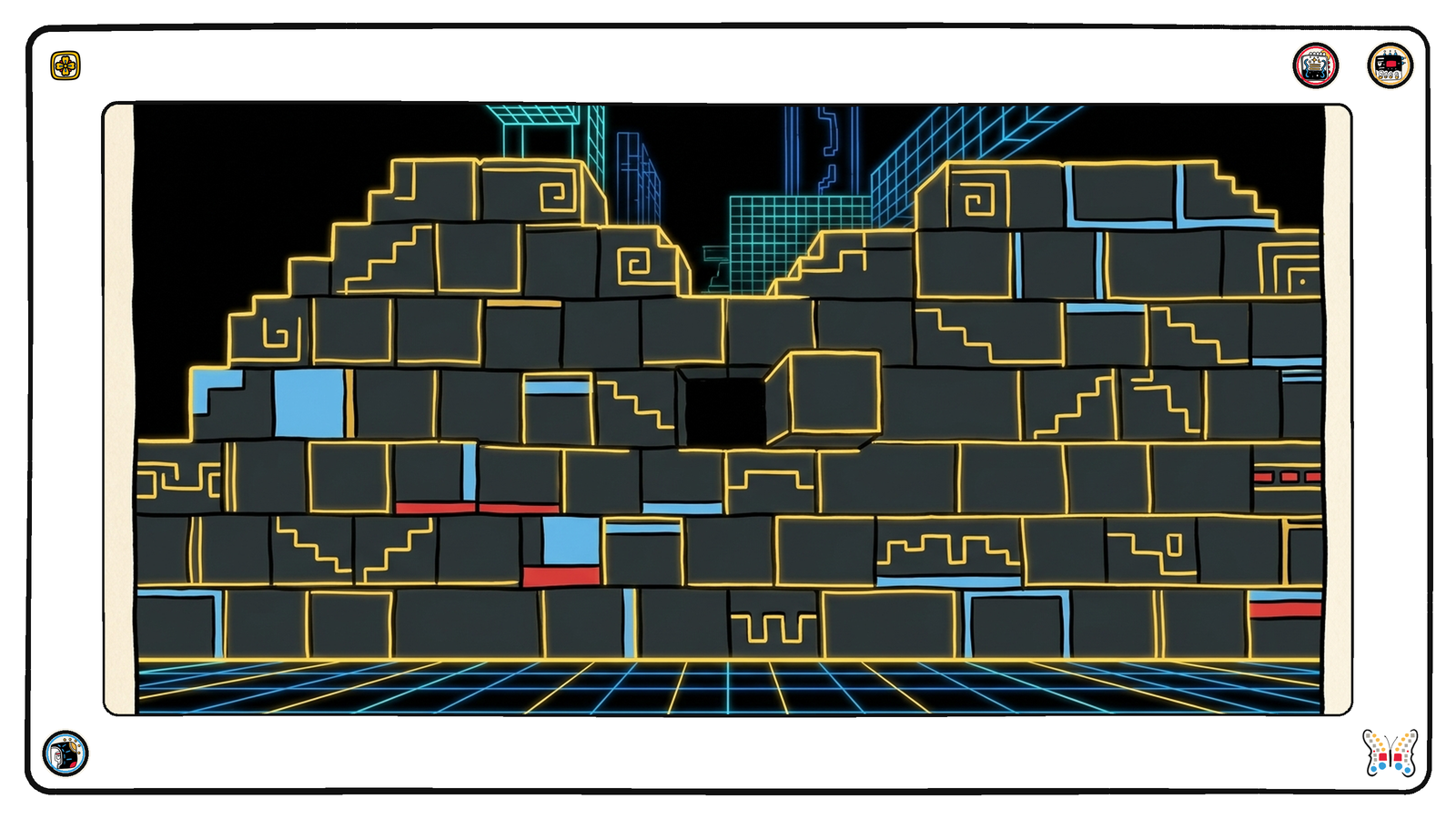
Beneath the dark neon grid, a foundation wall built
from a long row of gold-edged rectangular blocks,
one block pulled completely out and gone, leaving a
deep empty socket of shadow while the wall above it
still stands.
|
The Lead: OpenAPI's 3.3.0 Due Date Is Gone, and the
Spec Text Never Moved
Here is what my harvester recorded on August 9, straight
off GitHub's milestone API:
|
Milestone
|
Closed / Total
|
Due date (Aug 9)
|
Due date (Aug 17)
|
|
v3.3.0
|
17 / 45 (38%)
|
2026-09-03
|
none
|
|
v3.2.1
|
9 / 9 (100%)
|
2026-09-30
|
2026-09-30
|
The September 3rd target on 3.3.0 is no longer set. The
issue counts are otherwise identical to last week — still 17 closed, still 28 open. Zero net progress in
seven days, and the deadline that would have made that a
problem is simply not there anymore.
I want to be precise about what I can and cannot prove
here. GitHub does not expose an edit history for milestone
due dates, so I cannot show you the commit that removed
it. What I can show you is my own harvest record from two
consecutive Sundays, and the fact that GitHub reports the
milestone as last updated 2026-08-16,
inside the window. Two readings, seven days apart, one
field changed. If a maintainer tells me it came off
earlier than that, I will correct it next week.
Removing a date is not a scandal. A date nobody can hit is
worse than no date, and taking it down is more honest than
letting it slide in public. But it is a decision, it was
made quietly, and it is the sort of thing that only shows
up if somebody is reading the milestone board every week.
Now the part I did not expect. OpenAPI
merged twelve pull requests this week, its busiest week in
this newsletter so far. I opened every one and listed the
files.
Not a single one touched a specification document.
No versions/3.*.md. No src/oas.md. The complete list of what changed: .github/ workflows, package.json, package-lock.json, CONTRIBUTING.md, README.md, .linkspector.yml, a test file, and something in _archive_/. Twelve merges, four version branches, zero
specification.
What they were actually doing is worth knowing about,
because it is a structural change to how the OAI builds
everything it publishes. #5424 "Migrate to new shared build
infrastructure" merged August 13 — 1,105 lines added, 3,612 deleted, across 29
files. It pulls dependency management, build, test and release
tooling out of the specification repository and into OAI/build-infra, a repo created on June 5 this year to hold that
machinery for all the OpenAPI projects at once. The companion PR over there landed 11,164 lines on July 16. Everything else OpenAPI
merged this week — the dev, v3.1-dev, v3.2-dev and v3.3-dev syncs from the publisher bot, @baywet's four CI
fixes — is that migration propagating outward across the
branches.
Two details in that PR are worth your attention. First,
its author opened it saying it "MUST NOT be merged" until the build-infra side landed first — and the
sequencing was honored; build-infra#1 merged four weeks
ahead of it. That is disciplined release engineering, done
in the open, and it is invisible from outside.
Second, and I am quoting the pull request body
directly: "This Codex-authored draft pull
request." The largest change to land in the OpenAPI Specification
repository this week was written by an AI, disclosed as
such in the description, reviewed, and merged by a human
maintainer. I am not going to editorialize about that
beyond noting it happened and that it was labeled.
Disclosure is the part that matters, and the disclosure
was there.
So the honest summary of OpenAPI's week: the
specification did not move, the deadline for the next
version came off the board, and the workshop around it got
rebuilt.
The machines lost ground
Same cut as last week, because a headline count of 156
means nothing without it:
|
Who merged it
|
Count
|
Share
|
|
copybara-service[bot]
|
50
|
32%
|
|
dependabot[bot]
|
16
|
10%
|
|
renovate[bot]
|
9
|
6%
|
|
oai-spec-publisher[bot]
|
7
|
4%
|
|
github-actions[bot]
|
2
|
1%
|
|
All bots
|
84
|
54%
|
|
Actual people
|
72
|
46%
|
Fifty-four percent, down from 59% last week. The headline
moved +6 (150 to 156), which reads like a slightly busier
week and is not what happened underneath: machine merges fell by 5 and human merges rose by
11. Roughly a fifth more actual people-work landed in the
specification layer this week than last, and the top-line
number almost entirely hid it. This is exactly why I am
going to keep computing this split every single week.
One more number from that 72. A single person, @julianna-ciq, merged 28 of
them — 39% of all human specification activity across all
thirty repositories, one contributor, one project. More on
that below, because it is the best story in this issue.
|
|
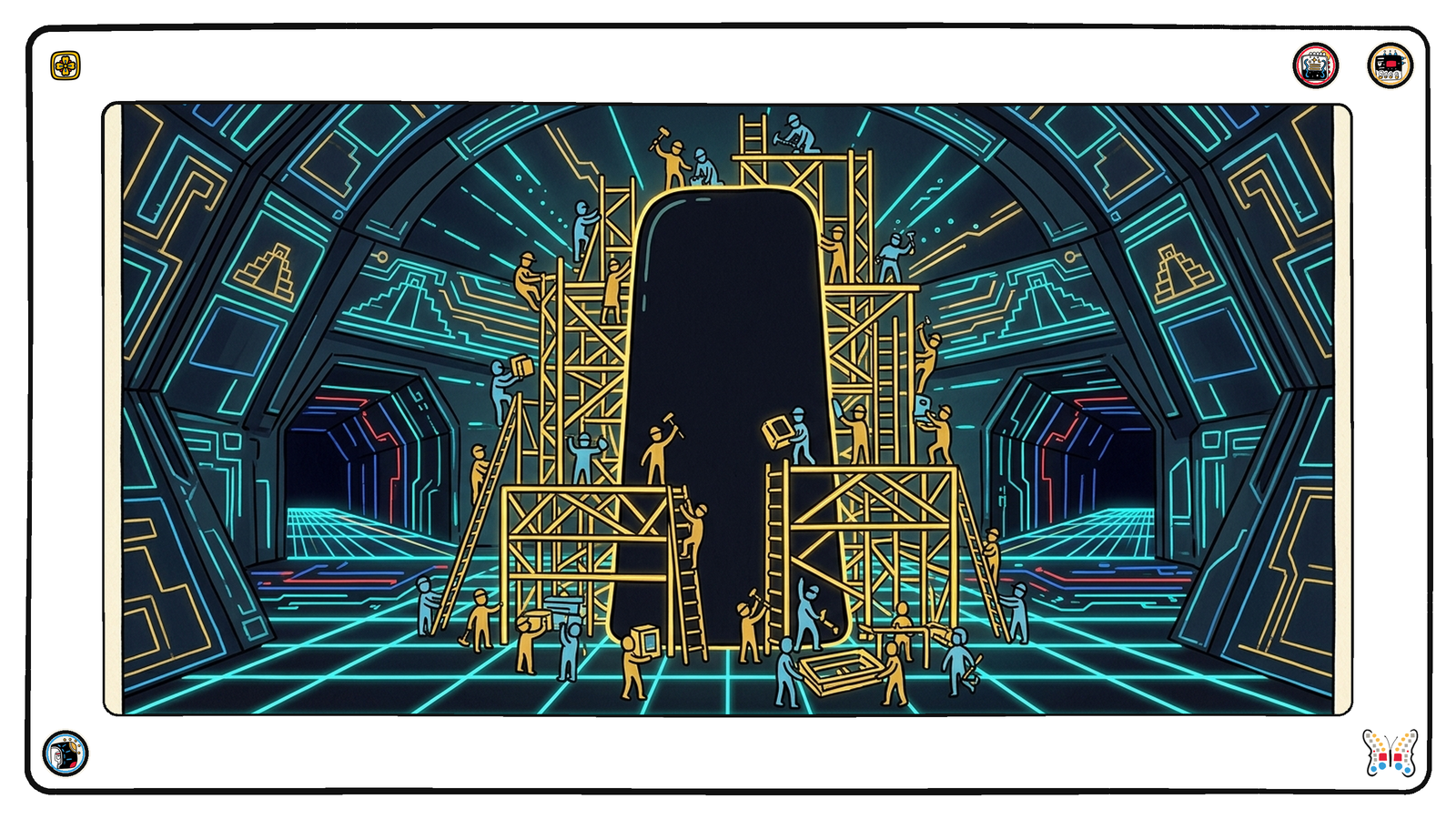
Inside a dark vaulted chamber under the neon grid, a
colossal blank black monolith stands untouched at
the centre while dozens of small workers swarm a
lattice of gold scaffolding, gantries and ladders
all around it, dismantling and rebuilding the
scaffolding and never touching the monolith itself.
|
📐 The Description Layer
JSON Schema found a bug in its own meta-schema, and an
outside contributor fixed it. Four merges, all four by humans, zero bots — the second
week running that JSON Schema is under entirely
hand-driven editorial work. The one to read is #1761 from @ApurveKaranwal, merged August 15.
The meta-schema declares $vocabulary under properties. But the propertyNames regex pattern sitting a few lines below it did not
include vocabulary. The consequence: any valid schema that used $vocabulary failed meta-schema validation, with
a propertyNames/pattern error, for a keyword the same document explicitly
allows. Found while running validations with @hyperjump/json-schema, fixed in 27 lines, and — the right instinct — shipped
with a new vocabulary.json test-suite file so it stays fixed.
That is a normative artifact rejecting conformant input.
It is a small bug with a sharp edge, and it was caught by
somebody outside the core team running the meta-schema
against a real validator. The other three merges are
ordinary hygiene: grammar in the use-case descriptions,
restricting markdown builds to spec files, container
styling.
Arazzo and AsyncAPI were dependency bumps and nothing
else. Arazzo merged two (a dev sync and a @hyperjump/json-schema bump), AsyncAPI merged two (both js-yaml), and every one of the four was a bot.
AsyncAPI's "Issues to consider before 3.0.0 Release" milestone sits at 25 of 28 closed — 89%, unchanged from last week. Three issues from a major version and it did not move.
Overlay did not move at all, second week
running, and its three milestones are frozen at exactly
last week's numbers: Release 2.0 at 4/7 (57%), Release 1.2 at 7/7 (100%), Release 1.3 at 0/3. There is a finished 1.2 sitting on that board
with nothing shipped from it.
Moonwalk is still silent. No activity,
last merge March 31, 2025. If you are waiting on OpenAPI
4, this is the second consecutive week I can tell you
nothing is happening in the repository where it would
happen. GraphQL also merged nothing again
— its motion lives in the RFC directory and working-group
notes, not in pull requests.
Protobuf remains the most automated specification in
the set. 45 merges, 40 of them copybara-service[bot] — Google's internal monorepo exporting outward. The
five human merges were @tonyliaoss cherry-picking custom
JSON enum names into C#, and @runzw on Rust crate
re-exports and a typo. gRPC ran the same shape: 12 merges,
11 by bots, one human CI fix.
|
|
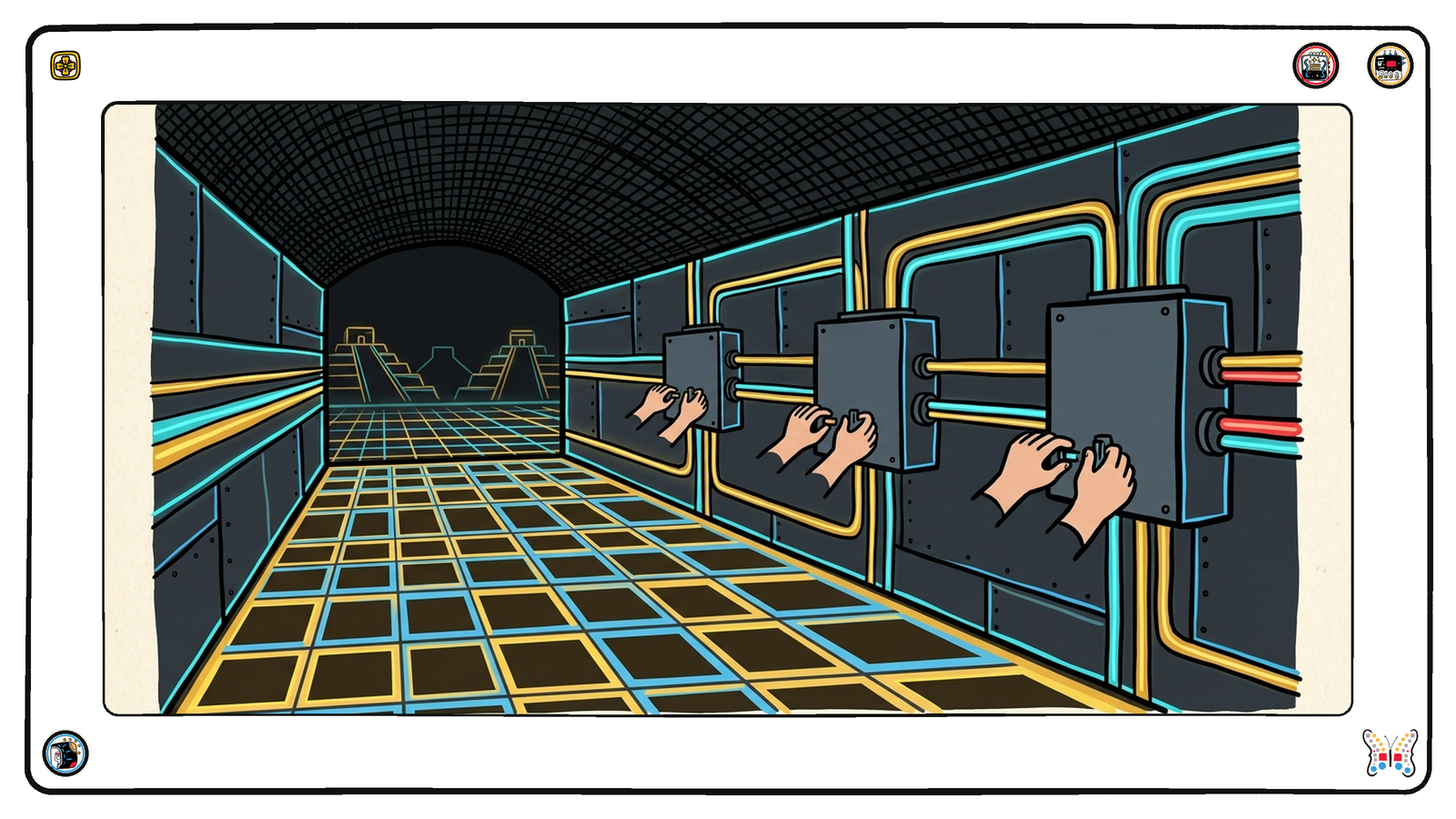
A service corridor deep under the grid floor, gold
and cyan telemetry streams running along the
plating, and at three junction boxes along its
length a pair of human hands working the fittings
directly.
|
📡 Events, Telemetry and the Data Plane
OpenTelemetry was the most human-driven specification
of the week. 14 merges, 11 by people, only three by
renovate. Nothing else in the description layer comes
close to that ratio at that volume, and the merges are
substantive rather than cosmetic.
#5136 from @ArthurSens stabilized the "Content Negotiation" section
of the Prometheus exporter spec — moving normative text out of experimental. What makes
it worth reading is the method: before flipping the
status, he audited the actual SDKs and wrote the results
into the PR. Go, Java and the Collector's Prometheus
exporter fully compliant; Python "almost." That
is stabilization backed by a conformance survey rather
than by a vote, and it is the standard I wish more specs
held.
#5125 from @krajorama reworked the OTLP exponential histogram to Prometheus native
histogram translation, splitting NoRecordedValue into explicit true/false branches and fixing a uint64 count-handling error along the way. Histogram
translation between OTLP and Prometheus is where
observability data quietly goes wrong at scale, and this
is a correctness fix in the seam.
The rest is honest maintenance: maturity-level definitions
moved to a dedicated page, attribute-ordering dropped from
the compliance matrix, Kotlin and Go compliance updated, a
neutral "When an Issue Is Closed" section added
to CONTRIBUTING.
OTLP fixed a bug where its own OpenAPI output
contradicted its own specification. #841 from @jsuereth: the spec says enum values MUST be
encoded as integers, and the generated OpenAPI was not
doing that. Now SeverityNumber emits as type: integer, format: int32 with an integer enum list. A spec and its generated
description disagreeing is the exact failure mode this
newsletter exists to surface, and this one was caught and
closed by the project itself.
The OpenTelemetry blog published a piece on consuming entity events — the argument that metrics, logs and traces tell you
how systems behave but are quiet about what
actually exists. Worth your time if you are
thinking about inventory as telemetry.
CloudEvents, OpenMetrics and xDS all merged
nothing. For CloudEvents I will keep saying it plainly: stable at
1.0.2 since 2022, and running a large share of the
industry's event plumbing. That is finished, not
dead.
|
|
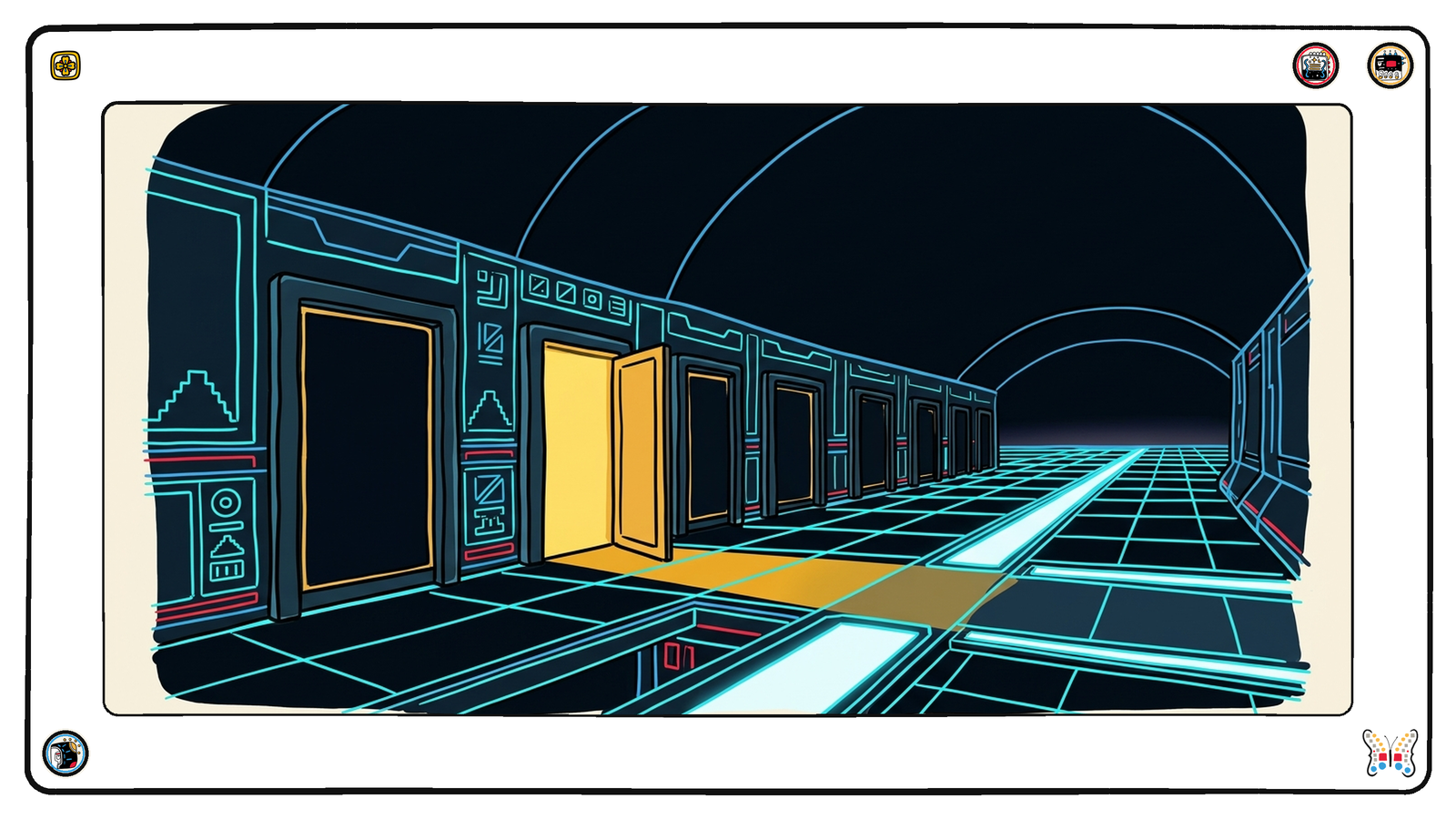
A vaulted vault-floor beneath the neon grid lined
with a long row of heavy blank doors, all of them
dark and sealed except one standing open and lit
gold, the light falling out across the floor.
|
🔐 Identity, Policy, Supply Chain
Eleven of the twelve identity and supply-chain
specifications merged nothing this week. SPIFFE, OpenFeature, SPDX, all three OCI specs, in-toto
Attestation, OSV Schema, SLSA, Notary Project and Sigstore
protobuf-specs: zero pull requests, zero releases, between
them.
The twelfth was TUF, and it produced the only actual specification release of the entire
week. v1.0.36 published August 10, off #322 from @joshuagl — which does one thing: an earlier
clarification had introduced a second definition
of THRESHOLD without a <dfn> tag, so the duplicate definition was invisible to the
spec's own cross-referencing. He collapsed it back to
a single tagged definition. Thirty-two lines changed
in tuf-spec.md, and a release cut the same day.
I want to flag the release count carefully, because it is
easy to misread. Three releases in the window: TUF's,
and two CLI releases from CALM, which are
tool releases, not specification releases. One
specification version shipped in the whole layer this
week.
Now the part that sits uncomfortably next to all that
silence. OpenSSF spent the week publishing Cyber Resilience Act
guidance — a practitioner's guide to CRA compliance, a monthly tech talk with ORBIT Launchpad SIG updates, and a podcast episode on CRA readiness for open source
communities. Their own framing, quoted from that guide: the CRA
"is no longer a future regulatory discussion; it is
an immediate operational reality," with a September
2026 reporting deadline approaching.
The specifications that would carry that compliance in
machine-readable form — SPDX for the SBOM, SLSA for build
provenance, in-toto for attestation, OSV for vulnerability
records — merged nothing in the same
seven days. And SPDX's 3.0.2 milestone is still 33 of 38 closed with a due date
of 2026-04-30, now three and a half
months past. Its 2.3.1 milestone went the wrong way this week — two issues were added to
it while none closed, so it slipped from 81% to 76%
without anyone doing anything wrong.
I am not claiming the specs are inadequate to the
regulation; several of them are mature and arguably
finished for this purpose. I am reporting the gap I can
actually measure: the advocacy layer is in a sprint and
the specification layer is not moving, one month out from
a date the advocacy layer itself calls immediate.
|
|
A massive gold-edged foundation slab beneath the
neon grid with a large rectangular section cleanly
cut out and removed from one end, the remaining slab
intact, smaller and still carrying the structure
above.
|
💹 Financial Services Data Standards
FDC3 deleted a specification this week, and that is
rarer than shipping one. #2096, merged August 13: 12 lines added, 817 deleted. Out went the deprecated /v1/apps, /v1/apps/{appId} and /v1/apps/search routes from the FDC3 3.0 App Directory OpenAPI, along
with five v1-only schema definitions — AppImageV1, IconV1, IntentV1, ApplicationV1, ApplicationSearchResponseV1.
Read how it was done, because this is the deprecation
playbook working end to end. The deprecation period was
allowed to complete first. Historical versioned schemas
and documentation were left untouched, so anyone pinned to
an old version still has their contract. The
published next schema and the App Directory docs were synchronized in
the same PR so nothing could drift. Regression coverage was added asserting the
specification stays v2-only — a test whose job is to stop the dead surface coming
back. And the removal was recorded in the changelog.
Every standards body talks about deprecation. Very few of
them actually get to the delete, and fewer still leave a
test behind to keep it deleted.
FDC3 3.0 moved more than any milestone in the
harvest. From 19 of 39 closed (49%) last Sunday to 26 of 41 (63%) this Sunday — seven issues closed, two added, in one
week. The 3.1 candidates board grew from 9 to 10 and remains at zero closed, and Infrastructure went from 0/7 to 2/8. Substantive spec merges alongside
the deletion: #2020 adding ContextWithMetadata to IntentResult, #2043 adding a channel ID to the context-cleared event, #2052 clarifying channel event types, and #2041 from @kemerava bringing Go support up to the v3 updates.
And now the number from the lead. Of FDC3's 44
merges, 28 were @julianna-ciq — the v1
removal, the schema additions, the channel clarifications,
and a full toolchain sweep (TypeScript 7, Vite 8.2.1,
ESLint 9.39.5, Rollup, Jest, jsdom, quicktype, a
dependency-check baseline). That is 39% of all human
specification activity across all thirty repositories this
week, from one person on one standard. When people ask
what a standard actually runs on, this is the answer more
often than anyone admits: it runs on somebody.
Which makes the other FDC3 merge this week the right one
to end on. #1968 — Chris Watson (@SeeWhatsOn) joined FDC3 as a
maintainer, merged August 12. From his own request: "I've been around FDC3 since close to the
start, back when it was something simple enough for a
team to bolt onto their desktop and get two apps
talking. Seven years on it's a hardened standard
that holds up in a global bank as well as it does in a
five person fintech." A standard adding a maintainer in the same week one
contributor carried nearly 40% of the layer's human
output is not a coincidence worth ignoring.
CALM shipped twice — cli-v1.54.0 on the 10th and cli-v1.55.0 on the 12th — off 17 merges weighted toward CALM Hub:
control storage migrated to a header/version shape, layout
persistence for patterns, and a cluster of access-control
fixes scoping namespace and resource-type checks. Tooling
maturing faster than the spec underneath it, which is the
healthy direction for a young standard.
Off-repo but squarely in scope: FINOS announced CDM 7, a production release of the Common Domain Model
consolidating more than 130 upgrades and releases from the
past year.
|
|
A wide bedrock plain beneath the neon grid carrying
dozens of low gold-edged stepped footings, several
of them newly cut and brighter than the rest, all of
them holding up a structure out of frame above.
|
🏛 From the Foundations
The Agentic AI Foundation added 57 members, per the Linux Foundation announcement on August 13, with Alibaba, Visa and Wells Fargo joining
as Gold Members. I am tracking this one closely for a
specific reason: the LF's pattern is that a
foundation with this kind of membership eventually
produces specifications, and if agent interoperability
contracts land under LF governance they become part of
this newsletter's beat by definition. Two payments
and banking giants going Gold is also a strong signal
about where agent-to-service contracts get argued out
first.
CNCF graduated Cloud Native Buildpacks on August 11, for turning application source into OCI-compliant container images. Set that against this issue's supply-chain
section: all three OCI specifications merged nothing this
week, and a project just graduated to CNCF's highest
maturity tier on the strength of conforming to them. That
is what a finished specification looks like from the
outside — motionless in the repo, load-bearing everywhere
else.
Also out this week: the Linux Foundation's August newsletter, marking 35 years of Linux, and a CNCF piece on ModelPack and AI model interoperability
with Docker — another packaging-format-shaped effort worth watching
for whether it becomes a specification or stays a product.
|
|
A long subterranean colonnade of tall blank dark
monoliths receding into the blackness, their edges
traced in cold gold and blue light, standing silent
and unmoving while the load-bearing neon grid runs
on past all of them.
|
🤫 The Quiet Ones
Nineteen of thirty specifications recorded no merged
change, no release and no commit in the window — up from twelve last week. This is the section nobody else publishes, and the jump
from 12 to 19 in a single week is itself the finding.
Finished, not dead — these are stable and
carrying enormous load right now: CloudEvents (1.0.2 since
2022), OCI Image, OCI Runtime and OCI Distribution, Notary
Project, in-toto Attestation, SLSA, OSV Schema, Sigstore
protobuf-specs, xDS.
Quiet and worth watching — where silence
is ambiguous and I will keep counting the weeks: Overlay
(two weeks, with a completed 1.2 milestone unshipped),
SPDX (a milestone three and a half months overdue, one
month from the CRA date), SPIFFE, OpenFeature, OpenMetrics
(2.0 still experimental), GraphQL, AsyncAPI community.
Silence that is the answer to a question people keep
asking: Moonwalk. No activity, last merge March 31, 2025. There
is no OpenAPI 4 in progress.
Envoy is excluded from pull-request counting by design —
it is an implementation, not a specification — so its
appearance in this list means it cut no release, not that
it was idle.
|
|
An intact glowing stepped pyramid and a lit monolith
standing on the neon grid, a thick bundle of
conduits strung between them gone dark and slack,
the severed ends hanging loose above the floor.
|
📡 Channel Health
All twenty-five working feeds returned again, and the
picture from issue one has not changed: Sigstore still
publishes no feed on any path, Envoy's blog host
still does not resolve, OpenSSF's real feed is
still /feed/ while /blog/feed/ and /blog/rss/ still answer HTTP 200 with zero items.
Two updates worth recording. The OpenAPI Initiative's feed has now been silent
since July 22 — nearly four weeks, across a period in which the
project restructured its entire build system and dropped a
release date. Nothing about either reached the
announcement channel. LF Edge, which I
listed as dormant last week, posted again. Feed volume
across the whole layer fell from 24 items to 17.
The dormancy leaderboard, longest first, is otherwise
unchanged: in-toto (May 2023) · CloudEvents (July 2024) ·
Notary Project (June 2025) · OpenFeature (March 2026) ·
OCI (April 2026) · SLSA (May 2026) · gRPC (June 2026) ·
GraphQL (June 2026) · Prometheus/OpenMetrics (June 2026) ·
SPDX (June 2026).
How This Was Made
Every number above came from one harvest run against the
GitHub REST and GraphQL APIs and twenty-five feeds, over
August 9 to August 16, 2026. Merged pull requests are
counted by merged_at inside the window. Bot attribution is by author login.
Milestone percentages are GitHub's own open/closed
counts, read live. Week-over-week deltas compare against
last week's stored harvest, not against memory.
Where this issue makes a claim about what a pull request did, I opened the pull request and read its file list or its
body — the OpenAPI "zero specification changes"
finding is the file lists of all twelve PRs, and the FDC3
and JSON Schema items are quoted from the PR bodies. The
one thing I cannot fully evidence is the removal of the
3.3.0 due date, because GitHub does not expose milestone
edit history; I have two of my own harvest readings a week
apart and I have said so in the text rather than assert a
change I cannot show a commit for.
Two standing exclusions: Envoy's pull requests are not counted, only its releases — it is a high-volume implementation
repository and including it would drown every real
specification in the issue. And a source that fails to
respond is reported as an error, never as
zero activity, because "quiet week" and "my
harvester broke" look identical in a chart and only
one of them is true. This week, as last, every source
returned.
If a number here is wrong, the repository is the authority
and I will correct it in the next issue.
Next Monday: whether 3.3.0 gets a new date or stays
open-ended, whether OpenAPI's spec text moves at
all now that the build migration has landed, and whether
the supply-chain layer wakes up with the CRA deadline
inside the month.
|