|
This is the sixth issue of The Specification Layer.
This newsletter window: September 6
through September 13. Thirty-two specification
repositories and twenty-five feeds, all read clean for the
sixth consecutive week — no source errored. 139 pull requests merged. 10 releases cut. 26 posts
published. Nineteen of the thirty-two specifications did not move
at all — the highest quiet count I have recorded.
Separately, the two release-path dependencies I added last
week merged 15 more.
Three weeks ago I made a prediction and said I would be
graded on it. Time to collect.
|
|
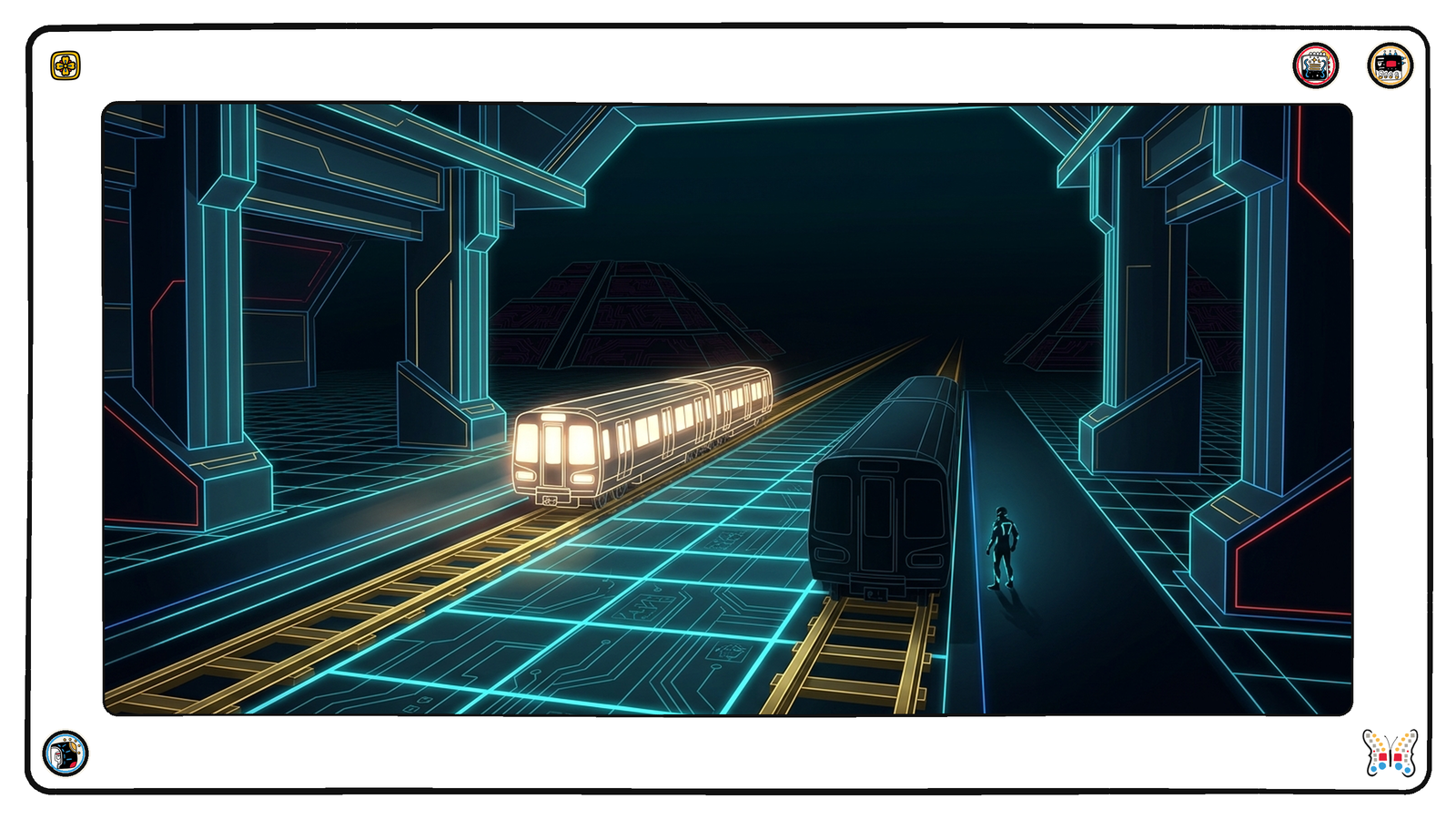
Deep beneath the neon grid, two parallel gold rail
tracks run out of a foundation vault: on one, a lit
carriage has departed and is well down the line; on
the other, an identical carriage sits dark and
unmoved at the platform with a single small figure
watching the first one go.
|
The Lead: OpenAPI 3.2.1 Shipped — and the Defect Could Not
Ride Along
On August 31 I wrote that the v3.2.1 milestone had been 10 of 10 closed for two weeks against a
September 30 due date, and that either it ships in the
next four weeks or a finished board sits unshipped and I
report that instead.
OAS 3.2.1 released September 10, twenty days early. The first OpenAPI release in almost
a year — 3.2.0 shipped September 2025.
And the chain that got it there is the chain this
newsletter has been reporting week by week, which is the
most satisfying thing I have got to write since I started:
|
|
|
|
Sep 3
|
build-infra cuts v1.0.0, its first tag, live on the TDC call
|
|
Sep 6
|
SpecRef comes back after nine days down,
unblocking bibliography resolution
|
|
Sep 8–11
|
build-infra v1.0.1 and v1.0.2; OpenAPI bumps to each
|
|
Sep 10
|
3.2.1 ships
|
Three weeks of infrastructure work that produced no
specification text at all, and then a release. I spent two
issues reporting that work as it happened without knowing
whether it would pay off. It paid off.
Now the part I have to be honest about
Last week I reported that the OpenAPI validation
schema's version pattern used \d, which under Python and .NET regex engines matches any
Unicode digit — so openapi: 3.2.৪, written with BENGALI DIGIT FOUR, validates as a legal
version string. @karenetheridge fixed it on August 31
in #5529 and #5530, changing \d to [0-9]. I noted the published schemas still carried the defect.
A release shipped nine days later. So I went to check
whether the fix rode along.
It did not. I fetched every 3.2 schema the OAI publishes
this morning:
|
Published schema
|
openapi pattern
|
|
oas/3.2/schema/2025-09-17
|
^3\.2\.\d+(-.+)?$
|
|
oas/3.2/schema/2025-11-23
|
^3\.2\.\d+(-.+)?$
|
|
v3.2-dev branch (unpublished)
|
^3\.2\.[0-9]+(-.+)?$
|
Here is the part that makes this interesting rather
than a gotcha. Before writing a word about it I went and read the
OAI's own contribution rules, because the standing
rule in this newsletter is that when the published check
comes back yes, the reporting bar goes up. CONTRIBUTING.md says:
Schema changes are made on the same branch, but can be
released independently. … Patch releases cannot contain changes that require a schema update.
And the patch-release criteria are editorial changes and
"clarifications or additions that do not change the
meaning of the specification."
So 3.2.1 could not have carried the schema fix.
Not an oversight, not a miss — a documented policy working exactly as written. The specification prose and the machine-readable schema
ship on separate tracks, which is why the OAI publishes
dated schemas (2025-09-17, 2025-11-23) that do not line up with specification version numbers
at all.
The consequence is still real, and it is worth naming
precisely: a defect can be fixed in the repository, and a release
everyone reads as "the new version" can go
out, and the machine-readable artifact your validator
actually downloads is unchanged. If you validate OpenAPI documents in Python or .NET
today, against the current published 3.2 schema, 3.2.৪ still passes. The fix exists. It is not where your
tooling looks.
That seam — between the document humans read and the
schema machines fetch — is invisible from the outside, and
it is the kind of thing I would never have found by
reading a release announcement.
The vote took three and a half minutes
Not a criticism, just a fact worth recording, because the
OAI's written process has real numbers in it. From
CONTRIBUTING.md: "Patch-level releases require majority approval by
TSC members. (Max voting period 3 days)."
PR #5549, "Release for 3.2.1", from @lornajane:
Three minutes, twenty-eight seconds from open to
merged. Three days is a ceiling, not a floor, and a majority
arrived inside a minute, so nothing here breaks the
written rule. It is simply a striking thing to see next to
the other release vote that happened in the same
organisation the same week, which took a day, cleared a
higher bar, and still has not shipped. That one is below.
|
|
A small underground chamber beneath the grid where a
handful of tiny figures cluster around one gold-lit
workbench carrying a single small structure freshly
assembled and glowing, the vast dark understructure
rising away above them.
|
🎙 From the Room: Overlay Bi-Weekly, September 8
Second week of this section. The Overlay Specification had
been in The Quiet Ones for five consecutive weeks with a
milestone board that had not been touched since December
2025. This week it merged six pull requests, every one of
them by a person and not a bot. I sat in on the bi-weekly
to find out what changed.
Overlay is deliberately the guinea pig. The group's own framing, from the call: there was
general agreement in the broader community to use Overlay
as the test subject for the whole new build
infrastructure, on the reasoning that it is a smaller
group than the main OpenAPI project and can absorb the
breakage. That is why Overlay's sudden burst of
activity is entirely plumbing — #379 "Prepare for new Build Infra" from @lornajane removes every previous script and
dependency in favour of the shared package, and
@baywet's #394 follows it through CI. The milestone boards were not touched at all — I checked the stored updated_at values against last week's harvest and they are
byte-identical: Release 2.0 last modified December 16
2025, Release 1.2 on July 28, Release 1.3 in May.
Six merges, zero specification change. The repository woke
up; the specification did not.
They merged it live and then built the document on the
call. #379 went in during the meeting, and the release was
then rehearsed locally end to end — yarn install --immutable, yarn test, yarn validate-markdown, yarn build — and it worked. The reaction, and I wrote this one down
because it is the whole argument for the three weeks of
infrastructure work: "we just built that everybody. This is fun. Why
don't we do this every week?"
And then the sentence that explains why specification
releases are so consistently painful. Paraphrasing closely: Overlay deploys once a year or
less, so something always breaks; the old process was a
sequence of scripts where, when one failed, you had to go
find the script and work out what it did; and releases
only ever happen live on a video call, at the end of a
working day, with everyone watching. "I've never had a good experience doing
this."
That is not a complaint about tooling. It is a structural
observation about the specification layer that applies far
beyond Overlay: a release path exercised once a year is a release path
that is broken every time you use it. Every project in this newsletter that releases rarely
has this problem, and none of them can see it, because the
failure only appears on the day it matters most.
Two smaller things worth recording. Overlay
does not have the automated
main→dev→version branch sync that OpenAPI uses — it is an
available option the project has deliberately not enabled,
on the grounds that it was a nightmare on the bigger repo.
And the new build makes Unix assumptions: a Windows
participant found things breaking and planned to retry
under WSL, with the group leaning toward simply telling
Windows contributors to use WSL.
The vote that has not closed. At 15:53
during that call, @lornajane opened issue #392, "VOTE: Approve release of OpenAPI
Overlay Specification v1.2". @baywet noted immediately that a minor release needs
two thirds of the TSC — four people. Five approvals landed
within a day: @lornajane, @earth2marsh, @mikekistler,
@miqui and @ralfhandl.
The issue is still open and 1.2 has not
shipped. @mikekistler's approval came with a condition: he
wants to hear the group's thinking on discussion #5538, "Terminology: relative URI
reference", before anyone pushes the button.
So the Overlay 1.2 milestone that has read 7 of 7 closed
through six consecutive issues of this newsletter is now,
genuinely, one terminology discussion away from shipping.
That is the closest it has been, and it is the first time
I can point at what is actually holding it.
Method note, same as last week: quotes
are from my notes of the call, speaker attribution is
reconstructed from content rather than captured speaker by
speaker, and anything carrying a claim was checked against
the repository record — the vote, the approvals, the
merged pull requests and the milestone timestamps above
are all links you can open. The group also discussed
whether its written release-approval terms match how
releases actually run, and expects to revise that text to
be more workable. I am reporting that they are revisiting
it, and not characterising any particular release, because
that is what I can evidence.
The split
|
Who merged it
|
Count
|
Share
|
|
copybara-service[bot]
|
29
|
21%
|
|
dependabot[bot]
|
12
|
9%
|
|
renovate[bot]
|
8
|
6%
|
|
oai-spec-publisher[bot]
|
7
|
5%
|
|
github-actions[bot]
|
1
|
1%
|
|
All bots
|
57
|
41%
|
|
Actual people
|
82
|
59%
|
Six readings: 59% machine, 54%, 72%, 59%,
36%, 41%.
Last week I warned that the human-majority headline was an
artifact of adding two young, fast-moving repositories.
Same split this week, and the picture is better:
|
|
Merges
|
Human
|
Human share
|
|
TRACE + PDPP
|
44
|
41
|
93%
|
|
The other thirty
|
95
|
41
|
43%
|
|
All thirty-two
|
139
|
82
|
59%
|
The established layer went from 32% human to
43% — its best reading in three weeks, and this time it is
real work, not a reporting artifact. Overlay merged six
and all six were people. FDC3 merged fourteen with ten by
people. OpenAPI, OpenTelemetry and CALM all landed genuine
human changes. The layer came back.
|
|
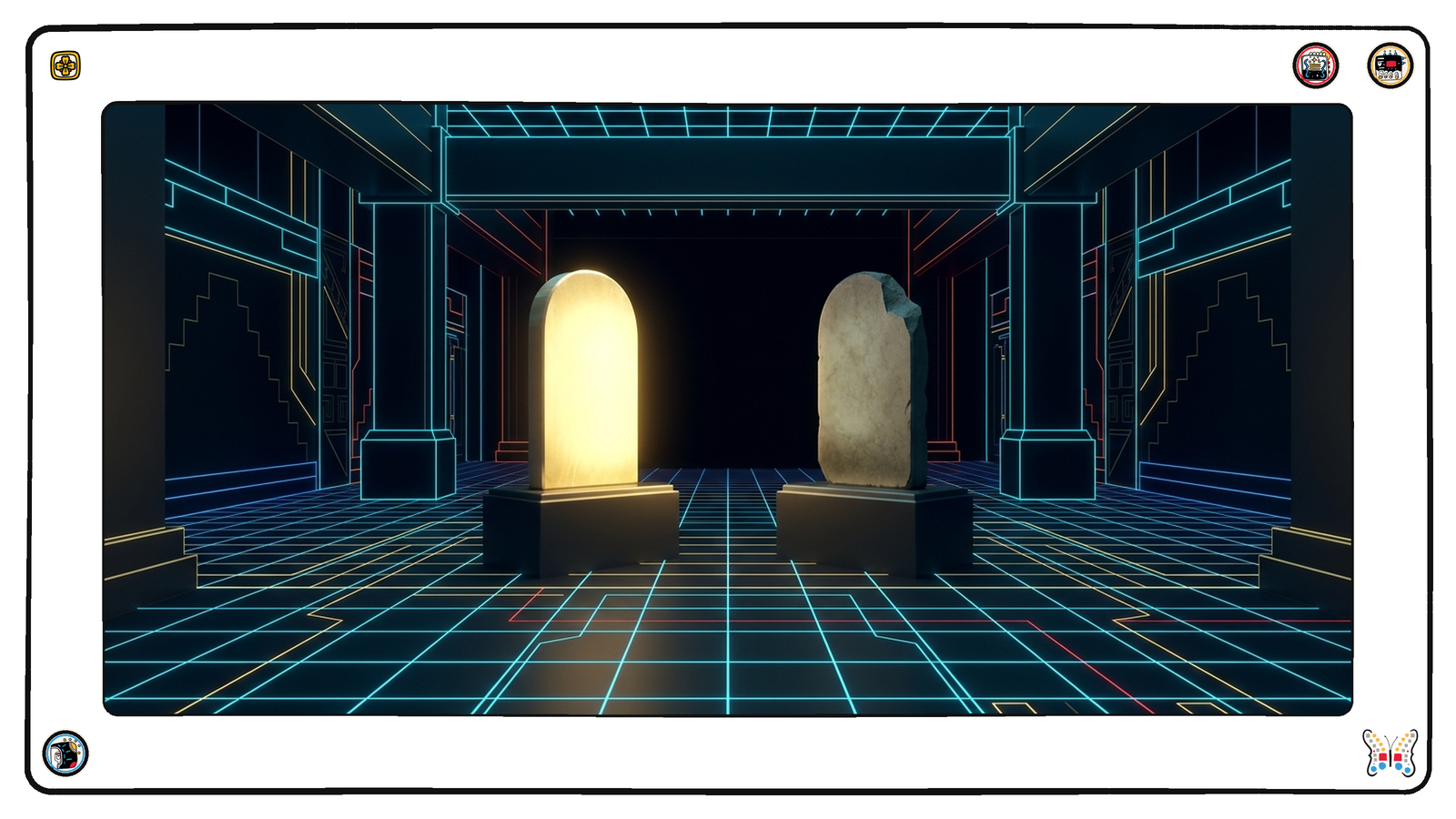
A foundation vault holding two enormous stone
tablets on separate plinths — the left freshly cut,
clean and brightly gold-lit, the right older, dimmer
and chipped at one corner — with no walkway between
the two plinths.
|
📐 The Description Layer
What is actually in 3.2.1, from the
release notes, because "no significant changes"
undersells it: corrections to the table of Style Examples
used in parameter encoding; new notes on prohibited in/style/explode combinations (in: cookie, style: form, explode: false with arrays or objects; style: form, explode: true with arrays or objects in encoding objects); corrections
to how encoding objects work including prefixEncoding and itemEncoding; clarification of how paths are matched when a template
variable contains a /; and an ABNF for the encoding/<name>/contentType field. Editorial in the governance sense, load-bearing
if you implement parameter serialisation.
JSON Schema merged nothing at all. First
fully silent week I have recorded from that repository,
and it ends a five-week run in which @RedZapdos123 was
the only human merging there. The action is at
the IETF: draft-ietf-jsonschema-json-schema is at revision -03, dated August 26, with an
informational RFC expected around 2027.
Arazzo merged five and all five were bots — three publisher syncs and two dependency bumps. Every
piece of 1.2's actual content remains an open pull
request: SOAP has been open since July 27, alongside GraphQL, Protocol Buffer RPC and actor-in-the-loop.
AsyncAPI merged one dependabot bump, its
3.0.0 board frozen at 25/28 for a sixth week. GraphQL merged nothing. Moonwalk merged nothing — sixth consecutive week, last merge March 31 2025.
There is still no OpenAPI 4.
Protocol Buffers merged 26, of which 23 were
copybara, and the substance is memory-safety hardening: an
in-place map reallocation that halves peak memory when it
triggers, an overflow check in bounded ZeroCopyInputStream parsing, a buffer-underflow guard in GzipInputStream::BackUp, and 0-length packed field handling in Java
Lite. gRPC shipped v1.84.0 on September 11.
|
|
A subterranean conduit hall where one pipe run
carries three identical gold test-rigs clamped along
its length, each lit, and at the end of the run a
heavy gold seal clamped shut.
|
📡 Events, Telemetry and the Data Plane
OpenTelemetry stabilised something, and the three-week
arc is the model I wish every specification
followed.
-
August 24 — #5265 clarified maxExportBatchSize behaviour on the Periodic exporting MetricReader,
explicitly "based on feedback and findings from
prototype implementations."
-
September 11 — #5291 marks it stable, and the pull
request lists the three prototype implementations that
merged in between, in Go, Java and JavaScript.
Ambiguity found by implementers, clarified in the
document, built three times independently, then declared
stable with the evidence attached. Three weeks, in public,
with links. That is what a healthy specification loop
looks like and it is rarer than it should be.
A requirement got relaxed, deliberately. #5294 from @carlosalberto makes global Propagators recommended
rather than required, bringing them in line with
global TracerProvider, MeterProvider and LoggerProvider. The PR states plainly that this is not considered a
breaking change because the specification is relaxing a
hard requirement, so existing implementations keep
working. A body that can loosen a MUST on purpose, and say
why, is a body paying attention to its own consistency.
#5280 also lets language SDKs expand the scope of the service resource detector, and @cijothomas and @herin049 filled
in more Python compliance-matrix entries.
And OpenTelemetry is asking for help on a genuinely
hard problem. Their September 11 post on environment variable context
propagation puts it well: a trace does not always cross a network
boundary. A workflow runner starts a shell, the shell
launches a build tool, the build tool starts test
processes. There is no HTTP header to carry context
through that chain. If you run CI at any scale, this is
the specification to go and read.
OTLP merged one renovate bump. CloudEvents,
OpenMetrics, xDS and Envoy merged nothing — CloudEvents stable at 1.0.2 since 2022, finished
rather than dead, as always.
|
|
A vast foundation vault where a heavy gold gate has
swung fully open on an empty hall, and beyond it a
long row of enormous finished tablets stands
completely dark, cold and unattended, with no
figures anywhere.
|
🔐 Identity, Policy, Supply Chain
The EU Cyber Resilience Act's first hard deadline
landed on September 11, and the specifications that
encode compliance evidence merged nothing.
OpenSSF published a community guide to the September 11 deadline for
manufacturers and a practitioner's guide recap noting vulnerability reporting obligations to ENISA
arriving that day, with the full weight of the law in
December 2027. The Linux Foundation published how OSPOs are preparing. This is the sixth consecutive week OpenSSF has led with
CRA content.
In the same seven days: SPDX, OCI Image, OCI Runtime, OCI Distribution, in-toto
Attestation, OSV Schema, SLSA, TUF and Notary Project
all merged nothing. Sigstore merged one dependabot bump. Nine of the ten
supply-chain specifications recorded no change in the week
the regulation that makes machine-readable software
inventory mandatory hit its first enforcement date.
I want to be careful about what that does and does not
mean. These are mostly mature specifications — SPDX is an
ISO standard, in-toto and SLSA shipped major work in
August — and a quiet week is not a dead project.
Compliance on September 11 runs on what was already
published, not on what merged that week, and that is
arguably the system working. But if you expected a
regulatory deadline to show up as a burst of specification
activity, the honest answer from the repository record is
that it shows up as blog posts and guidance, and not one
line of specification text.
SPDX's 3.0.2 milestone remains at 33/38 against
a 2026-04-30 due date, now more than four
months past, for a sixth week.
TRACE merged 27 and 26 were people, and
the shape of the week is a specification being attacked by
its own maintainers: reject a malformed signature field
with the documented error rather than a crash, validate
signed decision enums, require cnf.jwk confirmation keys to actually carry key material, add
non-JCS signature rejection controls. Two stand out for
intellectual honesty. #310 states that profile floors are specification choices, not regulatory
derivations — a spec explicitly declining to claim its thresholds
come from law. And #315 corrects a "can't fake hardware" claim in
its own sandbox adapter documentation. Walking back your
own security marketing inside your own docs is a good
sign.
PDPP merged 17 and cut six releases,
v1.11.1 through v1.12.0, though the week was mostly site
and packaging work rather than specification text.
SPIFFE and OpenFeature merged nothing.
|
|
An understructure beneath the neon grid where a crew
of small figures works a gold-lit beam joint while
beside them a second crew's tools lie set down
mid-task on the dark floor, the work passed from one
crew to the other.
|
💹 Financial Services Data Standards
FDC3 came back, and so did the maintainer I have now
written about three times.
Fourteen merges, ten by people. @julianna-ciq — who merged
28 in one week in August, then 1, then nothing for two
weeks — is back with five: conformance tests for addEventListener, tests for omitted metadata in proxy requests,
validation of retained context response invariants, an
ESLint 10 upgrade, and a trace-ID fix in the example apps.
I have amended my "FDC3 rests on very few
people" thesis twice now. The third data point says
the load rotates rather than rests: this
week @Roaders landed #1983, making the context argument of raiseIntent optional, which is his second normative interface
refinement in three weeks after newInstance. Apps that raise an intent only to get a result no
longer have to pass fdc3.nothing explicitly; the proxy substitutes it, so the wire
protocol is unchanged. Schema, interface, reference docs
and conformance tests moved together again.
Governance moved too: @Yannick-Malins removed himself from MAINTAINERS.md and retired the FDC3 Identity & Security Working Group
meeting. A working group being formally wound down is worth
noting; it is the kind of change that never makes an
announcement.
The FDC3 3.0 board went from 29/42 to 32/48 — three
closed, six added. Project news, not specification news.
CALM shipped cli-v1.59.0 — the sixth consecutive week its tooling has released
while the CALM schema has not changed. But this week the tooling is doing something
interesting: @jpgough-ms landed a five-slice run adding
OIDC-driven auth to calm-hub with VS Code plugin login, a
GitHub API response cache and observability dependencies,
and @rocketstack-matt shipped calm-lab, an in-browser learning lab running on the real CALM
engine rather than a simulation. A standard that gives you
somewhere to learn it without installing anything is doing
adoption work most specifications never attempt.
🏛 From the Foundations
The SpecRef governance thread moved, and it is going
somewhere. Last week I said I would follow issue #959 — the maintainer asking who should own the bibliography
service's domain, hosting and credentials long term.
Two substantive replies arrived inside this window. @xfq
proposed designating a legal entity to hold the assets —
domain, cloud accounts, CDN, trademarks — with a separate
SpecRef steering committee, and noted the entity could be
W3C or another candidate. Then @ianbjacobs: "I would like the nascent W3C OSS program to be
able to accommodate the governance needs of a multi-SDO
community. I'd love to have a discussion about
needs/requirements."
That is a concrete institutional offer to host a shared
dependency for a community that spans multiple standards
bodies, made in public, ten days after the outage. Worth
following to a conclusion.
SpecRef itself merged eight pull requests, all
operational hardening — a /health endpoint for Clever Cloud's checks, deployment
documentation, structured logging with pino "so that whatever takes the process down leaves a
trace", configurable IP filtering, serving the full 27MB
bibliography dump as a gzip stream instead of building it
as one enormous string, caching and pre-compression, and a
robots.txt confining crawlers to /bibrefs. A service that spent years as somebody's side
project got a fortnight of real operations work because it
fell over. That is the usual price.
CNCF graduated Karmada at KubeCon
Shanghai, announced September 7 — multi-cluster, multi-cloud Kubernetes orchestration
reaching production maturity. CNCF also welcomed new
silver members including SoftBank and Crusoe, and China
Merchants Bank won the end-user case study contest for
lifting accelerator utilisation from 35% to over 60%.
Mandy Chessell closed out her four-part Egeria series, and LF Decentralized Trust shipped Hyperledger Cacti v3 for cross-chain interoperability.
|
|
A long subterranean colonnade of tall blank dark
monoliths receding into blackness, their edges
traced in cold gold, standing silent while the
load-bearing neon grid runs on past all of them.
|
🤫 The Quiet Ones
Nineteen of thirty-two — the highest count in six weeks
of doing this, and almost the entire increase is the supply chain
going dark at once. The series now reads 12, 19, 16, 13,
15, 19.
Finished, not dead — stable, shipped,
carrying load: CloudEvents (1.0.2 since 2022), OCI Image
(last merge 2017), OCI Runtime, OCI Distribution, TUF,
Notary Project, xDS.
Quiet and worth watching: JSON Schema
(first silent week, and the work has moved to the IETF),
SLSA and in-toto (one and two weeks after major landings),
SPDX (second silent week, overdue board), OSV Schema,
SPIFFE, OpenFeature, OpenMetrics, GraphQL, AsyncAPI
community.
Silence that is the answer to the question I get asked
most: Moonwalk, sixth consecutive week.
Overlay is not in this list for the first
time since I started counting — though as the section
above explains, what it merged was build tooling, not
specification.
|
|
An intact newly-lit gold structure standing on the
neon grid, with a single conduit running away from
it that goes dark a short distance out and lies
unlit across the floor into the distance, never
reaching anything.
|
📡 Channel Health
All twenty-five working feeds returned for the sixth
consecutive week. Volume recovered
to 26 items from 17.
This week's finding is a good one. OpenAPI shipped
its first release in almost a year, and its own
announcement feed said nothing. openapis.org/feed has been silent since July 22 — eight
weeks — and 3.2.1 came and went inside that silence. If
you follow the OpenAPI Initiative through the channel it
publishes for exactly this purpose, you do not know there
is a new version of OpenAPI.
Protocol Buffers, re-verified this morning: protobuf.dev/news/v34/ returns 200; /news/v35/ and /news/v36/ both 404. Four consecutive weeks.
Unchanged since issue one: Sigstore publishes no feed on
any path, Envoy's blog host does not resolve, and
OpenSSF's working feed remains /feed/ while /blog/feed/ and /blog/rss/ answer 200 with zero items.
The dormancy leaderboard, longest first: in-toto (May
2023) · CloudEvents (July 2024) · Notary Project (June
2025) · OCI (April 2026) · SLSA (May 2026) · gRPC (June
2026) · GraphQL (June 2026) · Prometheus/OpenMetrics (June
2026) · Protocol Buffers (July 2026) · OpenAPI Initiative
(July 2026) · AsyncAPI (August 2026).
How This Was Made
Every number above came from one harvest run against the
GitHub REST and GraphQL APIs and twenty-five feeds, over
September 6 to September 13, 2026. Merged pull requests
are counted by merged_at inside the window. Bot attribution is by author login.
Milestone percentages, descriptions and updated_at timestamps are GitHub's own values, read live and
stored week over week — which is how I can say
Overlay's boards were untouched rather than merely
unchanged.
Where this issue makes a claim about what a pull request did, I opened it and read its file list, diff or body. The
schema finding is every published 3.2 schema fetched
from spec.openapis.org this morning and compared against v3.2-dev, then read against the OAI's own CONTRIBUTING.md
before I wrote a sentence about it — the rule that a patch
release cannot carry a schema update is theirs, quoted,
and it is the reason the story is a seam and not a
failure. The 3.2.1 vote timings are the pull
request's creation, review and merge timestamps.
Overlay's vote, its five approvals and its open
condition are issue #392.
Meeting material is from my notes of the Overlay bi-weekly
on September 8. Speaker attribution is reconstructed from
content rather than captured speaker by speaker, so
anything carrying a claim was corroborated against the
repository record; where the group's discussion could
not be evidenced against an artifact, I have described
what they are doing rather than characterised
anyone's conduct.
Standing rules, applied throughout: a
merge to a specification repository's default branch
is not a change to a published specification — check which
artifact it lands in and whether that artifact is
published. Milestones and planning boards are project
news, never specification news. The registry is a source
of findings, never a boundary on them. And report the
specifications' dependencies, not just the
specifications: OAI/build-infra and specinfra/specref merged 15 pull requests between them this week and are
counted separately from the 139, because a build tool and
a bibliography service are not specifications, but either
one can stop a release dead.
|