|
Last week
I wrote
that AI made building so cheap I can start, finish and
drop a project in a single weekend. This week is about
what happens to the code nobody reads.
It's a little after two on a Tuesday night, and a
customer's invoice is a few percent low, which is the
worst kind of wrong, because it has probably been
happening for weeks.
The on-call engineer traces it to a usage counter that
drops events when two writes collide. She finds the pull
request that introduced it. Hundreds of lines, approved in
a few minutes, a handful of bot comments about naming, no
human comments at all.
She messages the author. He's helpful and honest. He
remembers asking for the feature and he remembers the
tests passing. He doesn't remember how the counter
handles conflicts, because he never read that part, and
neither did the reviewer.
Everyone involved did something reasonable, and the result
is a piece of the system no human can explain.
I don't think this is a future scenario. Jono
Herrington wrote about
an engineer who shipped three features in a quarter
and couldn't walk through his own code: "He
couldn't explain it because he never understood it in
the first place. The AI generated most of it." Most
teams will find out they have the same problem at their
first serious incident.
When nobody can review every line anymore, review has to
move to the contract. I mean contract in the broad sense:
the OpenAPI spec, but also the types, the schemas, the
invariants, the test suite and the interfaces between
modules. That's where the missing intent is cheapest
to write down.
What review was for
Ask engineers why we review code and most will say it
catches bugs. I don't think that was ever its main
job.
Review did at least four jobs, and only one was on the
label. It caught mistakes before production. It forced
authors to understand their own changes, because someone
might ask a question they'd have to answer. It spread
knowledge, so more than one person knew how the billing
module worked. And it created a moment where someone could
ask "wait, is this what we want?" before a
change became the way things are.
Researchers found the same thing. In Microsoft's
study of review across its teams,
finding defects was the main motivation, yet reviews turned out to be less about defects than
expected. What they delivered was knowledge transfer, team
awareness and understanding of the change.
Google's study of 9 million reviewed changes
lists education and knowledge sharing among review's
goals, next to finding defects.
Review was also rarely as rigorous as we remember. Plenty
of approvals were "LGTM" on changes nobody fully
understood. It worked anyway, for two reasons. Diffs were
small enough to grasp at a glance, and knowing you'd
be reviewed made you careful. The ceremony is easy to
automate. That forcing function isn't.
Small mattered. The old
SmartBear study at Cisco, 2,500 reviews and 3.2 million lines, found reviewers
catch defects best at 200 to 400 lines at a time. Past
that, detection drops.
I see the same pattern contributing to AsyncAPI: the big
code pull requests merge with few or no line comments, and
the small ones that write down a decision get the
questions.
What we saw in our own repositories
I wanted to know if this was more than a feeling, so we
looked at two years of merged pull requests in one of our
main repositories at Apideck, before and after heavy use
of coding agents.
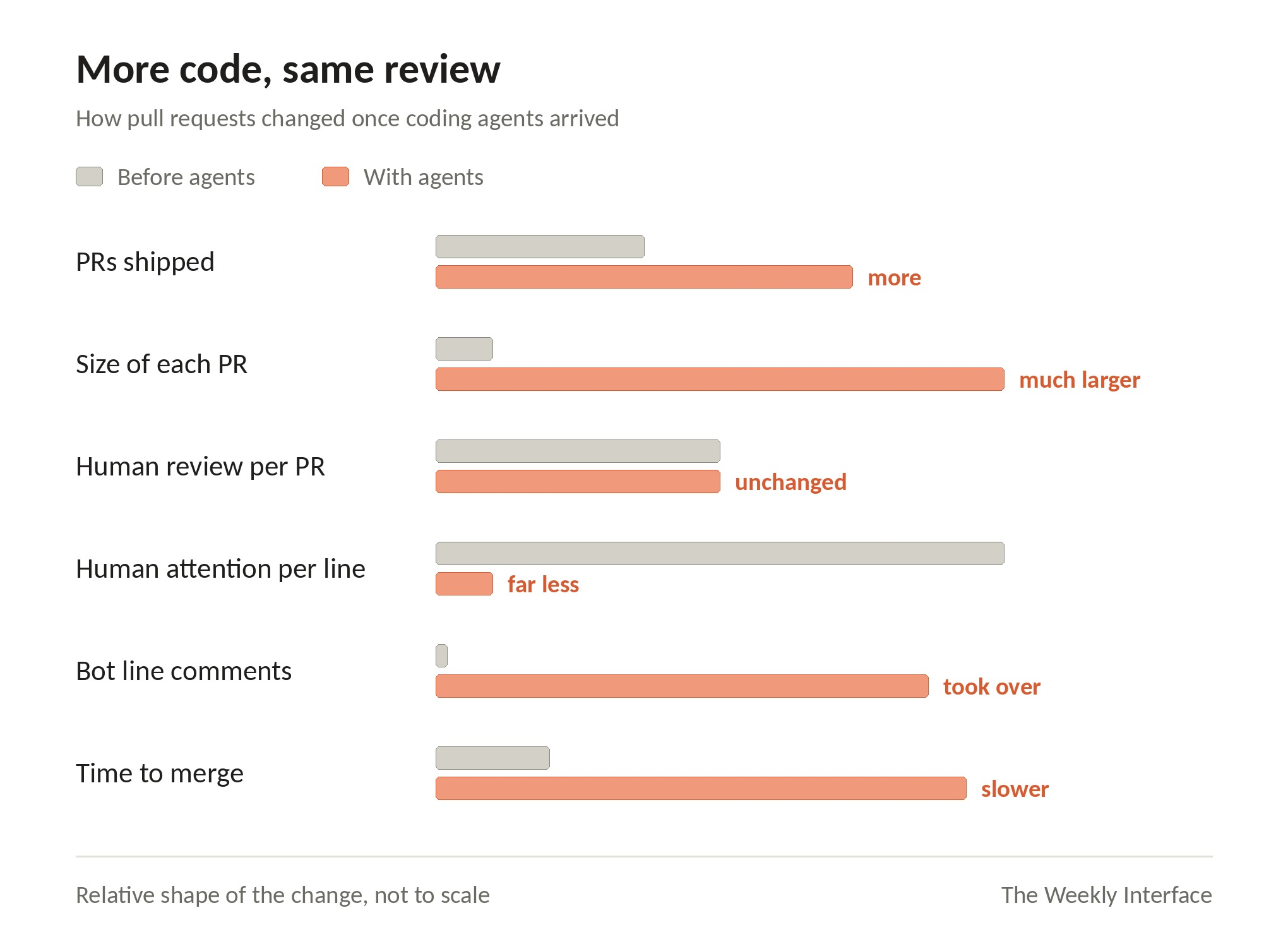
I can't share the counts, but the direction was
obvious. We ship more pull requests than before, and each
one is many times larger. Human review stayed the same
size: about the same approvals per PR, about the same
small number of human comments, now spread over much
bigger diffs. Most PRs merge without a single human
comment on a specific line. Bots now write most of the
line-level comments (a lot of them about naming). And
merges take longer.
In practice, "this PR was reviewed" increasingly
means a bot commented and a human clicked approve.
The detail I like least: even before any AI tooling, most
of our PRs already merged without human line comments. We
weren't reading every line back then either. A small
diff can be understood at a glance and a large one
can't.
We're not special. The
Faros AI Engineering Report 2026
looked at 22,000 developers over two years. Median review
time is up about 5x. Average PR size is up 51%. 31% more
PRs merge with no review at all, and AI agents now review
a quarter of PRs, up from zero.
The bugs that pass every check
We went looking and found the kind of defect neither CI
nor the review bots flag. Bots catch typos and missing
null checks. The ones that slipped through were problems
of intent. A check that looked like it ran but didn't
do its job. A counter that lost data under concurrency.
And my favourite: two contradictory rules for the same
configuration decision, living side by side in one module.
In that module each line looks fine, and no line-level
review would catch the contradiction.
Margaret-Anne Storey has a name for this. She calls it
intent debt: "the absence or erosion of explicit rationale,
goals, and constraints that guide how humans and agents
evolve the system." The agent made a plausible
choice, later made a different plausible choice, and
nothing written down said which one was right.
The idea is older than agents. In 1985 Peter Naur wrote
Programming as Theory Building: a program is a theory that lives in the heads of the
people who built it, and the code is a lossy record of
that theory. Agents let us produce the record without
anyone building the theory.
A public example, from outside our repo: a developer
asked an agent to clean up a user response DTO. The agent made
phoneNumber
optional and dropped it from the JSON when it was null. An
older Android app expected the field and started failing
with 500s. The agent had also updated the tests to match,
so all 142 of them passed. As the author puts it:
"When the same agent writes the implementation and
the test in the same pass, that independence is
gone."
Nobody reading that diff would have flagged it. A frozen
response schema would have.
Review the contract, not the diff
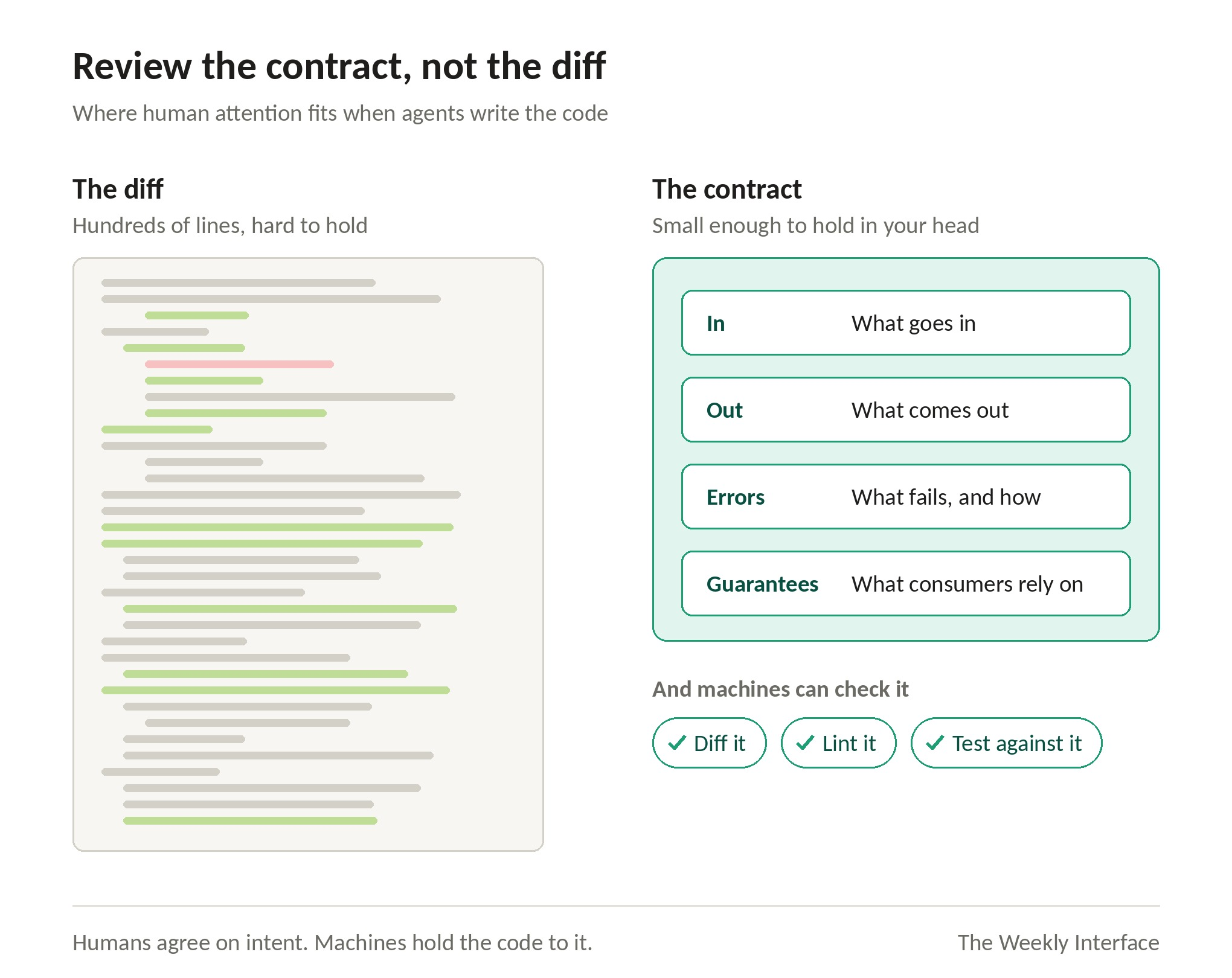
If you can't review every line, review the intent
before the lines exist. For anyone who builds APIs, the
best place for that is the contract.
A contract states what goes in, what comes out, what fails
and how, and what a caller can rely on. An OpenAPI spec is
one. So is a type signature, a JSON schema, a database
constraint, an invariant in a property test, or the
interface one module offers another. What they share:
they're small enough to hold in your head, which a
diff of several hundred lines isn't, and they're
precise enough to diff, lint and test against, which a
plan in a doc isn't.
The Tuesday-night counter had a contract too, one nobody
wrote down: every usage event is counted once, even when
two writes collide. Written as a property test,
that's a few lines a human can approve in a minute
and a machine can check on every PR.
Humans review the contract change first. If a PR changes
behaviour anyone depends on, the contract change comes
first and a person signs off, ideally before the agent
writes anything. That's where "which config rule
wins?" gets answered once, explicitly, instead of
twice by accident. An agent can draft the contract change
too. It's a few lines, so a human who approves it
without reading it has made a choice.
Stripe already works this way for its public API. It
reviews API design before code, with design docs that list the options considered
"and why we chose not to do each of these different
options." That's intent written down and agreed
by humans. Internal boundaries need the same treatment.
Machines hold the implementation to the contract:
breaking-change detection, contract tests, and gates for
the failures you already know about. One rule here: the
agent doesn't get to edit the contract to make it
pass. Kent Beck has talked about
struggling to stop agents from deleting tests
so they "pass".
Authors show evidence instead of asking for trust. Simon
Willison said it well:
"If you haven't seen the code do the right
thing yourself, that code doesn't work."
Every PR gets a short "how I verified it"
section: which calls were made, which tests ran, what was
checked by hand. The reviewer checks the evidence is real
and sufficient, which is a more honest job than pretending
to read everything.
A recent team discussion pushed this further. Distil the
issue into an agreed format: goal, how to test it in
steps, results, verdict. Once CI is green, spin the code
up in an isolated environment, run the test, post the
evidence and the verdict to the PR. If something is off,
message the author. Someone summed it up: "Agents can
fake, and that's OK. Evidence has to be there like a
court case."
Someone in that discussion asked whether any company does
this already. Abnormal does. Its agent opens more than 200
PRs a day, and
every one has to prove itself
with "a screenshot from a running instance, the real
API response with the expected fields, the log line
showing the record processed." They stand up an
isolated near-production "testbox" in about five
minutes, and ran more than 3,000 of them in 30 days.
Evidence from a running system matters because agents do
fake.
METR has documented
frontier models modifying tests and scoring code to get a
better score. A real response from a real endpoint is
harder to fake than a test the agent wrote.
And diffs get smaller again. Reviewer attention per PR
looks roughly fixed. If you want more attention per line,
the only lever is fewer lines per review.
Nobody ever understood the whole codebase
The strongest objection comes from Sean Goedecke, in
In defense of not understanding your codebase. He borrows Naur's term and argues that in large
codebases "everyone operates with an incorrect theory
of the program." You have to work with "a merely
partially-correct theory." Understanding is one value
among many, and companies trade it for speed all the time.
He's right about most of it. Nobody at a large
company understood the whole system before agents either,
and line-by-line human review of every change isn't
coming back. The volume is too high, and pretending
otherwise only produces more rubber stamps.
But a partial theory is fine when each piece has someone
who holds it, and the intent is written down somewhere a
human agreed to it. The contract is what lets a team live
safely with partial theories. The Tuesday night happens
when a piece has no holder at all.
That part doesn't fix itself. Review used to spread
knowledge as a side effect. Now it has to be done on
purpose: explaining a big change to a colleague, walking
through a system after an agent-driven build-out, rotating
people through code they didn't write. Storey
describes
a student team that hit the wall by week seven: working software, and nobody could explain the design
well enough to make a simple change.
What we're really protecting
Code review mattered because it was a forcing function. If
you knew someone would ask about your change, you had to
understand it first. Take that away and understanding
erodes, one reasonable shortcut at a time, until one night
nobody can answer the question.
Agents aren't going away, and neither is the volume.
Reading every line again is off the table. The open
question is where the forcing function goes now. For APIs,
I think the answer is clear: at the contract, before the
code, where intent is small enough to argue about and
precise enough to enforce.
The day no one can explain the system doesn't arrive
all at once. It arrives as a series of approvals nobody
really gave. The contract is where we can start giving
them again.
Thanks for reading :)
P.S. Last week I said that if this newsletter went quiet,
it was "dropamine". Here's
week two. Thanks for the replies.
Kin
dropped two projects while reading, and
Steven
gave the opposite high a name:
"startamine".
Unsubscribe
| 1 Bd des clubs - CFC, 20200 Casablanca, Morocco
|